A team of researchers from the U.S. and South Korea have developed a potentially more sustainable way to refine crude oil, reducing the energy needed for the process by 31.6% in process simulations. The team published their findings in Nature.
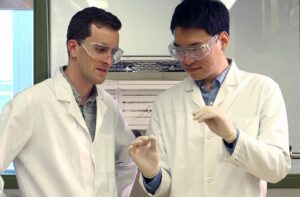
Ryan Lively (Georgia Tech) and Dong-Yeun Koh (KAIST). Koh used to be postdoctoral researcher in the Lively Lab. Credit: Georgia Tech
The scientists investigated the use of polyacrylonitrile (PAN) membranes, which are commonly used as a non-selective support layer in filtration systems, for refining the oil. The material is porous, so the team did not expect it to perform molecular separations, but they found that heavier hydrocarbons accumulated within the membrane’s pores, creating a stable internal layer that gradually narrowed the pores through which the molecules could travel. The membrane enriched lighter fractions such as naphtha and kerosene.
“To our great surprise, the membrane was found to deliver a high-quality oil product from the raw crude oil feed, and it did this continuously over the period of a month,” Ryan Lively, a professor of chemical and biomolecular engineering at Georgia Tech who served as an advisor and corresponding author on the study, said in an email to R&D World.
How the process works
Refineries heat streams of crude oil to vaporize its components, then separate those vapors by boiling point through atmospheric and vacuum distillation. Worldwide, atmospheric and vacuum distillation consume more than 1,100 terawatt-hours of energy a year and emit more than 160 million metric tons of CO2 equivalent, according to the paper.
In the process the researchers modeled, the PAN membrane splits the crude into two streams before that heating step: a lighter, naphtha- and kerosene-rich stream that continues on to the furnace and distillation as usual, and a heavier stream that bypasses the furnace and goes straight to a separate distillation step.
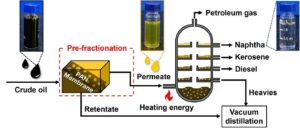
Schematic illustration of the membrane-based pre-fractionation process, showing the selective separation of light hydrocarbon fractions from crude oil feedstock to reduce energy requirements for subsequent atmospheric distillation. Credit: Georgia Tech
The research builds on a 2020 study, also involving Lively, which showed membranes could separate crude oil at the molecular level. The study relied on custom-designed membrane materials that proved too slow to be practical at refinery scale.
“A key issue was that the membranes were simply not productive enough to be commercially viable… The surprising ability of commercial membranes to achieve crude oil separations helps reduce the cost of the technology relative to bespoke membrane materials,” Lively said in an email.
Reducing carbon emissions by 37.6%
The researchers modeled a refinery process that incorporated a membrane separation step before conventional distillation, showing that it could reduce distillation energy use by 31.6%, carbon dioxide emissions by 37.6% and water consumption by 20.7%.
They also found that the total annualized cost of that portion of the refining process could be reduced from $140.3 million per year to $89.8 million per year, a 36% decrease, assuming a membrane unit cost of $10 per square meter.
While this innovation could help decrease the emissions from refining processes, it could also make refining more economically attractive. A 2021 paper in Economics Letters modeled how technologies which lower the effective cost of using fossil fuels, whether by reducing fuel required per unit of output or by making fossil fuel energy production more efficient more broadly, tend to increase the total amount ultimately extracted, since previously uneconomical reserves become worth pursuing as the switch to cleaner alternatives gets pushed to a higher cost threshold.



Tell Us What You Think!
You must be logged in to post a comment.