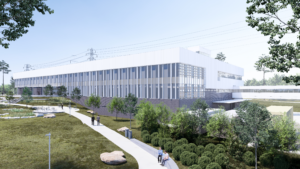
Early planning and right-sizing strategies help laboratory developers balance cost control with long-term flexibility, creating facilities that can adapt to changing tenant and research requirements without major reinvestment. Image courtesy of Hanbury.
Delivering laboratory buildings within tight budgets remains a challenge, particularly for developer-led projects where cost certainty is critical. Early planning decisions shape upfront costs and long-term adaptability. Establishing parameters early helps control capital investment without limiting future usability. Integrating cost estimation consultants, construction managers, and general contractors early in the design process is a key strategy for managing risk. Early collaboration allows teams to create accurate budgets, identify cost drivers, evaluate design trade-offs, and align design intent with financial constraints before changes become expensive. Right-sizing strategies offer a practical framework for delivering flexible, high-performing laboratory buildings that remain financially viable from initial development through long-term operation.
Define the lab before design
The single most consequential cost decision in laboratory development happens before commencing the design process. Initially identifying the intended use, capability limits, and likely tenant profile determines the cost trajectory for everything downstream, and the earlier those parameters are established, the less expensive they are to address.

Modern laboratory facilities increasingly incorporate a mix of research, collaboration, and focused work environments to support both scientific innovation and evolving workforce expectations. Image courtesy of Hanbury.
Heating, ventilation, and air conditioning (HVAC) and exhaust systems are primary cost drivers. The volume and type of exhaust requirements, covering fume hoods, clean rooms, and biosafety cabinets, dictate interstitial depth, ceiling heights, shaft sizing, and energy and sustainability strategy. Incorporating incorrect variables at the concept stage means correcting them in the construction documents, which multiplies the cost and limits the facility’s capabilities.
Early engagement with lab planners and engineering consultants at the concept stage enables teams to produce an engineering narrative alongside a test-fit plan. That package provides a contractor with enough definition to generate a rough order of magnitude budget within roughly 10% before committing significant design fees. The early definition approach applies to purpose-built facilities and speculative space: BASF’s purpose-built research and design (R&D) headquarters involved exhaustive user-group programming from day one, while a 5,800-square-foot incubator for the City of Virginia Beach required designing to accommodate multiple biosafety levels for unknown, revolving tenants, and within a fixed budget. In both cases, early definition helped control cost.
Facility right-sizing: The middle path between under- and over-investment
On speculative projects, miscalibration runs in both directions. Under‑invest in base building infrastructure, and the space can’t support the tenants most likely to lease it. Over‑invest by building out highly specific systems for an unknown program, and the building self‑selects against tenants who don’t need what was built. The practical target is a base building that meets local market benchmarks and plans for additional demand without delivering it on day one. With purpose‑built projects, the risk shifts to over‑specifying current needs at the expense of space efficiency. BASF’s North American R&D headquarters entered the design stage at 198,000 square feet. Through exhaustive user‑group programming and consolidating labs where containment didn’t require separation, the team eliminated redundant support space and reduced the footprint to 157,000 square feet. At roughly $900 per square foot, that 41,000‑square‑foot reduction translates directly into significant capital savings, without compromising the science the building was designed to support. This rigorous programming effort required stakeholders to rethink methods of working and the ways materials are utilized throughout the building.
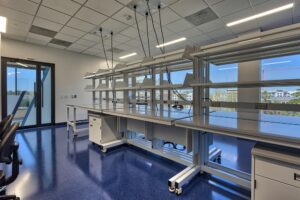
Flexible laboratory infrastructure, including modular casework and adaptable utility distribution, allows spaces to evolve with changing scientific programs while minimizing renovation costs. Image courtesy of Hanbury.
For the City of Virginia Beach’s incubator, a biosafety level (BSL)‑2 capability was planned, with door locations, autoclave space, and clearances, without installing every piece of equipment on the first day. More broadly, on-spec labs, demisable floor plates, and pre‑planned infrastructure allow suites to flex and specialize without triggering a new building permit and invasive construction activities. When a tenant requiring higher classification moves in, the work becomes an equipment and fit‑out package rather than a base‑building renovation. Reserving space in mechanical rooms, penthouses, and exterior equipment yards for future equipment ensures landlords can add additional tenants while limiting risk to their current and future investment. That suggests a useful threshold. If a typical tenant move‑in requires a robust permitting, such as site plan, rezoning, or use permits, the base building was under‑designed. If the base infrastructure assumes an exhaust load or occupancy classification most tenants will never use, it’s been over‑designed. Right‑sizing falls between those two extremes, establishing significant flexibility while reducing exposure to additional costs.
Designing in flexibility without building it out
Designing for flexibility in an unknown lab program means assuming the science will change and favoring adaptable systems over fixed ones wherever containment and process allow.
The incremental cost of that planned capacity is small compared to the impact on who the space can serve, and how often it must be renovated.
Delivery method as a budget tool
Delivery method selection is a risk allocation decision before it is a cost decision. Owners who need full visibility and structured reporting often favor construction‑manager models, where costs are open‑book, and project control stays with the owner, but the schedule typically carries more exposure. Owners prioritizing speed to market, especially when rent commencement or a tenant’s operational timeline is the primary driver, are often better served by design‑build, where a contractor accepts more scope risk in exchange for establishing a price earlier based on a partially defined scope of work.
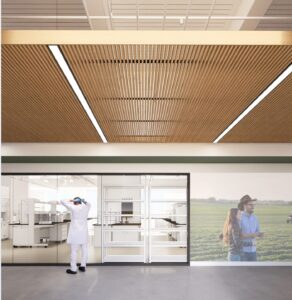
Transparent laboratory environments support collaboration while allowing researchers to remain connected to adjacent workspaces, a design approach that improves functionality without increasing building complexity. Image courtesy of Hanbury.
Across all delivery models, the constant is the value of early planning investment. When scope, performance criteria, and infrastructure limits are defined before the design advances too far, owners receive realistic budgets and clearer risk profiles, reducing the exposure to the scope gaps and pricing variables that drive late-stage cost surprises.
First costs, long-term position
Smart labs are defined less by their gadgets than by how efficiently they turn capital into flexible space without causing budget overruns. Companies and developers that define capability limits and regulatory ceilings up front can right-size first costs. Designing shared services across the space, such as backup power, exhaust, autoclaves, and specialty equipment, improves lab efficiency without sacrificing function. Infrastructure planned for change but not initially overbuilt produces spaces that can attract and retain tenants and evolve alongside a company’s science, while containing initial budgets and avoiding major reinvestment whenever the program shifts. These are buildings where the first dollar spent on planning buys the most optionality per square foot.
About the Author:

Chris Small is principal, science market leader, at Hanbury. Hanbury is a 100% employee-owned, multidisciplinary design practice founded in 1979, specializing in architecture, planning, and interior design across the higher education, life science, and civic and community markets. Over more than four decades, the firm has grown into a recognized industry leader with a diverse team of experts across multiple offices who approach every project through partnership and shared vision, aligning design with the global impact of clients’ work to address critical issues and enhance community well-being. For more information, please visit www.hanbury.design.