Research & Development World

  • R&D World Home
  • Topics
    • Aerospace
    • Automotive
    • Biotech
    • Careers
    • Chemistry
    • Environment
    • Energy
    • Life Science
    • Material Science
    • R&D Management
    • Physics
  • Technology
    • 3D Printing
    • A.I./Robotics
    • Software
    • Battery Technology
    • Controlled Environments
      • Cleanrooms
      • Graphene
      • Lasers
      • Regulations/Standards
      • Sensors
    • Imaging
    • Nanotechnology
    • Scientific Computing
      • Big Data
      • HPC/Supercomputing
      • Informatics
      • Security
    • Semiconductors
  • R&D Market Pulse
  • R&D 100
    • 2026 R&D 100 Award Winners
    • 2026 Professional Award Winners
    • 2026 Special Recognition Winners
    • R&D 100 Awards Event
    • R&D 100 Submissions
    • Winner Archive
  • Resources
    • Research Reports
    • Digital Issues
    • Educational Assets
    • Subscribe
    • Video
    • Webinars
    • PharmSci360
    • Content submission guidelines for R&D World
  • Global Funding Forecast
  • Top Labs
  • Advertisers
    • Advertise
    • PR Submissions
    • Eblast Submissions
  • SUBSCRIBE

A metal composite that will float your boat

By R&D Editors | May 13, 2015

The first metal matrix syntactic foam is so light it can float, strong enough to withstand the rigors of a marine environment, and resistant to heat, which makes it a candidate for automakers seeking to shed weight to improve fuel economy. The composite was the work of NYU Polytechnic School of Engineering Professor Nikhil Gupta and Deep Springs Technology (DST) in collaboration with the U.S. Army Research Laboratory. Image: NYU Polytechnic School of EngineeringResearchers have demonstrated a new metal matrix composite that is so light that it can float on water. A boat made of such lightweight composites will not sink despite damage to its structure. The new material also promises to improve automotive fuel economy because it combines light weight with heat resistance.

Although syntactic foams have been around for many years, this is the first development of a lightweight metal matrix syntactic foam. It is the work of a team of researchers from Deep Springs Technology (DST) and the New York Univ. Polytechnic School of Engineering.

Their magnesium alloy matrix composite is reinforced with silicon carbide hollow particles and has a density of only 0.92 g/cc compared to 1.0 g/cc of water. Not only does it have a density lower than that of water, it is strong enough to withstand the rigorous conditions faced in the marine environment.

Significant efforts in recent years have focused on developing lightweight polymer matrix composites to replace heavier metal-based components in automobiles and marine vessels. The technology for the new composite is very close to maturation and could be put into prototypes for testing within three years. Amphibious vehicles such as the Ultra Heavy-lift Amphibious Connector (UHAC) being developed by the U.S. Marine Corps can especially benefit from the light weight and high buoyancy offered by the new syntactic foams, the researchers explained.

“This new development of very light metal matrix composites can swing the pendulum back in favor of metallic materials,” forecasted Nikhil Gupta, an NYU School of Engineering professor in the Dept. of Mechanical and Aerospace Engineering and the study’s co-author. “The ability of metals to withstand higher temperatures can be a huge advantage for these composites in engine and exhaust components, quite apart from structural parts.”

The syntactic foam made by DST and NYU captures the lightness of foams, but adds substantial strength. The secret of this syntactic foam starts with a matrix made of a magnesium alloy, which is then turned into foam by adding strong, lightweight silicon carbide hollow spheres developed and manufactured by DST. A single sphere’s shell can withstand pressure of over 25,000 pounds per square inch (PSI) before it ruptures—one hundred times the maximum pressure in a fire hose.

The hollow particles also offer impact protection to the syntactic foam because each shell acts like an energy absorber during its fracture. The composite can be customized for density and other properties by adding more or fewer shells into the metal matrix to fit the requirements of the application. This concept can also be used with other magnesium alloys that are non-flammable.

The new composite has potential applications in boat flooring, automobile parts, and buoyancy modules as well as vehicle armor.

Source: New York Univ.

Related Articles Read More >

Inside the Lab: Can AI Solve the Critical Materials Challenge?
Two Science papers catch altermagnets by handedness
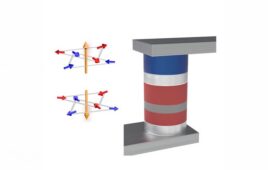
Illustration of an antiferromagnetic tunnel junction pillar beside the two spin configurations of platinum-manganese that store a bit.
Northwestern and Western Digital demonstrate a new way to write magnetic memory
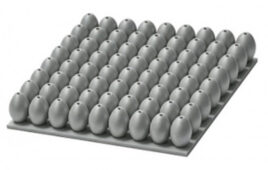
Eggshell-inspired shield cut projectile speed by 65% in simulation, but light-gas gun testing has not confirmed it 
rd newsletter
EXPAND YOUR KNOWLEDGE AND STAY CONNECTED
Get the latest info on technologies, trends, and strategies in Research & Development.

R&D World Digital Issues

Fall 2026 issue

Browse the most current issue of R&D World and back issues in an easy to use high quality format. Clip, share and download with the leading R&D magazine today.

R&D 100 Awards
Research & Development World
  • Subscribe to R&D World Magazine
  • Sign up for R&D World’s newsletter
  • Contact Us
  • About Us
  • Drug Discovery & Development
  • Pharmaceutical Processing
  • Global Funding Forecast

Copyright © 2026 Arrowfly LLC. All Rights Reserved. The material on this site may not be reproduced, distributed, transmitted, cached or otherwise used, except with the prior written permission of Arrowfly
Privacy Policy | Advertising | About Us

Search R&D World

  • R&D World Home
  • Topics
    • Aerospace
    • Automotive
    • Biotech
    • Careers
    • Chemistry
    • Environment
    • Energy
    • Life Science
    • Material Science
    • R&D Management
    • Physics
  • Technology
    • 3D Printing
    • A.I./Robotics
    • Software
    • Battery Technology
    • Controlled Environments
      • Cleanrooms
      • Graphene
      • Lasers
      • Regulations/Standards
      • Sensors
    • Imaging
    • Nanotechnology
    • Scientific Computing
      • Big Data
      • HPC/Supercomputing
      • Informatics
      • Security
    • Semiconductors
  • R&D Market Pulse
  • R&D 100
    • 2026 R&D 100 Award Winners
    • 2026 Professional Award Winners
    • 2026 Special Recognition Winners
    • R&D 100 Awards Event
    • R&D 100 Submissions
    • Winner Archive
  • Resources
    • Research Reports
    • Digital Issues
    • Educational Assets
    • Subscribe
    • Video
    • Webinars
    • PharmSci360
    • Content submission guidelines for R&D World
  • Global Funding Forecast
  • Top Labs
  • Advertisers
    • Advertise
    • PR Submissions
    • Eblast Submissions
  • SUBSCRIBE