Research & Development World

  • R&D World Home
  • Topics
    • Aerospace
    • Automotive
    • Biotech
    • Careers
    • Chemistry
    • Environment
    • Energy
    • Life Science
    • Material Science
    • R&D Management
    • Physics
  • Technology
    • 3D Printing
    • A.I./Robotics
    • Software
    • Battery Technology
    • Controlled Environments
      • Cleanrooms
      • Graphene
      • Lasers
      • Regulations/Standards
      • Sensors
    • Imaging
    • Nanotechnology
    • Scientific Computing
      • Big Data
      • HPC/Supercomputing
      • Informatics
      • Security
    • Semiconductors
  • R&D Market Pulse
  • R&D 100
    • 2025 R&D 100 Award Winners
    • 2025 Professional Award Winners
    • 2025 Special Recognition Winners
    • R&D 100 Awards Event
    • R&D 100 Submissions
    • Winner Archive
  • Resources
    • Research Reports
    • Digital Issues
    • Educational Assets
    • R&D Index
    • Subscribe
    • Video
    • Webinars
    • Content submission guidelines for R&D World
  • Global Funding Forecast
  • Top Labs
  • Advertise
  • SUBSCRIBE

A new study shows how fluid flow and chemicals team up to halt harmful bacteria

By Heather Hall | December 17, 2024

A new study reveals that two stressors may be better than one in preventing certain harmful bacteria from thriving in the human body. Researchers at the University of Illinois Urbana-Champaign report that physical fluid flow and the chemical presence of hydrogen peroxide can work together to halt the spread and growth of dangerous pathogens.
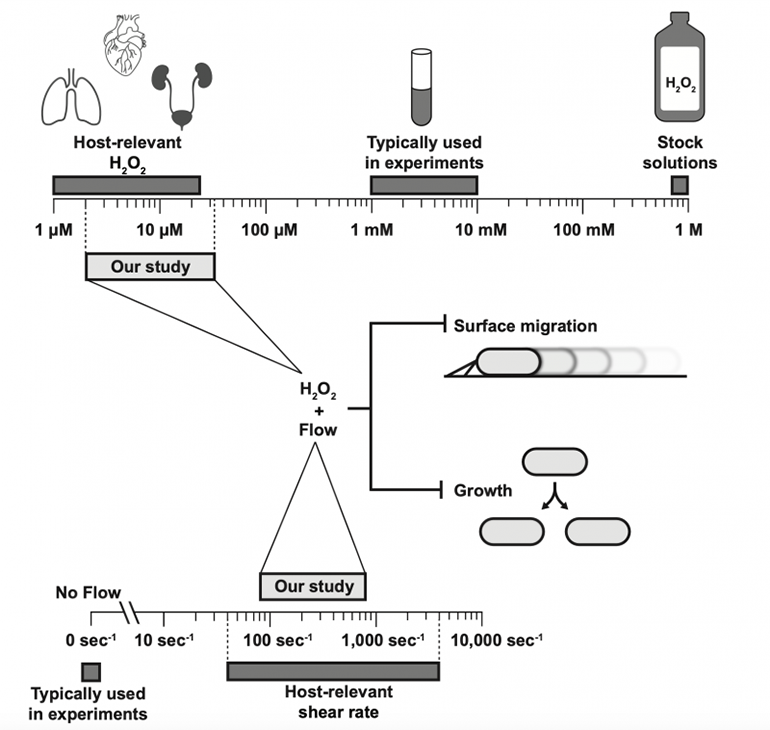
By treating cells with levels of flow and hydrogen peroxide (H2O2) that commonly co-occur in human host tissues, the Illinois researchers discovered that previous reports significantly overestimated the hydrogen peroxide levels required to block bacterial growth. They found that flow increases the effectiveness of hydrogen peroxide by 50-fold.

The findings, published in the journal Current Biology, stem from an interdisciplinary effort led by Joe Sanfilippo, an assistant professor of biochemistry at the University of Illinois Urbana-Champaign. His lab crafted tiny devices to mimic fluid movement through the body — like blood flowing through arteries or air passing through the lungs — and tested how these conditions interact with small amounts of hydrogen peroxide, a natural compound in human tissues.

“Traditionally, studying how bacteria handle physical flow in the body is hard because the standard lab tools — Petri dishes and test tubes — don’t recreate these conditions,” said Sanfilippo. “By building microfluidic devices, we can study the effect of realistic fluid flow at the cellular level. That gives us a whole new picture of how bacteria respond to stress.”

In their experiments, the researchers focused on Pseudomonas aeruginosa, a well-known pathogen that can cause serious infections. Under normal lab conditions, scientists believed the amount of hydrogen peroxide needed to suppress bacterial growth would be far beyond what the human body naturally produces. But this new study tells a different story.
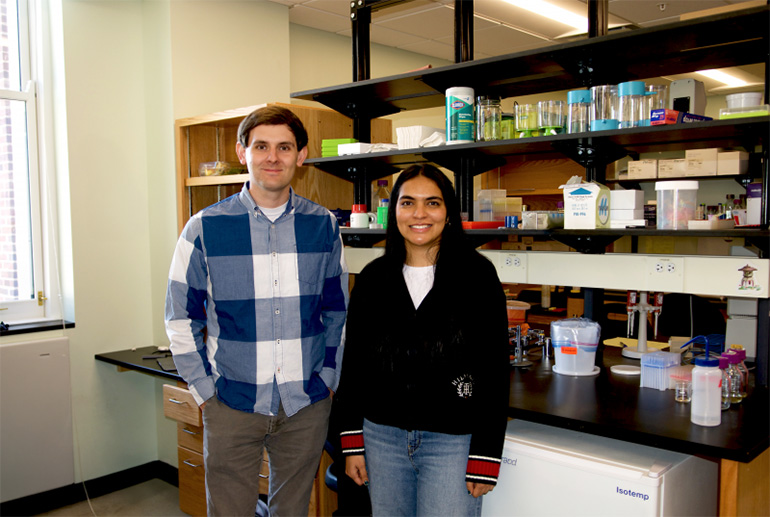
Joe Sanfilippo, professor of biochemistry, and Anu Sharma, PhD student.

“When we added even a small flow — similar to what bacteria experience in the human body — the naturally occurring levels of hydrogen peroxide suddenly became powerful enough to block bacterial migration and growth,” said Anu Sharma, a PhD student, and the study’s lead author. “Without flow, we would need far higher doses of hydrogen peroxide to achieve the same effect. Under realistic conditions, it’s a 50-fold increase in effectiveness.”

The research also delves into how different types of stressors can work together. Rather than simply predictably stacking their effects, flow and hydrogen peroxide showed “positive synergy.” In other words, their combined impact in stopping bacterial spread was greater than the sum of their individual contributions.

“Stressors can add up in unexpected ways,” said Sanfilippo. “Sometimes two stressors combine to be weaker than expected: sometimes they’re stronger. Here, we saw a clear boost in their collective power. It’s like getting a 2+2=5 scenario.”

The team’s findings raise new questions: If flow and hydrogen peroxide can work together so effectively against bacteria, what about other pairs of stressors? The Sanfilippo lab plans to continue using microfluidic systems to explore how various challenging conditions — from chemical compounds to mechanical forces— combine to help or hinder harmful bacteria.

The National Institutes of Health supported the study, “Combining multiple stressors blocks bacterial migration and growth.”




Comments

  1. Mary says

    December 18, 2024 at 7:38 am

    That was awesome to read.

Related Articles Read More >

Parallel Bio’s embraces in-house drug development as FDA backs animal testing alternatives
R&D 100 Winner Spotlight: A closer look at Thermo Fisher Scientific’s trio of R&D 100 wins in 2025
Life sciences M&A hit $240B in 2025 as Big Pharma preps for patent cliffs
Hansoh Bio signs 32,000-sq.-ft. lab lease at Research Square in Rockville, MD
rd newsletter
EXPAND YOUR KNOWLEDGE AND STAY CONNECTED
Get the latest info on technologies, trends, and strategies in Research & Development.
RD 25 Power Index

R&D World Digital Issues

Fall 2025 issue

Browse the most current issue of R&D World and back issues in an easy to use high quality format. Clip, share and download with the leading R&D magazine today.

R&D 100 Awards
Research & Development World
  • Subscribe to R&D World Magazine
  • Sign up for R&D World’s newsletter
  • Contact Us
  • About Us
  • Drug Discovery & Development
  • Pharmaceutical Processing
  • Global Funding Forecast

Copyright © 2026 WTWH Media LLC. All Rights Reserved. The material on this site may not be reproduced, distributed, transmitted, cached or otherwise used, except with the prior written permission of WTWH Media
Privacy Policy | Advertising | About Us

Search R&D World

  • R&D World Home
  • Topics
    • Aerospace
    • Automotive
    • Biotech
    • Careers
    • Chemistry
    • Environment
    • Energy
    • Life Science
    • Material Science
    • R&D Management
    • Physics
  • Technology
    • 3D Printing
    • A.I./Robotics
    • Software
    • Battery Technology
    • Controlled Environments
      • Cleanrooms
      • Graphene
      • Lasers
      • Regulations/Standards
      • Sensors
    • Imaging
    • Nanotechnology
    • Scientific Computing
      • Big Data
      • HPC/Supercomputing
      • Informatics
      • Security
    • Semiconductors
  • R&D Market Pulse
  • R&D 100
    • 2025 R&D 100 Award Winners
    • 2025 Professional Award Winners
    • 2025 Special Recognition Winners
    • R&D 100 Awards Event
    • R&D 100 Submissions
    • Winner Archive
  • Resources
    • Research Reports
    • Digital Issues
    • Educational Assets
    • R&D Index
    • Subscribe
    • Video
    • Webinars
    • Content submission guidelines for R&D World
  • Global Funding Forecast
  • Top Labs
  • Advertise
  • SUBSCRIBE