Research & Development World

  • R&D World Home
  • Topics
    • Aerospace
    • Automotive
    • Biotech
    • Careers
    • Chemistry
    • Environment
    • Energy
    • Life Science
    • Material Science
    • R&D Management
    • Physics
  • Technology
    • 3D Printing
    • A.I./Robotics
    • Software
    • Battery Technology
    • Controlled Environments
      • Cleanrooms
      • Graphene
      • Lasers
      • Regulations/Standards
      • Sensors
    • Imaging
    • Nanotechnology
    • Scientific Computing
      • Big Data
      • HPC/Supercomputing
      • Informatics
      • Security
    • Semiconductors
  • R&D Market Pulse
  • R&D 100
    • 2026 R&D 100 Award Winners
    • 2026 Professional Award Winners
    • 2026 Special Recognition Winners
    • R&D 100 Awards Event
    • R&D 100 Submissions
    • Winner Archive
  • Resources
    • Research Reports
    • Digital Issues
    • Educational Assets
    • Subscribe
    • Video
    • Webinars
    • PharmSci360
    • Content submission guidelines for R&D World
  • Global Funding Forecast
  • Top Labs
  • Advertise
  • SUBSCRIBE

A Step Closer to Sci-Fi Holograms

By Australian National University | January 25, 2017

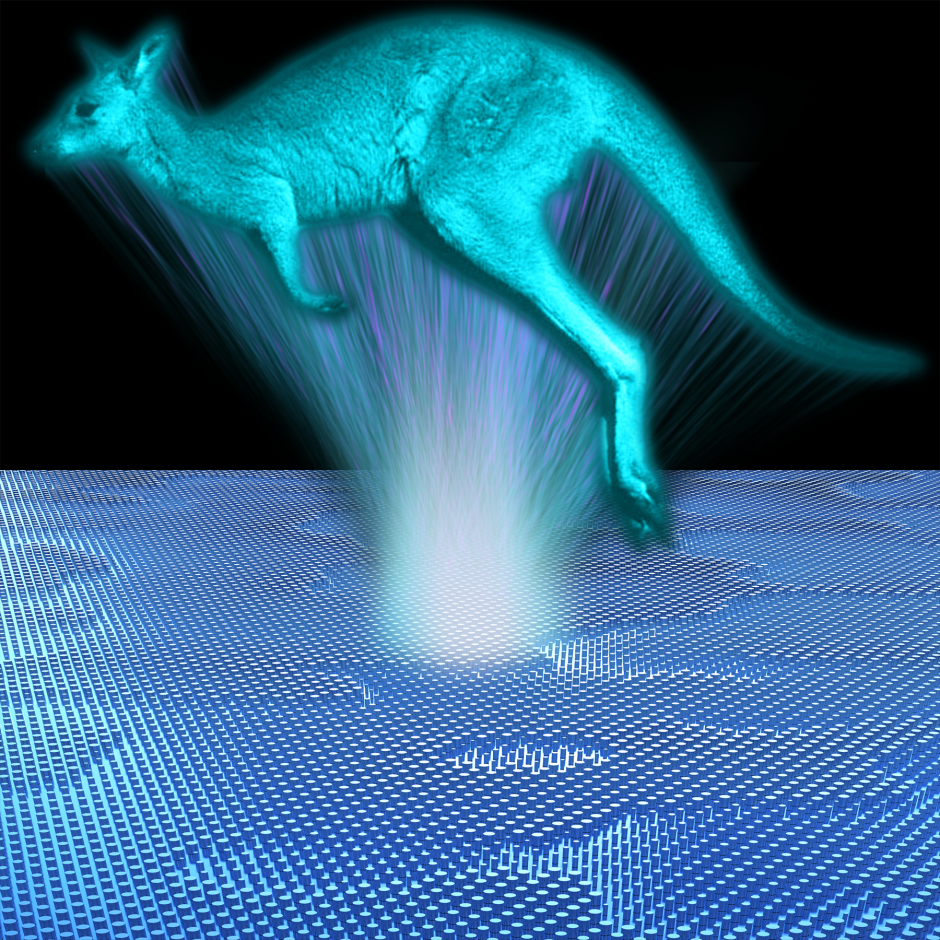
Australian researchers have made a breakthrough in holographic technology. Image: Australian National University

Australian National University physicists have invented a tiny device that creates the highest quality holographic images ever achieved, opening the door to imaging technologies seen in science fiction movies such as Star Wars.

Lead researcher Lei Wang said the team created complex holographic images in infrared with the invention that could be developed with industry.

“As a child, I learned about the concept of holographic imaging from the Star Wars movies. It’s really cool to be working on an invention that uses the principles of holography depicted in those movies,” says Wang, a PhD student at the ANU Research School of Physics and Engineering.

Holograms perform the most complex manipulations of light. They enable the storing and reproduction of all information carried by light in 3D. In contrast, standard photographs and computer monitors capture and display only a portion of 2D information.

“While research in holography plays an important role in the development of futuristic displays and augmented reality devices, today we are working on many other applications such as ultra-thin and light-weight optical devices for cameras and satellites,” he says.

Wang says the device could replace bulky components to miniaturize cameras and save costs in astronomical missions by reducing the size and weight of optical systems on space craft.

Co-lead researcher Dr. Sergey Kruk says the device consisted of millions of tiny silicon pillars, each up to 500 times thinner than a human hair.

“This new material is transparent, which means it loses minimal energy from the light, and it also does complex manipulations with light,” says Kruk, who is from the ANU Research School of Physics and Engineering.

“Our ability to structure materials at the nanoscale allows the device to achieve new optical properties that go beyond the properties of natural materials. The holograms that we made demonstrate the strong potential of this technology to be used in a range of applications.”

Kruk says ANU led the design, fabrication, and optical testing of the device.

Part of the research was conducted in collaboration with the Oak Ridge National Laboratory, and Nanjing University in China.

The research is supported by the Australian Research Council and is published in Optica as a Memorandum, a special announcement of scientific breakthroughs.

Source: Australian National University
Related Articles Read More >

Researchers developed quantum nanosensors that can measure the temperature of a single cell
Overcoming the 100-nanometer barrier: New microbottle resonators scale up optical trapping
R&D 100 winner LLNL achieves 1,000x speed boost in 3D nanofabrication
CEA-Leti achieves 400°C CMOS fabrication milestone for 3D chip stacking
rd newsletter
EXPAND YOUR KNOWLEDGE AND STAY CONNECTED
Get the latest info on technologies, trends, and strategies in Research & Development.

R&D World Digital Issues

Fall 2025 issue

Browse the most current issue of R&D World and back issues in an easy to use high quality format. Clip, share and download with the leading R&D magazine today.

R&D 100 Awards
Research & Development World
  • Subscribe to R&D World Magazine
  • Sign up for R&D World’s newsletter
  • Contact Us
  • About Us
  • Drug Discovery & Development
  • Pharmaceutical Processing
  • Global Funding Forecast

Copyright © 2026 Arrowfly LLC. All Rights Reserved. The material on this site may not be reproduced, distributed, transmitted, cached or otherwise used, except with the prior written permission of Arrowfly
Privacy Policy | Advertising | About Us

Search R&D World

  • R&D World Home
  • Topics
    • Aerospace
    • Automotive
    • Biotech
    • Careers
    • Chemistry
    • Environment
    • Energy
    • Life Science
    • Material Science
    • R&D Management
    • Physics
  • Technology
    • 3D Printing
    • A.I./Robotics
    • Software
    • Battery Technology
    • Controlled Environments
      • Cleanrooms
      • Graphene
      • Lasers
      • Regulations/Standards
      • Sensors
    • Imaging
    • Nanotechnology
    • Scientific Computing
      • Big Data
      • HPC/Supercomputing
      • Informatics
      • Security
    • Semiconductors
  • R&D Market Pulse
  • R&D 100
    • 2026 R&D 100 Award Winners
    • 2026 Professional Award Winners
    • 2026 Special Recognition Winners
    • R&D 100 Awards Event
    • R&D 100 Submissions
    • Winner Archive
  • Resources
    • Research Reports
    • Digital Issues
    • Educational Assets
    • Subscribe
    • Video
    • Webinars
    • PharmSci360
    • Content submission guidelines for R&D World
  • Global Funding Forecast
  • Top Labs
  • Advertise
  • SUBSCRIBE