Researchers have developed molecular quantum nanosensors (MoQNs) designed to operate in the cytoplasm and nuclei of living cancer cells to map radical-generation processes and thermal dynamics that are linked to cancer-associated cellular physiology.
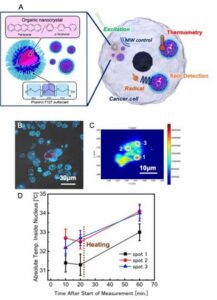
Visualization of temperature difference inside nucleus of cancer cells. Researchers observed localized temperature differences inside nucleus using quantum sensing techniques. Credit: National Institutes for Quantum Science and Technology, Japan
The sensors use molecular-level uniformity to achieve a threefold enhancement in spectral resolution and superior thermometric specificity. The platform enables absolute temperature mapping with a precision of 0.3 degrees Celsius and the detection of paramagnetic radicals within the cytoplasm and nuclei. The study, published in Science Advances, demonstrated that the MoQNs were highly biocompatible, maintaining cellular viability and metabolic activity while providing spatially resolved quantum readouts under physiological conditions.
Nanoscale synthesis
The MoQNs consist of photoexcited triplet states of pentacene doped into para-terphenyl (TP) nanocrystals. The nanocrystals are coated with Pluronic F-127, a nonionic triblock copolymer. The copolymer consists of hydrophilic polyethylene oxide (PEO) and hydrophobic polypropylene oxide (PPO). The PPO domains strongly adsorb to the hydrophobic surface of the nanocrystal, leaving the PEO blocks facing outward, ensuring that the sensors can be dispersed in water.
The MoQNs are produced via wet ball milling. Pentacene and TP are vacuum-sealed, melted at temperatures above 493 Kelvin and rapidly cooled. The bulk solids are then subjected to ball milling in a Pluronic F-127 solution at 280 rpm. Centrifugation then isolates the particles according to two sizes, 200 nm and 500 nm.
Thermometric Mechanisms
The researchers were able to read the temperature of individual cells by monitoring the minute thermal changes in the TP host lattice of the MoQNs. The lattice changes affect the Zero-Field Splitting (ZFS) parameters of the pentacene’s photoexcited triplet state. Scientists track these shifts in the ODMR peak position to calculate the temperature.
Using a confocal microscope, the researchers shone a green laser onto the sensors inside the cell, exciting the pentacene molecules. Then, microwave radiation was applied to the sensors through a copper wire antenna. The radiation flipped the spin of the electrons in the pentacene’s triplet state, changing the fluorescence emitted by the sensor.
When the microwave frequency matches the sensor’s resonance frequency, there is a detectable dip in fluorescence intensity. Researchers measure this dip to determine the peak resonance frequency, using this to calculate the absolute temperature.
The study verified MoQN safety across multiple cell lines, Hepa1-6, HEK 293H and HepG2 using diverse assays. The study did not detect any disruption of the plasma membrane after 72 hours. Safety was confirmed via negative Caspase-3/7, robust AlamarBlue and EdU profiles.
Comparative Sensitivity and Spectral Uniformity
The MoQNs achieve a threefold enhancement in spectral resolution over NDs by avoiding defect formation. Unlike NDs, which rely on vacancies that introduce defect-induced strain and charge-state-dependent variability, MoQNs use an intrinsic molecular uniformity that minimizes local strain.
The nanosensors also achieved a precision of 0.3 degrees Celsius, which was possible due to chemical tuning using deuterated pentacene. The deuterated pentacene suppressed hyperfine interactions, enhancing ODMR detection precision.
Further improvements
The researchers are aiming to develop organelle-targeted delivery methods that do not require microinjection. They are also aiming to optimize surface functionalization and trafficking strategies to improve the specificity of targeting organelles and the cytosol in living cells.
The team also plans to further miniaturize the MoQNs to reduce the impact of introducing them into cells. They plan to control the pentacene doping concentration during synthesis to create smaller sensors.