Research & Development World

  • R&D World Home
  • Topics
    • Aerospace
    • Automotive
    • Biotech
    • Careers
    • Chemistry
    • Environment
    • Energy
    • Life Science
    • Material Science
    • R&D Management
    • Physics
  • Technology
    • 3D Printing
    • A.I./Robotics
    • Software
    • Battery Technology
    • Controlled Environments
      • Cleanrooms
      • Graphene
      • Lasers
      • Regulations/Standards
      • Sensors
    • Imaging
    • Nanotechnology
    • Scientific Computing
      • Big Data
      • HPC/Supercomputing
      • Informatics
      • Security
    • Semiconductors
  • R&D Market Pulse
  • R&D 100
    • 2025 R&D 100 Award Winners
    • 2025 Professional Award Winners
    • 2025 Special Recognition Winners
    • R&D 100 Awards Event
    • R&D 100 Submissions
    • Winner Archive
  • Resources
    • Research Reports
    • Digital Issues
    • Educational Assets
    • Subscribe
    • Video
    • Webinars
    • PharmSci360
    • Content submission guidelines for R&D World
  • Global Funding Forecast
  • Top Labs
  • Advertise
  • SUBSCRIBE

Overcoming the 100-nanometer barrier: New microbottle resonators scale up optical trapping

By Julia Rock-Torcivia | March 9, 2026

Near-field optical trapping allows for contact-free control of objects, including nanoparticles and living cells. This is traditionally done using whispering-gallery-mode and waveguide-based platforms that rely on evanescent fields that only penetrate about 100 nanometers into the surrounding medium. This shallow interaction restricts trapping efficiency and makes the system highly sensitive to perturbations, limiting the practical applications that require dense, large-area or long-term manipulation. 
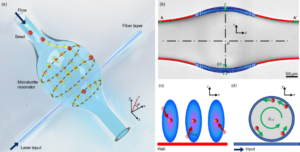
Gradient-thickness-protected WGM microbottle resonator for large-scale particle trapping. Credit: Microsystems & Nanoengineering

Researchers from Fudan University and The Hong Kong Polytechnic University have developed a new optical trapping platform in Microsystems & Nanoengineering that overcomes this limitation. 

The gradient-thickness-protected design

The team demonstrated a gradient-thickness-protected (GTP) microbottle resonator that enables large-scale, stable optical trapping via whispering-gallery modes. This method introduces a controlled wall-thickness gradient into a hollow microbottle geometry, supporting high-order axial modes that generate multiple optical trapping sites along its length. The design allows particles to be trapped over nearly 200 micrometers with ultra-low optical power. 

The microbottle resonator’s wall is thinnest at the equator and gradually thickens toward both ends, fundamentally changing how optical fields are distributed inside the resonator. Instead of confining particles to weak evanescent fields near the surface, the device generates strong optical-field antinodes that extend several micrometers into the liquid core, creating deep, stable trapping potentials. The antinodes are the peaks of the light wave rather than the tail, making the trapping force significantly stronger and allowing it to reach farther into the liquid core. 

The researchers showed that this configuration supports high-order axial whispering-gallery modes, forming dozens of discrete trapping “orbits” along the resonator axis. Experiments demonstrated stable trapping of 500-nanometer-radius polystyrene particles across an axial span exceeding 195 micrometers, with a trapping threshold power of 0.198 milliwatts. 

Protection against performance degradation

The gradient-thickness design protects the strongest optical fields by confining them within the silica wall at the resonator ends. This minimizes the degradation of the optical quality factor when particles are trapped, ensuring consistent performance even during large-scale, multi-particle manipulation. The platform also supports localized, tunable trapping via standing-wave excitation, enabling precise repositioning of individual particles. 

The microbottle resonator opens new possibilities for high-throughput and label-free particle manipulation. Its extended trapping range and multiple stable orbits make it suitable for parallel single-cell analysis, bioparticle sorting and real-time monitoring of microbial dynamics. The rapid orbital motion of trapped particles can also enhance micromixing, potentially accelerating biochemical reactions in microfluidic environments. The platform may also enable advanced sensing, targeted drug delivery and reconfigurable optofluidic devices. The study highlights how geometric design can unlock new regimes of light-matter interactions. 
Related Articles Read More >

Researchers developed quantum nanosensors that can measure the temperature of a single cell
R&D 100 winner LLNL achieves 1,000x speed boost in 3D nanofabrication
CEA-Leti achieves 400°C CMOS fabrication milestone for 3D chip stacking
The 2025 R&D 100 Finalists are here
rd newsletter
EXPAND YOUR KNOWLEDGE AND STAY CONNECTED
Get the latest info on technologies, trends, and strategies in Research & Development.

R&D World Digital Issues

Fall 2025 issue

Browse the most current issue of R&D World and back issues in an easy to use high quality format. Clip, share and download with the leading R&D magazine today.

R&D 100 Awards
Research & Development World
  • Subscribe to R&D World Magazine
  • Sign up for R&D World’s newsletter
  • Contact Us
  • About Us
  • Drug Discovery & Development
  • Pharmaceutical Processing
  • Global Funding Forecast

Copyright © 2026 WTWH Media LLC. All Rights Reserved. The material on this site may not be reproduced, distributed, transmitted, cached or otherwise used, except with the prior written permission of WTWH Media
Privacy Policy | Advertising | About Us

Search R&D World

  • R&D World Home
  • Topics
    • Aerospace
    • Automotive
    • Biotech
    • Careers
    • Chemistry
    • Environment
    • Energy
    • Life Science
    • Material Science
    • R&D Management
    • Physics
  • Technology
    • 3D Printing
    • A.I./Robotics
    • Software
    • Battery Technology
    • Controlled Environments
      • Cleanrooms
      • Graphene
      • Lasers
      • Regulations/Standards
      • Sensors
    • Imaging
    • Nanotechnology
    • Scientific Computing
      • Big Data
      • HPC/Supercomputing
      • Informatics
      • Security
    • Semiconductors
  • R&D Market Pulse
  • R&D 100
    • 2025 R&D 100 Award Winners
    • 2025 Professional Award Winners
    • 2025 Special Recognition Winners
    • R&D 100 Awards Event
    • R&D 100 Submissions
    • Winner Archive
  • Resources
    • Research Reports
    • Digital Issues
    • Educational Assets
    • Subscribe
    • Video
    • Webinars
    • PharmSci360
    • Content submission guidelines for R&D World
  • Global Funding Forecast
  • Top Labs
  • Advertise
  • SUBSCRIBE