Research & Development World

  • R&D World Home
  • Topics
    • Aerospace
    • Automotive
    • Biotech
    • Careers
    • Chemistry
    • Environment
    • Energy
    • Life Science
    • Material Science
    • R&D Management
    • Physics
  • Technology
    • 3D Printing
    • A.I./Robotics
    • Software
    • Battery Technology
    • Controlled Environments
      • Cleanrooms
      • Graphene
      • Lasers
      • Regulations/Standards
      • Sensors
    • Imaging
    • Nanotechnology
    • Scientific Computing
      • Big Data
      • HPC/Supercomputing
      • Informatics
      • Security
    • Semiconductors
  • R&D Market Pulse
  • R&D 100
    • 2025 R&D 100 Award Winners
    • 2025 Professional Award Winners
    • 2025 Special Recognition Winners
    • R&D 100 Awards Event
    • R&D 100 Submissions
    • Winner Archive
  • Resources
    • Research Reports
    • Digital Issues
    • Educational Assets
    • Subscribe
    • Video
    • Webinars
    • PharmSci360
    • Content submission guidelines for R&D World
  • Global Funding Forecast
  • Top Labs
  • Advertise
  • SUBSCRIBE

Animal, Plant Biology Improves Electronic and Energy Conversion Devices

By Chris Adam, Purdue University | January 25, 2019

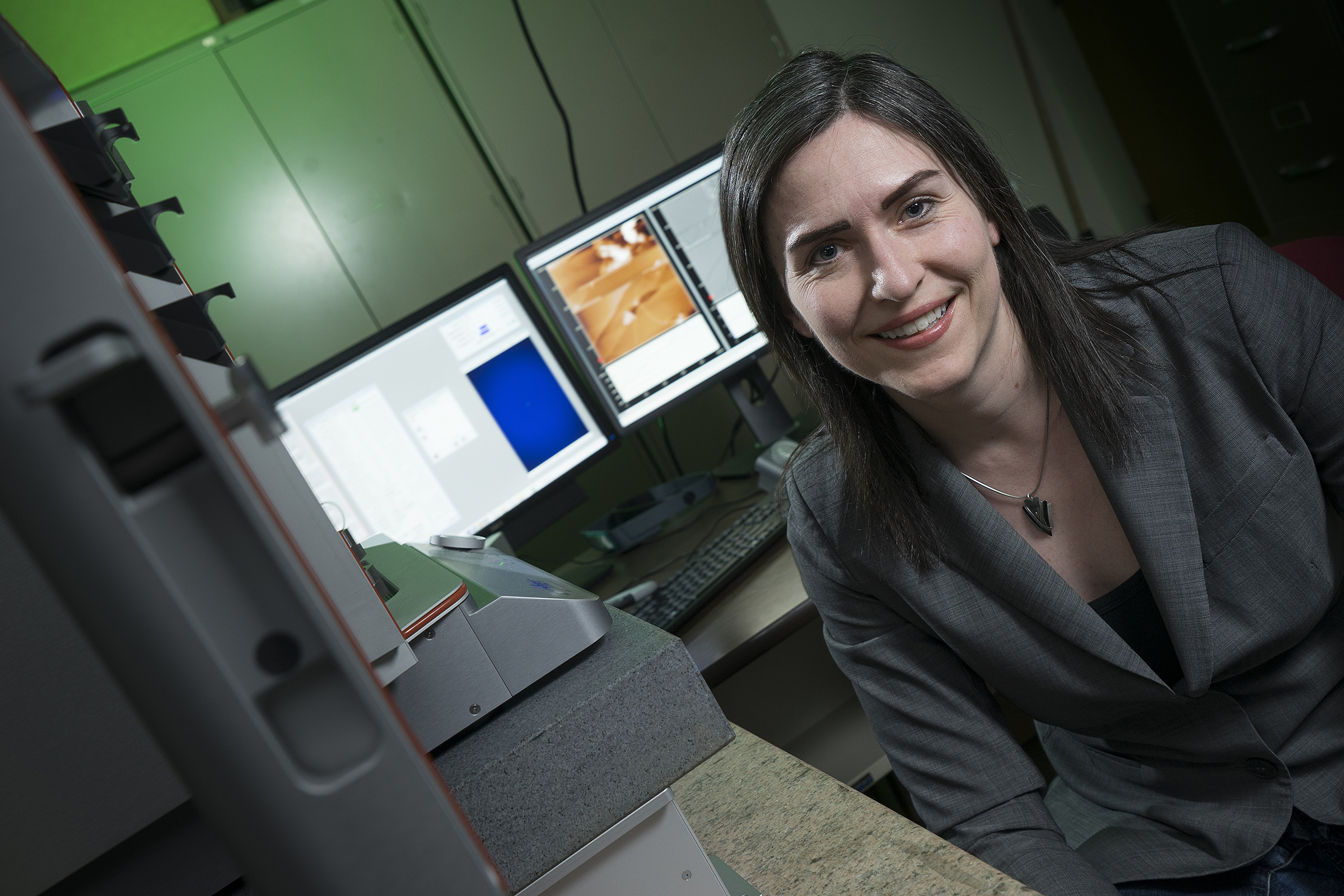
Shelley Claridge, an assistant professor at Purdue University, is leading research to improve electronic and energy conversion devices. Image: Vincent Walter

Inspired by the unique structural elements of animal and plant biological cell membranes, Purdue University researchers have scaled up the production of nanoscale electronics by replicating the living molecular precision and “growing” a circuit of solar cells for use on electronic surfaces.

The technology could address some of the greatest challenges in the production of nanoscale electronic and optoelectronic devices: scaling up to meet production demand of better, faster phones, computers and other electronic devices.  

In cellular membranes, molecules with distinctive heads and tails stand together, tightly packed, like commuters in a subway at rush hour. For the most part, only the heads of the molecules are exposed to the environment around the cell, where they control interactions with other cells and with the world at large.

“Biology has developed a phenomenal set of building blocks for embedding chemical information in a surface,” said Shelley Claridge, an assistant professor of chemistry and biomedical engineering at Purdue, who leads the group. “We hope to translate what we have learned from biological design to address current scaling challenges in industrial fabrication of nanoscale electronic and optoelectronic devices.”

One of those scaling challenges relates to controlling surface structure at scales below 10 nanometers—a need common to modern devices for computing and energy conversion.

Claridge’s research group has found that it is possible to design surfaces in which phospholipids sit, rather than stand on the surface, exposing both heads and tails of each molecule. Because the cell membrane is remarkably thin, just a few atoms across, this creates striped chemical patterns with scales between 5 and 10 nm, a scale very relevant to device design.

One unique discovery by the team reveals that these striped, “sitting” monolayers of phospholipids influence the shape and alignment of liquid nanodroplets placed on the surfaces. Such directional wetting at the molecular scale can localize solution-phase interactions with 2D materials, potentially facilitating deposition of constituents for graphene-based devices.

The Purdue Office of Technology Commercialization has filed multiple patents on the technology. OTC are looking for partners for continued research and to take the technology to market.

The work aligns with Purdue’s Giant Leaps celebration, celebrating the global advancements in sustainability as part of Purdue’s 150th anniversary. This is one of the four themes of the yearlong celebration’s Ideas Festival, designed to showcase Purdue as an intellectual center solving real-world issues.
Related Articles Read More >

Researchers developed quantum nanosensors that can measure the temperature of a single cell
Overcoming the 100-nanometer barrier: New microbottle resonators scale up optical trapping
R&D 100 winner LLNL achieves 1,000x speed boost in 3D nanofabrication
CEA-Leti achieves 400°C CMOS fabrication milestone for 3D chip stacking
rd newsletter
EXPAND YOUR KNOWLEDGE AND STAY CONNECTED
Get the latest info on technologies, trends, and strategies in Research & Development.

R&D World Digital Issues

Fall 2025 issue

Browse the most current issue of R&D World and back issues in an easy to use high quality format. Clip, share and download with the leading R&D magazine today.

R&D 100 Awards
Research & Development World
  • Subscribe to R&D World Magazine
  • Sign up for R&D World’s newsletter
  • Contact Us
  • About Us
  • Drug Discovery & Development
  • Pharmaceutical Processing
  • Global Funding Forecast

Copyright © 2026 Arrowfly LLC. All Rights Reserved. The material on this site may not be reproduced, distributed, transmitted, cached or otherwise used, except with the prior written permission of Arrowfly
Privacy Policy | Advertising | About Us

Search R&D World

  • R&D World Home
  • Topics
    • Aerospace
    • Automotive
    • Biotech
    • Careers
    • Chemistry
    • Environment
    • Energy
    • Life Science
    • Material Science
    • R&D Management
    • Physics
  • Technology
    • 3D Printing
    • A.I./Robotics
    • Software
    • Battery Technology
    • Controlled Environments
      • Cleanrooms
      • Graphene
      • Lasers
      • Regulations/Standards
      • Sensors
    • Imaging
    • Nanotechnology
    • Scientific Computing
      • Big Data
      • HPC/Supercomputing
      • Informatics
      • Security
    • Semiconductors
  • R&D Market Pulse
  • R&D 100
    • 2025 R&D 100 Award Winners
    • 2025 Professional Award Winners
    • 2025 Special Recognition Winners
    • R&D 100 Awards Event
    • R&D 100 Submissions
    • Winner Archive
  • Resources
    • Research Reports
    • Digital Issues
    • Educational Assets
    • Subscribe
    • Video
    • Webinars
    • PharmSci360
    • Content submission guidelines for R&D World
  • Global Funding Forecast
  • Top Labs
  • Advertise
  • SUBSCRIBE