One of the most hotly debated issues in current human origins research focuses on how the 4.4-million-year-old African species Ardipithecus ramidus is related to the human lineage.
“Ardi” was an unusual primate. Though it possessed a tiny brain and a grasping big toe used for clambering in the trees, it had small, humanlike canine teeth and an upper pelvis modified for bipedal walking on the ground.
Scientists disagree about where this mixture of features positions Ardipithecus ramidus on the tree of human and ape relationships. Was Ardi an ape with a few humanlike features retained from an ancestor near in time (between 6 and 8 million years ago, according to DNA evidence) to the split between the chimpanzee and human lines? Or was it a true relative of the human line that had yet to shed many signs of its remote tree-dwelling ancestry?
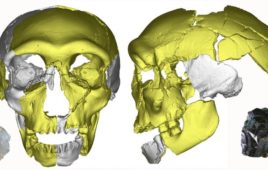
New research led by Arizona State Univ. (ASU) paleoanthropologist William Kimbel confirms Ardi’s close evolutionary relationship to humans. Kimbel and his collaborators turned to the underside (or base) of a beautifully preserved partial cranium of Ardi. Their study revealed a pattern of similarity that links Ardi to Australopithecus and modern humans, but not to apes.
The research appears online in the Proceedings of the National Academy of Sciences. Kimbel is director of the ASU Institute of Human Origins. Joining ASU’s Kimbel as co-authors are Gen Suwa (Univ. of Tokyo Museum), Berhane Asfaw (Rift Valley Research Service, Addis Ababa), Yoel Rak (Tel Aviv Univ.) and Tim White (Univ. of California at Berkeley).
White’s field-research team has been recovering fossil remains of Ardipithecus ramidus in the Middle Awash research area, Ethiopia since the 1990s. The most recent study of the Ardi skull, led by Suwa, was published in Science in 2009, whose work (with the Middle Awash team) first revealed humanlike aspects of its base. Kimbel co-leads the team that recovered the earliest known Australopithecus skulls from the Hadar site, home of the “Lucy” skeleton, in Ethiopia.
“Given the very tiny size of the Ardi skull, the similarity of its cranial base to a human’s is astonishing,” says Kimbel.
The cranial base is a valuable resource for studying phylogenetic, or natural evolutionary relationships, because its anatomical complexity and association with the brain, posture and chewing system have provided numerous opportunities for adaptive evolution over time. The human cranial base, accordingly, differs profoundly from that of apes and other primates.
In humans, the structures marking the articulation of the spine with the skull are more forwardly located than in apes, where the base is shorter from front to back and the openings on each side for passage of blood vessels and nerves are more widely separated.
These shape differences affect the way the bones are arranged on the skull base, such that it is fairly easy to tell apart even isolated fragments of ape and human basicrania.
Ardi’s cranial base shows the distinguishing features that separate humans and Australopithecus from the apes. Kimbel’s earlier research (with collaborator Rak) had shown that these human peculiarities were present in the earliest known Australopithecus skulls by 3.4 million years ago.
The new work expands the catalogue of anatomical similarities linking humans, Australopithecus and Ardipithecus on the tree of life, and shows that the human cranial base pattern is at least a million years older than Lucy’s species, A. afarensis.
Paleoanthropologists generally fall into one of two camps on the cause of evolutionary changes in the human cranial base. Was it the adoption of upright posture and bipedality that caused a shift in the poise of the head on the vertebral column? If so, does the humanlike cranial base of Ar. ramidus confirm postcranial evidence for partial bipedality in this species? Or, do the changes tell us about the shape of the brain (and of the base on which it sits), perhaps an early sign of brain reorganization in the human lineage? Both alternatives will need to be re-evaluated in light of the finding that Ardi does indeed appear to be more closely related to humans than to chimpanzees.
“The Ardi cranial base fills some important gaps in our understanding of human evolution above the neck,” adds Kimbel. “But it also opens up a host of new questions … just as it should.”
Source: Arizona State Univ.