Research & Development World

  • R&D World Home
  • Topics
    • Aerospace
    • Automotive
    • Biotech
    • Careers
    • Chemistry
    • Environment
    • Energy
    • Life Science
    • Material Science
    • R&D Management
    • Physics
  • Technology
    • 3D Printing
    • A.I./Robotics
    • Software
    • Battery Technology
    • Controlled Environments
      • Cleanrooms
      • Graphene
      • Lasers
      • Regulations/Standards
      • Sensors
    • Imaging
    • Nanotechnology
    • Scientific Computing
      • Big Data
      • HPC/Supercomputing
      • Informatics
      • Security
    • Semiconductors
  • R&D Market Pulse
  • R&D 100
    • 2026 R&D 100 Award Winners
    • 2026 Professional Award Winners
    • 2026 Special Recognition Winners
    • R&D 100 Awards Event
    • R&D 100 Submissions
    • Winner Archive
  • Resources
    • Research Reports
    • Digital Issues
    • Educational Assets
    • Subscribe
    • Video
    • Webinars
    • PharmSci360
    • Content submission guidelines for R&D World
  • Global Funding Forecast
  • Top Labs
  • Advertise
  • SUBSCRIBE

Carbon Nanotubes Align in Unison

By Kenny Walter | July 25, 2017

Rendering of a 2D X-ray scattering pattern containing information about the multiscale structure of a carbon nanotube (CNT) ‘forest’ across four orders of magnitude in length scale, a much wider range than previously achieved. Fully resolved features include the graphitic lattice and interlayer wall spacing, CNT diameter, CNT spacing and vertical corrugations. Image by Ryan Chen/LLNL

For the first time, scientists have continuously mapped the multiscale structure of hierarchically self-organized carbon nanotubes across four orders of magnitude in length scale, according to a new study.

Researchers from Lawrence Livermore National Lab (LLNL) used synchrotron X-ray scattering to fully capture the hierarchical structure in self-organized carbon nanotube materials from the atomic to micrometer scale.

“Structural characteristics like pore size distribution, pore density and tortuosity dictate membrane transport performance and can be quantified easily with X-ray methods,” Francesco Fornasiero, LLNL scientist and the principal investigator on the project, said in a statement.

Complex hierarchical structures are made from synthetic nanocarbon allotropes, including nanotubes and graphene, and could be used in several applications, including nanoelectronics, energy storage, filtration and separation.

The arrangement of atoms and defects classically govern a material’s function—similar to how nanoscale building blocks order and align within a larger ensemble strongly influence the material’s macroscale performance.

When it lacks comprehensive, multiscale structural characterization, the progress in application-targeted synthesis of hierarchical nanomaterials is stalled.

“We were interested in describing the entire structure of aligned carbon nanotube ‘forests’ across dramatically different length scales, which typically cannot be done using just one technique, such as conventional microscopy or spectroscopy,” Eric Meshot, an LLNL scientist and lead author of the study, said in a statement.

“X-ray scattering is powerful because the addressable feature size is widely tunable, simply based on the incoming X-ray energy and where you place your detector to collect the outgoing X-rays,” he added.

 The researchers drew correlations between adjacent length scales to discover that the packing density of nanotubes ultimately influences alignment at every length scale.

They also used soft X-rays to resolve microscale structural patterns that can emerge along the nanotube growth direction, which showed that the carbon nanotube materials may form vertical corrugations with high microscale order despite having low nanoscale order.

The study was published in ACS Nano.
Related Articles Read More >

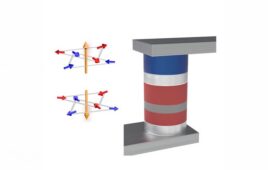
Illustration of an antiferromagnetic tunnel junction pillar beside the two spin configurations of platinum-manganese that store a bit.
Northwestern and Western Digital demonstrate a new way to write magnetic memory
Eggshell-inspired shield cut projectile speed by 65% in simulation, but light-gas gun testing has not confirmed it 
The Space Systems Division (05)-developed Parallelogram Synchronized Truss Assembly (PaSTA), seen Aug. 12, 2025, is a mechanism that will be integrated into the Life-Extension In-orbit Servicer (LEXI) and Astroscale Prototype Servicer for Refueling (APS-R) spacecrafts.
One SwRI R&D 100 winner turns buckled fiberglass into a spacecraft truss. The other models freight rail with 900 hours of BNSF field data
Researchers develop sawdust-based foam as polystyrene bans force industry to adapt
rd newsletter
EXPAND YOUR KNOWLEDGE AND STAY CONNECTED
Get the latest info on technologies, trends, and strategies in Research & Development.

R&D World Digital Issues

Fall 2025 issue

Browse the most current issue of R&D World and back issues in an easy to use high quality format. Clip, share and download with the leading R&D magazine today.

R&D 100 Awards
Research & Development World
  • Subscribe to R&D World Magazine
  • Sign up for R&D World’s newsletter
  • Contact Us
  • About Us
  • Drug Discovery & Development
  • Pharmaceutical Processing
  • Global Funding Forecast

Copyright © 2026 Arrowfly LLC. All Rights Reserved. The material on this site may not be reproduced, distributed, transmitted, cached or otherwise used, except with the prior written permission of Arrowfly
Privacy Policy | Advertising | About Us

Search R&D World

  • R&D World Home
  • Topics
    • Aerospace
    • Automotive
    • Biotech
    • Careers
    • Chemistry
    • Environment
    • Energy
    • Life Science
    • Material Science
    • R&D Management
    • Physics
  • Technology
    • 3D Printing
    • A.I./Robotics
    • Software
    • Battery Technology
    • Controlled Environments
      • Cleanrooms
      • Graphene
      • Lasers
      • Regulations/Standards
      • Sensors
    • Imaging
    • Nanotechnology
    • Scientific Computing
      • Big Data
      • HPC/Supercomputing
      • Informatics
      • Security
    • Semiconductors
  • R&D Market Pulse
  • R&D 100
    • 2026 R&D 100 Award Winners
    • 2026 Professional Award Winners
    • 2026 Special Recognition Winners
    • R&D 100 Awards Event
    • R&D 100 Submissions
    • Winner Archive
  • Resources
    • Research Reports
    • Digital Issues
    • Educational Assets
    • Subscribe
    • Video
    • Webinars
    • PharmSci360
    • Content submission guidelines for R&D World
  • Global Funding Forecast
  • Top Labs
  • Advertise
  • SUBSCRIBE