Research & Development World

  • R&D World Home
  • Topics
    • Aerospace
    • Automotive
    • Biotech
    • Careers
    • Chemistry
    • Environment
    • Energy
    • Life Science
    • Material Science
    • R&D Management
    • Physics
  • Technology
    • 3D Printing
    • A.I./Robotics
    • Software
    • Battery Technology
    • Controlled Environments
      • Cleanrooms
      • Graphene
      • Lasers
      • Regulations/Standards
      • Sensors
    • Imaging
    • Nanotechnology
    • Scientific Computing
      • Big Data
      • HPC/Supercomputing
      • Informatics
      • Security
    • Semiconductors
  • R&D Market Pulse
  • R&D 100
    • 2026 R&D 100 Award Winners
    • 2026 Professional Award Winners
    • 2026 Special Recognition Winners
    • R&D 100 Awards Event
    • R&D 100 Submissions
    • Winner Archive
  • Resources
    • Research Reports
    • Digital Issues
    • Educational Assets
    • Subscribe
    • Video
    • Webinars
    • PharmSci360
    • Content submission guidelines for R&D World
  • Global Funding Forecast
  • Top Labs
  • Advertisers
    • Advertise
    • PR Submissions
    • Eblast Submissions
  • SUBSCRIBE

Camouflage Sea Creatures Could Inspire Next-Generation Materials

By Kenny Walter | February 27, 2018

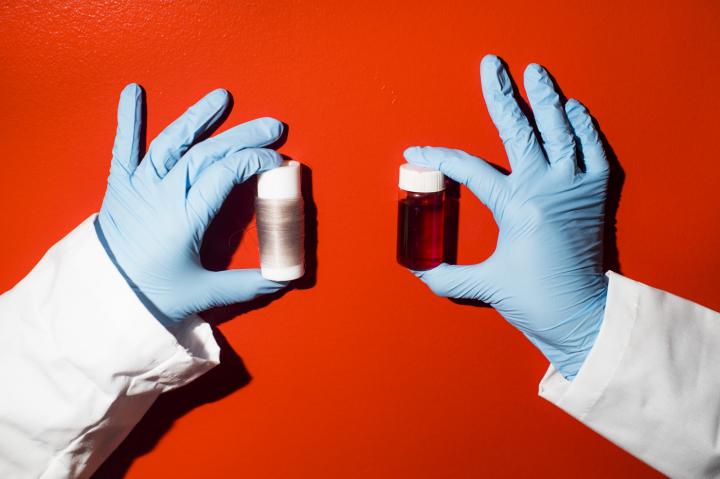
Northeastern researcher Leila Deravi displays spools of thread that were created using squid pigment. Credit: Adam Glanzman/Northeastern University

The properties that enable squid and octopi to quickly change their appearance may inspire a new class of camouflage materials.

A team from Northeastern University has found that the chromatophore organs of cephalopods–which appear as hundreds of red, yellow, brown and orange freckles and contribute to fast changes in the animal’s skin color—have the optical qualities that could be used to make thin films and fibers. These  could be incorporated into textiles, flexible displays and future color-changing devices.

“For more than a decade, scientists and engineers have been trying to replicate this process and build these devices that can color match, color change, and camouflage just like the cephalopods, but many of them come nowhere near the speed or dynamic range of color that the animals can display,” Deravi said. “Cephalopods have evolved to incorporate these specific pigment granules for a reason, and we’re starting to piece together what that reason is.”


The researchers isolated the pigment granules within the organs of cephalopods, which includes octopi, squid and cuttlefish, to get a better understanding of their role in color change. The cephalopods “freckles” open and close within a fraction of a second to give rise to a continuously reconfiguring skin color. Underneath the chromatophores is a layer of iridophores that act as a mirror. Together, the organs are able to reflect all colors of visible light.

By removing individual pigment particles—which are only 500 nanometers in size— from a squid, the researchers are able to explore the breadth of their capabilities as static materials by layering and reorganizing the particles. By doing this, the scientists found they could produce an expansive color pallet.

“We’re showing these pigments are a powerful tool that can produce ultra-thin films that are really rich in colors,” Leila Deravi, an assistant professor of chemistry and chemical biology at Northeastern, said in a statement.

The researchers also found that the pigments could scatter both visible and infrared light, enhancing brightness and light absorption and affecting how a final color is perceived. When they engineered a system that included a mirror to mimic the layout of organs that squids have naturally, the researchers were able to further enhance the perceived color through scattering light through and off the granules.

The process could possibly be replicated on functional materials like solar cells to increase the absorption of sunlight.

“From a scientific and technical engineering perspective, understanding how light scattering affects color is very important, and this is an exciting new development in the field of optics in biology,” Richard Osgood, a collaborator from the U.S. Army Natick Soldier Research, Development, and Engineering Center, said in a statement. “This is an unusual harnessing of optics and physics knowledge in scattering to understand biological systems.”  

 “For more than a decade, scientists and engineers have been trying to replicate this process and build these devices that can color match, color change, and camouflage just like the cephalopods, but many of them come nowhere near the speed or dynamic range of color that the animals can display,” Deravi said. “Cephalopods have evolved to incorporate these specific pigment granules for a reason, and we’re starting to piece together what that reason is.”
Related Articles Read More >

Inside the Lab: Can AI Solve the Critical Materials Challenge?
Two Science papers catch altermagnets by handedness
Illustration of an antiferromagnetic tunnel junction pillar beside the two spin configurations of platinum-manganese that store a bit.
Northwestern and Western Digital demonstrate a new way to write magnetic memory
Eggshell-inspired shield cut projectile speed by 65% in simulation, but light-gas gun testing has not confirmed it 
rd newsletter
EXPAND YOUR KNOWLEDGE AND STAY CONNECTED
Get the latest info on technologies, trends, and strategies in Research & Development.

R&D World Digital Issues

Fall 2026 issue

Browse the most current issue of R&D World and back issues in an easy to use high quality format. Clip, share and download with the leading R&D magazine today.

R&D 100 Awards
Research & Development World
  • Subscribe to R&D World Magazine
  • Sign up for R&D World’s newsletter
  • Contact Us
  • About Us
  • Drug Discovery & Development
  • Pharmaceutical Processing
  • Global Funding Forecast

Copyright © 2026 Arrowfly LLC. All Rights Reserved. The material on this site may not be reproduced, distributed, transmitted, cached or otherwise used, except with the prior written permission of Arrowfly
Privacy Policy | Advertising | About Us

Search R&D World

  • R&D World Home
  • Topics
    • Aerospace
    • Automotive
    • Biotech
    • Careers
    • Chemistry
    • Environment
    • Energy
    • Life Science
    • Material Science
    • R&D Management
    • Physics
  • Technology
    • 3D Printing
    • A.I./Robotics
    • Software
    • Battery Technology
    • Controlled Environments
      • Cleanrooms
      • Graphene
      • Lasers
      • Regulations/Standards
      • Sensors
    • Imaging
    • Nanotechnology
    • Scientific Computing
      • Big Data
      • HPC/Supercomputing
      • Informatics
      • Security
    • Semiconductors
  • R&D Market Pulse
  • R&D 100
    • 2026 R&D 100 Award Winners
    • 2026 Professional Award Winners
    • 2026 Special Recognition Winners
    • R&D 100 Awards Event
    • R&D 100 Submissions
    • Winner Archive
  • Resources
    • Research Reports
    • Digital Issues
    • Educational Assets
    • Subscribe
    • Video
    • Webinars
    • PharmSci360
    • Content submission guidelines for R&D World
  • Global Funding Forecast
  • Top Labs
  • Advertisers
    • Advertise
    • PR Submissions
    • Eblast Submissions
  • SUBSCRIBE