Research & Development World

  • R&D World Home
  • Topics
    • Aerospace
    • Automotive
    • Biotech
    • Careers
    • Chemistry
    • Environment
    • Energy
    • Life Science
    • Material Science
    • R&D Management
    • Physics
  • Technology
    • 3D Printing
    • A.I./Robotics
    • Software
    • Battery Technology
    • Controlled Environments
      • Cleanrooms
      • Graphene
      • Lasers
      • Regulations/Standards
      • Sensors
    • Imaging
    • Nanotechnology
    • Scientific Computing
      • Big Data
      • HPC/Supercomputing
      • Informatics
      • Security
    • Semiconductors
  • R&D Market Pulse
  • R&D 100
    • 2026 R&D 100 Award Winners
    • 2026 Professional Award Winners
    • 2026 Special Recognition Winners
    • R&D 100 Awards Event
    • R&D 100 Submissions
    • Winner Archive
  • Resources
    • Research Reports
    • Digital Issues
    • Educational Assets
    • Subscribe
    • Video
    • Webinars
    • PharmSci360
    • Content submission guidelines for R&D World
  • Global Funding Forecast
  • Top Labs
  • Advertisers
    • Advertise
    • PR Submissions
    • Eblast Submissions
  • SUBSCRIBE

Diamond Enables Circuits to Take More Heat

By Kenny Walter | April 10, 2018

A new diamond semiconductor circuit could make power conversion systems more efficient, reducing wasted power.

Researchers from Japan’s National Institute for Materials Science have fabricated a key circuit in power conversion systems using hydrogenated diamond that can function at temperatures as high as 300 degrees Celsius.

Power generators such as windmills and solar panels transfer electricity to buildings and the power grid, but lose nearly 10 percent of the generated power.

The new circuits can be used in diamond-based electronic devices that are smaller, lighter and more efficient than their silicon-based counterparts are.

“For the high-power generators, diamond is more suitable for fabricating power conversion systems with a small size and low power loss,” Jiangwei Liu, a researcher at Japan’s National Institute for Materials Science and a co-author on the paper, said in a statement.

Due to the limitation of material physical properties, silicon-based electronic devices are difficult for applications in fields of high-power handling, high-temperature operation, and high frequency switching.

Diamond is regarded as the preferred semiconductor for future high-power, high-temperature and high frequency applications due to its wide bandgap energy, high breakdown field, high thermal conductivity, high carrier saturation velocity, and high carrier mobility.

The researchers tested an H-diamond NOR logic circuit’s—commonly used in computers— stability at high temperatures.

The circuit consisted of two metal-oxide-semiconductor field-effect transistors (MOSFETs), which are used in many electronic devices, and in digital integrated circuits, like microprocessors.

After heating the circuit to 300 degrees Celsius, it functioned correctly, significantly higher than the maximum operation temperature for a silicon-based electronic device, which is about 150 degrees Celsius. The circuit ultimately failed at 400 degrees Celsius. The researchers believe the higher temperatures caused the MOSFETs to breakdown.

However, another team of researchers has reported success on a similar H-diamond MOSFET at temperatures as high as 400 degrees Celsius.

The researchers now plan to improve the circuit’s stability at higher temperatures by altering the oxide insulators and modifying the fabrication process. The goal is to contrast an H-diamond MOSFET logic circuit that can operate above 500 degrees Celsius and at 2.0 kilovolts.

“Diamond is one of the candidate semiconductor materials for next-generation electronics, specifically for improving energy savings,” Yasuo Koide, a director at the National Institute for Materials Science and co-author on the paper, said in a statement. “Of course, in order to achieve industrialization, it is essential to develop inch-sized single-crystal diamond wafers and other diamond-based integrated circuits.”

The study was published in Applied Physics Letters.

Related Articles Read More >

Inside the Lab: Can AI Solve the Critical Materials Challenge?
Two Science papers catch altermagnets by handedness
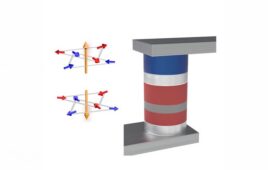
Illustration of an antiferromagnetic tunnel junction pillar beside the two spin configurations of platinum-manganese that store a bit.
Northwestern and Western Digital demonstrate a new way to write magnetic memory
Eggshell-inspired shield cut projectile speed by 65% in simulation, but light-gas gun testing has not confirmed it 
rd newsletter
EXPAND YOUR KNOWLEDGE AND STAY CONNECTED
Get the latest info on technologies, trends, and strategies in Research & Development.

R&D World Digital Issues

Fall 2026 issue

Browse the most current issue of R&D World and back issues in an easy to use high quality format. Clip, share and download with the leading R&D magazine today.

R&D 100 Awards
Research & Development World
  • Subscribe to R&D World Magazine
  • Sign up for R&D World’s newsletter
  • Contact Us
  • About Us
  • Drug Discovery & Development
  • Pharmaceutical Processing
  • Global Funding Forecast

Copyright © 2026 Arrowfly LLC. All Rights Reserved. The material on this site may not be reproduced, distributed, transmitted, cached or otherwise used, except with the prior written permission of Arrowfly
Privacy Policy | Advertising | About Us

Search R&D World

  • R&D World Home
  • Topics
    • Aerospace
    • Automotive
    • Biotech
    • Careers
    • Chemistry
    • Environment
    • Energy
    • Life Science
    • Material Science
    • R&D Management
    • Physics
  • Technology
    • 3D Printing
    • A.I./Robotics
    • Software
    • Battery Technology
    • Controlled Environments
      • Cleanrooms
      • Graphene
      • Lasers
      • Regulations/Standards
      • Sensors
    • Imaging
    • Nanotechnology
    • Scientific Computing
      • Big Data
      • HPC/Supercomputing
      • Informatics
      • Security
    • Semiconductors
  • R&D Market Pulse
  • R&D 100
    • 2026 R&D 100 Award Winners
    • 2026 Professional Award Winners
    • 2026 Special Recognition Winners
    • R&D 100 Awards Event
    • R&D 100 Submissions
    • Winner Archive
  • Resources
    • Research Reports
    • Digital Issues
    • Educational Assets
    • Subscribe
    • Video
    • Webinars
    • PharmSci360
    • Content submission guidelines for R&D World
  • Global Funding Forecast
  • Top Labs
  • Advertisers
    • Advertise
    • PR Submissions
    • Eblast Submissions
  • SUBSCRIBE