A team of researchers recently uncovered living microorganisms on the remains of the 5,300-year-old Iceman, revealing a methodological gap in modern genomics. In a study published in Microbiome, the team showed that while DNA analysis can map the presence of ancient genetic material, traditional petri dish cultivation remains necessary to determine if those microorganisms are actually alive.
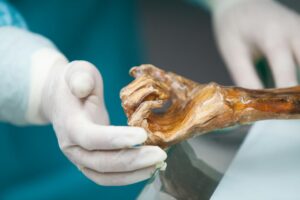
Credit: South Tyrol Museum of Archaeology/Eurac Research/Marion Lafogler
“The initial idea was to find the post mortem growth of certain microbes and determine if there was continuous presence of certain microbes in what I now call ecosystem Iceman,” said co-author Frank Maixner.
The Tyrolean Iceman, nicknamed Ӧtzi, is a 5,300 year-old natural alpine glacier mummy discovered in 1991 in the Ӧtztal Alps. He is now housed at the South Tyrolean Museum of Archaeology in Italy.
Sequencing finds ancient and modern DNA
The researchers analyzed microbial DNA from samples taken from the remains to determine which microbes were from the Iceman’s life and which were introduced after his death. They used Ancient DNA (aDNA) analysis to identify specific chemical and structural changes that occur in DNA after an organism dies and its cells lyse. Ancient yeast DNA on the Iceman was in fragment lengths of only around 40 nucleotides, showing that it was thousands of years old.
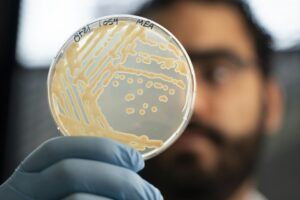
Microbiologist Mohamed Sarhan is examining colonies of yeast taken from a sample of Ötzi’s stomach.
Credit: Eurac Research | Andrea De Giovanni
The aDNA analysis method also looks for damage patterns, specifically cytosine to thymine deamination at the ends of DNA fragments. The researchers found deamination levels between 10% to 20% in the microbial DNA on the remains. Taxa such as Romboutsia hominis, Treponema succinifaciens, and members of the Clostridiaceae family exhibited high C-to-T deamination frequencies, confirming they represent an ancient community associated with the Iceman’s 5,300-year-old intestinal ecosystem.
Culturing reveals life on the Iceman
One criticism of only using DNA sequencing is that DNA is highly stable and can linger in an ecosystem long after an organism has died. A 2017 paper in Microbiome found that culture-independent sequencing methods cannot unequivocally prove cell viability and argues that relying on computational sequencing creates a distorted view of active ecological functions.
While the analysis confirmed the presence of ancient and modern bacteria, the researchers attempted to cultivate the microorganisms to determine if any of them were alive. They collected material from various parts of the mummy, including skin swabs, water collected during the defrosting process and stomach content. The swab samples and water runoff were streaked directly onto agar plates of brain-heart infusion (BHI), Reasoner’s 2A (R2A) and malt-extract agar (MEA). The stomach contents were enriched with BHI broth for two weeks to encourage growth before being spread on agar for single colony isolation.
The plates were incubated at 4 degrees Celsius and 20 to 22 degrees Celsius and monitored periodically over 28 days. Researchers isolated Staphylococcus spp. from back swabs and internal water, which matched the high relative abundance of the same bacteria found in DNA profiling. They also recovered Massilia brevitalea from the air in the conservation facility.
The team also uncovered four distinct strains of cold-adapted yeasts: Glaciozyma watsonii, Mrakia robertii, Phenoliferia glacialis and a Goffeauzyma species. These were most likely introduced to the remains while the Iceman was buried in the glacier. Morphological observation under microscopy confirmed the presence of active structures like budding cells and pseudohyphae.
“We showed that this dogma of having just ancient DNA fragments of certain yeasts present does not necessarily mean that these yeasts cannot be cultivated,” said Maixner. “If we had looked only at the DNA data set and we had looked only at the damage pattern, we would have put [the yeasts] into this kind of corner that they were in a certain time, maybe living on the Iceman, but they died.”
The Iceman ecosystem
Cultivating the samples showed, for the first time, that there is an ecosystem of microorganisms living on the Iceman. Previous studies relying on aDNA analysis and other sequencing methods, disregarding cultivation, missed this finding.
While the researchers did not resurrect dead microorganisms from the remains, they did find evidence that modern descendants of the ancient yeasts continue to live and multiply on the remains. By comparing the 2019 samples to others taken in 2010, they saw an increase in the amount of DNA. In the 2010 samples, the yeast DNA was highly fragmented and damaged. By 2019, samples from the same spot had long, pristine DNA.
“We saw from the isolated yeasts that there seems to be an increase of their presence in amounts of DNA,” Maixner said. “They do not show any more damage, so we interpreted this as active replication that is ongoing.”