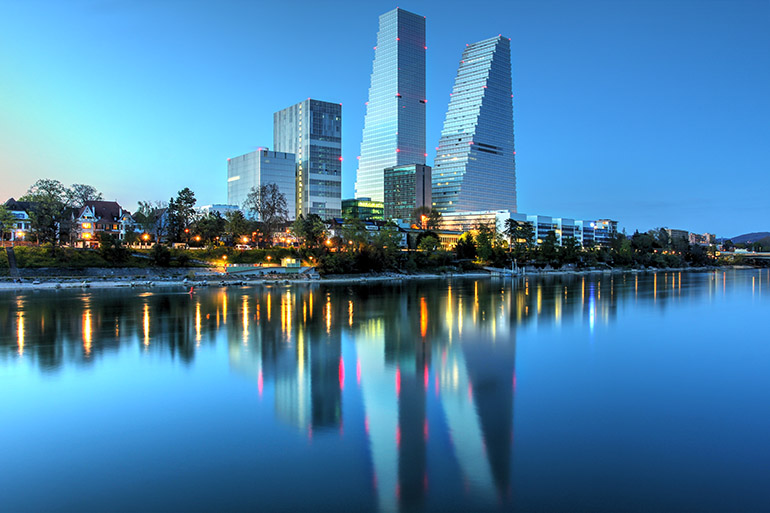
The two skyscrapers commonly referred to as Roche Towers have been built in 2015 and 2022 respectively along the Rhine River. The taller one, finished last is currently the tallest building in Switzerland standing at 205m. The design belongs to Herzog & de Meuron also based in Basel, Switzerland. [Adobe Stock]
“The cycles are not as extreme here… on the downswing, we’re more resilient”
The picture in Switzerland’s Basel-anchored cluster is steadier: Swiss biotech financings totaled CHF 2.5B in 2024, a 22% year-over-year jump, and H1 2025 Swiss startup VC hit CHF 1.47B (+36% YoY), with a record CHF 705M to biotech. While the broader biotech sector has faced headwinds, “the cycles are not as extreme here… on the downswing, we’re more resilient,” says Christof Klöpper, CEO of Basel Area Business & Innovation.
Strategic expansion meets architectural distinction
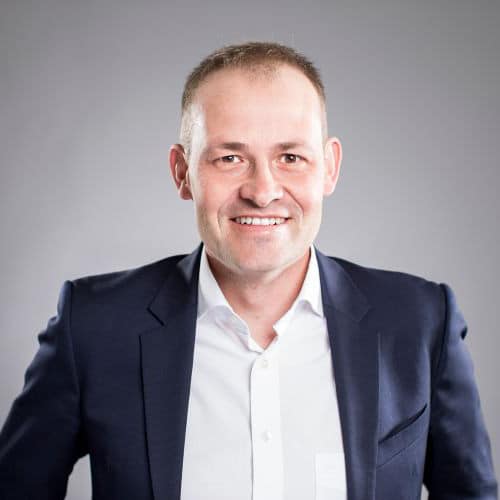
Christof Klöpper, Ph.D.
When it comes to lab space, Basel is in a phase of strategic expansion. “Over the next two years, expect three to four additional large lab buildings to come online,” says Christof Klöpper, CEO of Basel Area Business & Innovation. This growth is attracting major international players, exemplified by BeOne Medicines (formerly BeiGene), which officially redomiciled its global headquarters to Basel in May 2025. The move anchors the nearly 11,000-employee oncology firm in the Swiss hub, a decision State Councilor Kaspar Sutter said “reinforces Basel’s status as one of Europe’s leading life science clusters.”
The growth is centered on Allschwil’s BaseLink district, where the Switzerland Innovation Park is more than doubling its footprint to 115,000 m² by 2028. Its HORTUS building opened in June 2025, while the new “ALL” laboratory building, with the Botnar Institute for Immune Engineering (BIIE) serving as an anchor, targets a 2027 completion. In parallel, the established giants are reinvesting heavily: Novartis has opened its campus to startups, and Roche’s new pRED center, which came online in late 2024, provides around 1,000 laboratory and office workplaces (with capacity for substantially more researchers).
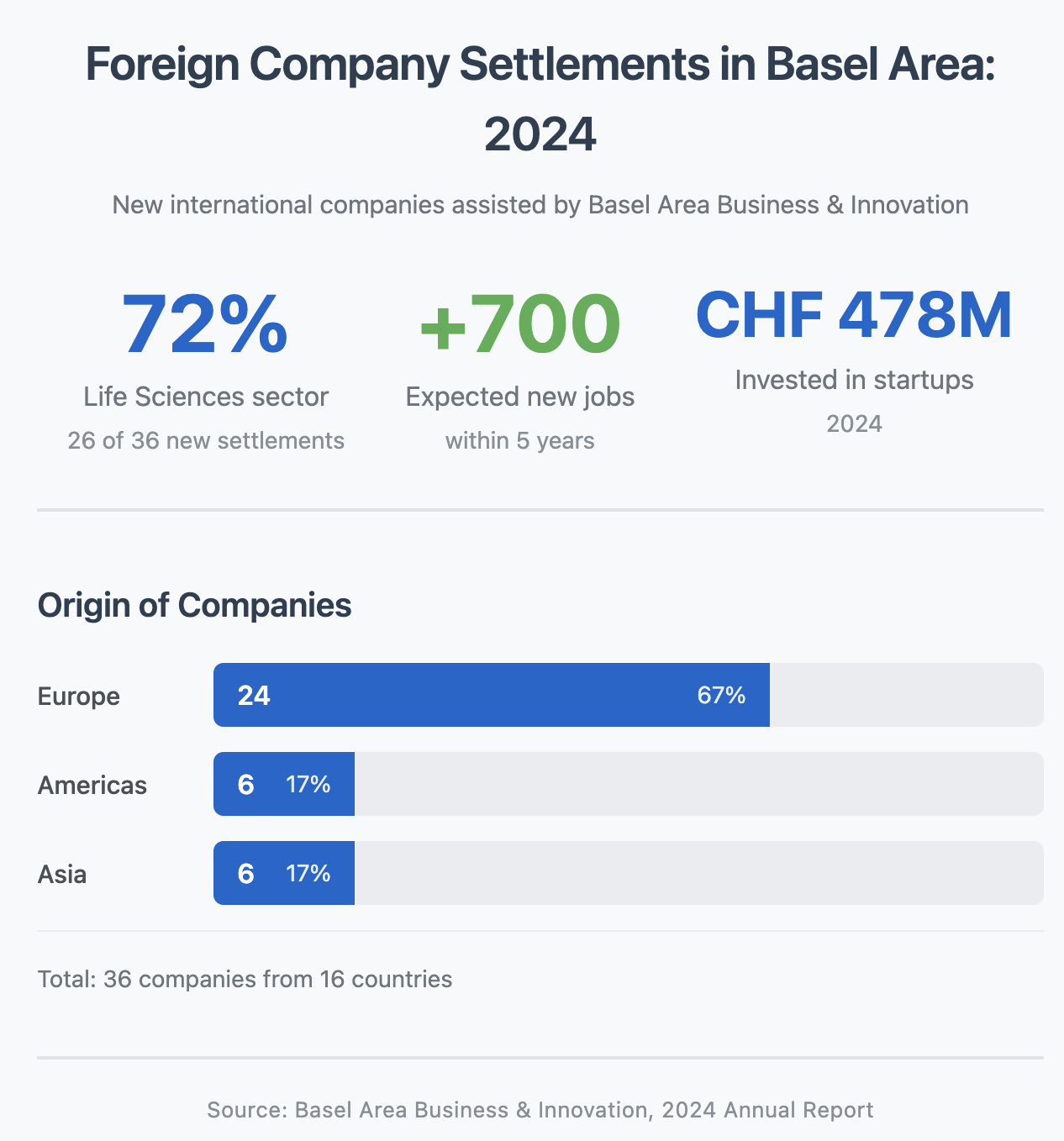
Source: Basel Area press release
Several of these new lab buildings feature design from Basel-based star architects Herzog & de Meuron, who bring architectural distinction without excessive costs. Herzog & de Meuron, the Basel-based Pritzker Prize-winning firm behind London’s Tate Modern and Beijing’s Bird’s Nest Stadium, demonstrates that prestige and practicality can coexist. Herzog & de Meuron’s fingerprints are present in many biopharma sites in the area, including the Switzerland Innovation Park Basel Area. World-class architecture doesn’t necessarily have to cost a fortune. Klöpper said initially he assumed that “fancy” meant “expensive,”‘ Klöpper said. “But they manage to keep the fancy part to certain aspects while the rest is functional and well-built for labs at a reasonable cost.”
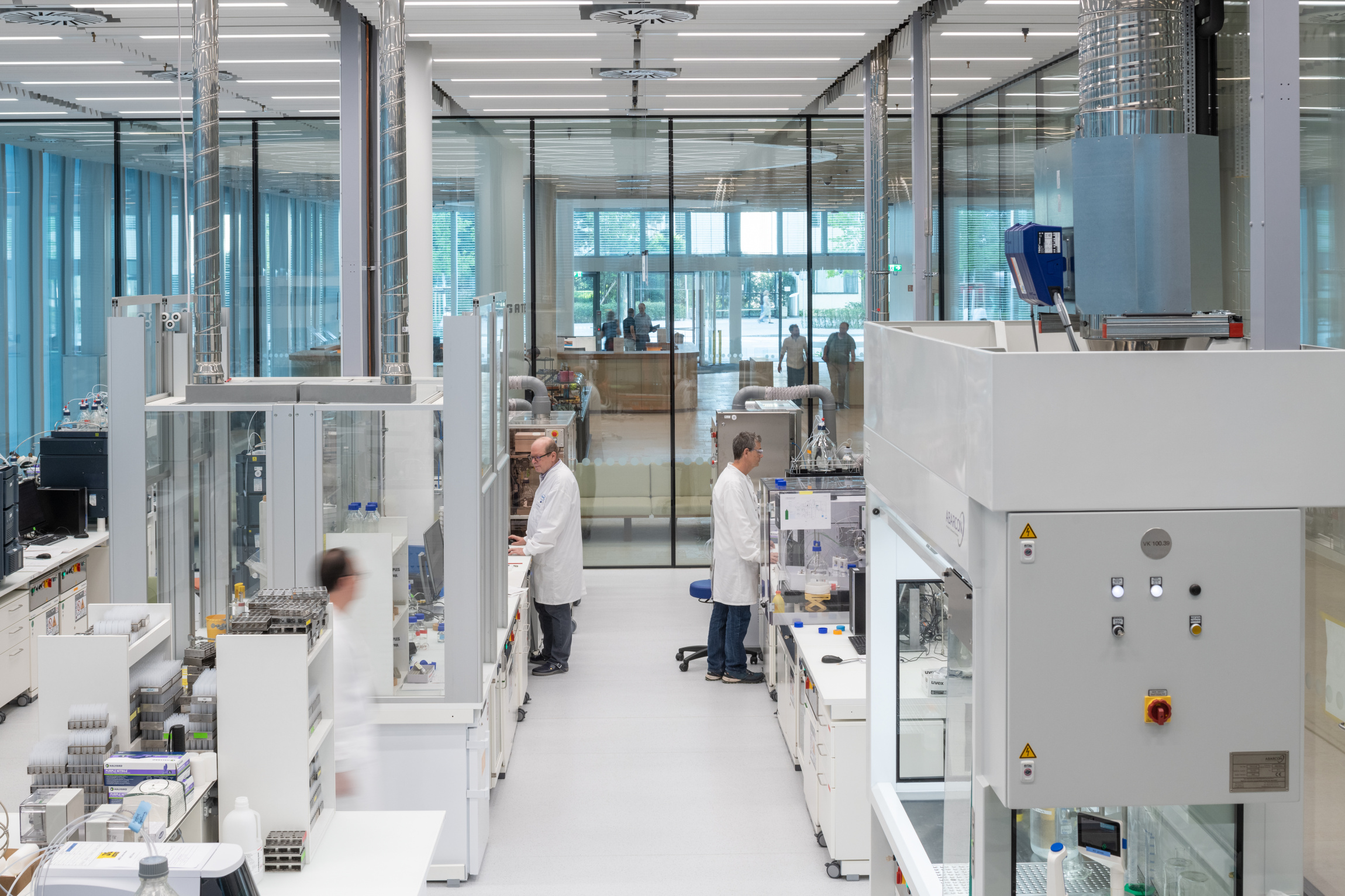
The 425 Roche Pred Center as shown on the Herzog & DeMeuron website
From ‘Forbidden City’ to open innovation hub
This infrastructure evolution represents a significant change in how Basel operates. “Now, multi-tenant lab buildings are standard,” Klöpper notes. The transformation is notable at Novartis, whose research campus was once nicknamed the ‘Forbidden City‘ owing to restricted access.
“Startups needing labs or offices can even be located right on the Novartis campus”
Today, “startups needing labs or offices can even be located right on the Novartis campus, as they’ve shifted their policy to create a true innovation hub,” says Klöpper. Roche has followed suit: “Roche is quite open to collaboration, with the usual high-quality bar.” This openness extends beyond real estate, programs like the BaseLaunch incubator actively connect startups with pharmaceutical expertise, while spin-offs like Actelion (sold to J&J for $30 billion) and Idorsia have created a generation of experienced entrepreneur-investors who provide both capital and mentorship.
Building the talent pipeline across borders
Basel’s talent engine is anchored by universities as much as incumbents. “The University of Basel has strong life-science departments. A real highlight is that ETH Zurich… runs its key life science department, the Department of Biosystems Science and Engineering (D-BSSE), here in Basel,” Klöpper says. New anchors are widening the pipeline, including the Botnar Institute for Immune Engineering, “supported by a ~CHF 1 billion donation from Fondation Botnar,” and Roche’s Institute for Human Biology.
“There’s a saying that the optimal way to live here is to live in France, shop in Germany, and work in Switzerland”
This ecosystem draws talent from nearby countries as well as farther afield. “Switzerland’s comparatively liberal immigration policy helps recruitment, and people are drawn to the quality of life,” Klöpper says. The tri-national setting also shapes household economics.
“There’s a saying that the optimal way to live here is to live in France, shop in Germany and work in Switzerland.” While the local Basel dialect of German is most common, French is also present, while English is widely used in research and industry, “the lingua franca for life sciences,” reducing language frictions for newcomers. It is possible to get by using mostly English.
With a full value chain anchored by Lonza, “headquartered here and among the largest [CDMOs] globally,” Klöpper said, Basel offers comprehensive manufacturing capabilities. The CDMO landscape extends beyond Lonza. “All the global players have a presence here, plus specialized Swiss firms like Bachem,’ Klöpper added. He described the field as offering “a broad mix of global and local providers, and some of the global ones are also local, having originated in Basel.”
From corporate stronghold to diversified ecosystem
Basel’s life-sciences base is longstanding. Local chemicals and dye makers began producing medicines roughly 150 years ago, eventually giving rise to the modern pharma sector. “For a long time, the landscape was dominated by these large companies. What was lacking was a broader ecosystem around them,” Klöpper says. Over the past 25 years, university spin-offs, alumni from big pharma and international arrivals have broadened that base.
“What was lacking was a broader ecosystem around them”
Basel’s shift from a primarily corporate stronghold to a more open, multi-tenant ecosystem offers a different profile from larger hubs. Klöpper argues that political stability and predictable institutions add another layer of appeal. “Switzerland is sometimes seen as “boring” politically. That used to be a negative, but in these uncertain times, it seems to have become a positive,” Klöpper said. “Stability is a strength that many companies truly value.”