By Dave Bukey
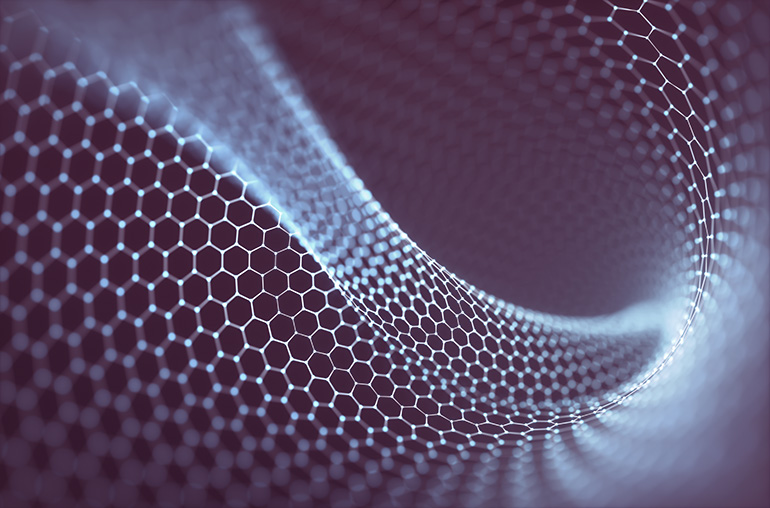
By applying the AI that social networks use to identify people in photos, an Argonne engineer discovered a new way to predict the structure of a material, given its preferred properties. The discovery may help save time and money and allow businesses to use techniques once reserved for supercomputers. (Image by Shutterstock / ktsdesign.)
The future of clean energy is hot. Temperatures hit 800° C in parts of solar energy plants and advanced nuclear reactors. Finding materials that can stand that type of heat is tough. So experts look to Mark Messner for answers.
A principal mechanical engineer at the U.S. Department of Energy’s (DOE) Argonne National Laboratory, Messner is among a group of engineers who are discovering better ways to predict how materials will behave under high temperatures and pressures. The current prediction methods work well, but they take time and often require supercomputers, especially if you already have a set of specific material properties — e.g., stiffness, density or strength — and want to find out what type of structure a material would need to match those properties.
“You would typically have to run tons of physics-based simulations to solve that problem,” said Messner.
Looking for a shortcut, he found that neural networks, a type of artificial intelligence (AI) that uncovers patterns in huge data sets, can accurately predict what happens to a material in extreme conditions. And they can do this much faster and easier than standard simulations can.
Messner’s new method found the properties of a material more than 2,000 times faster than the standard approach, as reported in an October 2019 Journal of Mechanical Design article. Many of the calculations, Messner realized, could run on a regular laptop with a graphics processing unit (GPU) — instead of a supercomputer, which are often inaccessible to most businesses.
This was the first time anyone had used a so-called convolutional neural network — a type of neural network with a different, simpler structure that’s ideal for recognizing patterns in photos — to accurately recognize a material’s structural properties. It is also one of the first steps in accelerating how researchers design and characterize materials, which could help us move toward a fully clean energy economy.
Cats on the Internet play a role
Messner began designing materials as a postdoctoral researcher at DOE’s Lawrence Livermore National Laboratory, where a team sought to produce structures on a 3D printer at a scale of microns, or millionths of a meter. While cutting edge, the research was slow. Could AI speed up results?
At the time, technology giants in Silicon Valley had started using convolutional neural networks to recognize faces and animals in images. This inspired Messner.
“My idea was that a material’s structure is no different than a 3D image,” he said. “It makes sense that the 3D version of this neural network will do a good job of recognizing the structure’s properties — just like a neural network learns that an image is a cat or something else.”
To test his theory, Messner took four steps. He:
- designed a defined square with bricks — like pixels;
- took random samples of that design and used a physics-based simulation to create 2 million data points. Those points linked his design to the desired properties of density and stiffness;
- fed the 2 million data points into the convolutional neural network. This trained the network to look for the correct results;
- used a genetic algorithm, another type of AI designed to optimize results, together with the trained convolutional neural network, to find an overall structure that would match the properties he wanted.
The result? The new AI method found the right structure 2,760 times faster than the standard physics-based model (0.00075 sec vs. 0.207 sec, respectively).
New tools boost nuclear innovation
This abstract idea might transform how engineers design materials — especially those meant to withstand conditions with high temperatures, pressures and corrosion.
Messner recently joined a team of engineers from Argonne and DOE’s Idaho and Los Alamos National Laboratories that is partnering with Kairos Power, a nuclear startup. The team is creating AI-based simulation tools that will help Kairos design a molten salt nuclear reactor, which, unlike current reactors, will use molten salt as a coolant. With those tools, the team will project how a specific type of stainless steel, called 316H, will behave under extreme conditions for decades.
This simulation shows the steps that neural networks and genetic algorithms take to find an overall structure that matches specific material properties. (Image by Argonne National Laboratory.)
“This is a small, but vital, part of the work we are doing for Kairos Power,” said Rui Hu, a nuclear engineer who is managing Argonne’s role in the project. “Kairos Power wants very accurate models of how reactor components are going to behave inside its reactor to support its licensing application to the Nuclear Regulatory Commission. We look forward to providing those models.”
Another promising avenue for this type of work is 3D printing. Before 3D printing caught on, engineers struggled to build structures like the one Messner found using AI in his 2019 paper. Yet making a structure layer by layer with a 3D printer allows for more flexibility than traditional manufacturing methods.
The future of mechanical engineering may be in combining 3D printing with new AI-based techniques, said Messner. “You would give the structure — determined by a neural network — to someone with a 3D printer and they would print it off with the properties you want,” he said. “We are not quite there yet, but that’s the hope.”
This research used Argonne’s Bebop cluster in its Laboratory Computing Resource Center.


Very interesting and we are in the packaging Consulting field and I would like to talk to someone from Argonne natl Labs about holding a meeting there with a number of Fortune 500 companies on aI and new matls tech nology – please contact me
Thank you
Mike
It looks exciting project