Research & Development World

  • R&D World Home
  • Topics
    • Aerospace
    • Automotive
    • Biotech
    • Careers
    • Chemistry
    • Environment
    • Energy
    • Life Science
    • Material Science
    • R&D Management
    • Physics
  • Technology
    • 3D Printing
    • A.I./Robotics
    • Software
    • Battery Technology
    • Controlled Environments
      • Cleanrooms
      • Graphene
      • Lasers
      • Regulations/Standards
      • Sensors
    • Imaging
    • Nanotechnology
    • Scientific Computing
      • Big Data
      • HPC/Supercomputing
      • Informatics
      • Security
    • Semiconductors
  • R&D Market Pulse
  • R&D 100
    • 2025 R&D 100 Award Winners
    • 2025 Professional Award Winners
    • 2025 Special Recognition Winners
    • R&D 100 Awards Event
    • R&D 100 Submissions
    • Winner Archive
  • Resources
    • Research Reports
    • Digital Issues
    • Educational Assets
    • Subscribe
    • Video
    • Webinars
    • PharmSci360
    • Content submission guidelines for R&D World
  • Global Funding Forecast
  • Top Labs
  • Advertise
  • SUBSCRIBE

Clean Fuel Cells Could be Cheap Enough to Replace Gas Engines in Vehicles

By University of Waterloo | May 8, 2019

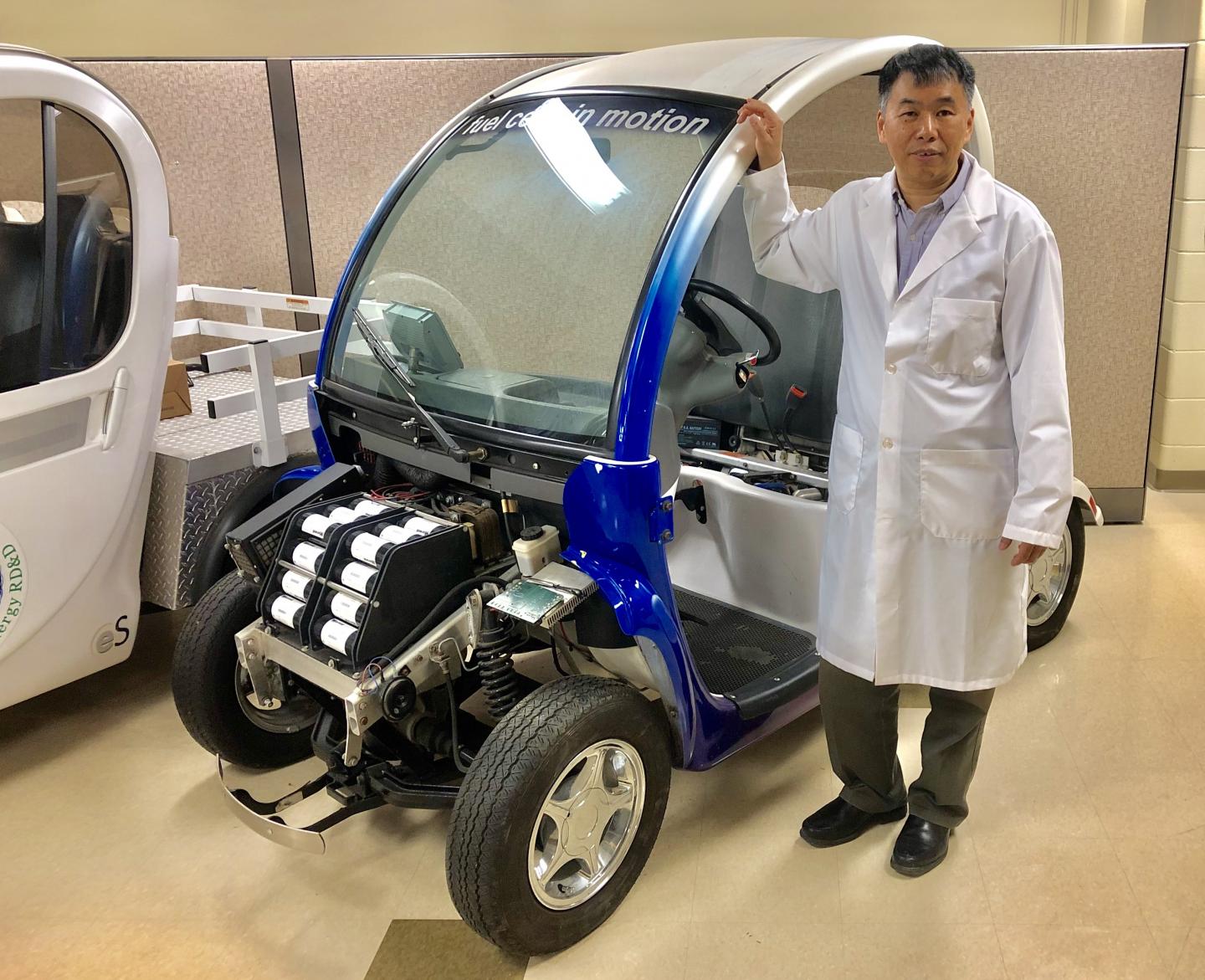
This is Xianguo Li with a fuel cell test vehicle in his lab. Credit: UWaterloo

Advancements in zero-emission fuel cells could make the technology cheap enough to replace traditional gasoline engines in vehicles, according to researchers at the University of Waterloo.

The researchers have developed a new fuel cell that lasts at least 10 times longer than current technology, an improvement that would make them economically practical, if mass-produced, to power vehicles with electricity.

“With our design approach, the cost could be comparable or even cheaper than gasoline engines,” said Xianguo Li, director of the Fuel Cell and Green Energy Lab at Waterloo. “The future is very bright. This is clean energy that could boom.”

Researchers initially concentrated on hybrid vehicles, which now have gas engines as well as batteries due to issues involving limited driving range and long charging times.

Existing fuel cells could theoretically replace those gas engines, which power generators to recharge batteries while hybrid vehicles are in operation, but are impractical because they are too expensive.

The researchers solved that problem with a design that makes fuel cells far more durable by delivering a constant, rather than fluctuating, amount of electricity.

That means the cells, which produce electricity from the chemical reaction when hydrogen and oxygen are combined to make water, can be far simpler and therefore far cheaper.

“We have found a way to lower costs and still satisfy durability and performance expectations,” said Li, a professor of mechanical and mechatronics engineering. “We’re meeting economic targets while providing zero emissions for a transportation application.”

Researchers hope the introduction of fuel cells in hybrid vehicles will lead to mass production and lower unit costs. That could pave the way for the replacement of both batteries and gas engines entirely by providing an affordable, safe, dependable, clean source of electrical power.

“This is a good first step, a transition to what could be the answer to the internal combustion engine and the enormous environmental harm it does,” said Li.

Li collaborated with lead researcher Hongtao Zhang, a former post-doctoral fellow, Waterloo mathematics professor Xinzhi Liu and Jinyue Yan, an energy expert and professor in Sweden.


Related Articles Read More >

BYD’s EV megawatt leap is a 1,000-hp supercar with flash charging
175 Wh/kg: How CATL’s Naxtra Architecture Moves Sodium-Ion Beyond the Lab
Rewriting the EV cost curve: The tech that has already pushed Chinese EVs below gasoline parity
GM XFC Cell: EV battery charges from 10% to 70% in approximately 5.6 minutes | Inside the R&D 100 win
rd newsletter
EXPAND YOUR KNOWLEDGE AND STAY CONNECTED
Get the latest info on technologies, trends, and strategies in Research & Development.

R&D World Digital Issues

Fall 2025 issue

Browse the most current issue of R&D World and back issues in an easy to use high quality format. Clip, share and download with the leading R&D magazine today.

R&D 100 Awards
Research & Development World
  • Subscribe to R&D World Magazine
  • Sign up for R&D World’s newsletter
  • Contact Us
  • About Us
  • Drug Discovery & Development
  • Pharmaceutical Processing
  • Global Funding Forecast

Copyright © 2026 WTWH Media LLC. All Rights Reserved. The material on this site may not be reproduced, distributed, transmitted, cached or otherwise used, except with the prior written permission of WTWH Media
Privacy Policy | Advertising | About Us

Search R&D World

  • R&D World Home
  • Topics
    • Aerospace
    • Automotive
    • Biotech
    • Careers
    • Chemistry
    • Environment
    • Energy
    • Life Science
    • Material Science
    • R&D Management
    • Physics
  • Technology
    • 3D Printing
    • A.I./Robotics
    • Software
    • Battery Technology
    • Controlled Environments
      • Cleanrooms
      • Graphene
      • Lasers
      • Regulations/Standards
      • Sensors
    • Imaging
    • Nanotechnology
    • Scientific Computing
      • Big Data
      • HPC/Supercomputing
      • Informatics
      • Security
    • Semiconductors
  • R&D Market Pulse
  • R&D 100
    • 2025 R&D 100 Award Winners
    • 2025 Professional Award Winners
    • 2025 Special Recognition Winners
    • R&D 100 Awards Event
    • R&D 100 Submissions
    • Winner Archive
  • Resources
    • Research Reports
    • Digital Issues
    • Educational Assets
    • Subscribe
    • Video
    • Webinars
    • PharmSci360
    • Content submission guidelines for R&D World
  • Global Funding Forecast
  • Top Labs
  • Advertise
  • SUBSCRIBE