Scientist wearing sterile blue gloves and white lab coat opening cryogenic freezer storing samples at -80 degrees Celsius in scientific laboratory
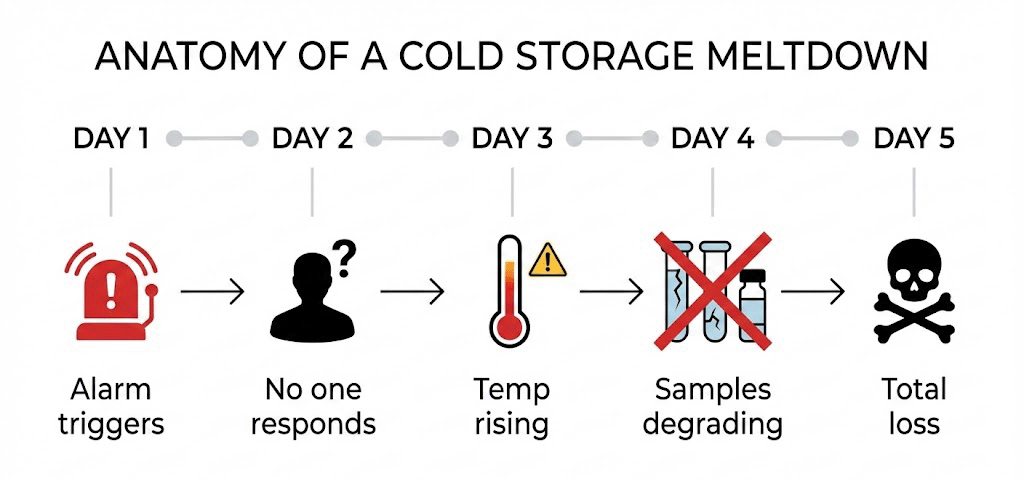
When a cryogenic storage failure hit Karolinska Institutet’s Neo building over the 2023 Christmas holidays, it destroyed decades of samples in just five days. An interruption in the automatic liquid nitrogen refill for 16 of 19 cryogenic tanks allowed temperatures to rise beyond safe limits. Karolinska Institutet’s (KI) internal report later quantified the damage: approximately 47,100 samples were lost. The breakdown included 34,400 biobank samples, 3,800 animal model samples, 2,600 cell line samples and 6,300 manipulated cell line samples.
In 2012, a different kind of failure at Harvard-affiliated McLean Hospital sent a similar message. When a freezer in the hospital’s brain bank failed, almost 150 brain samples, about one-third of the autism brain collection, were destroyed. The controls malfunctioned and the alarms never triggered. Investigators concluded the loss could delay parts of autism research by years.
During the COVID-19 vaccine rollout, cold storage problems moved from the back room to the front page. At a VA hospital in Boston, an unplugged freezer ruined approximately 1,900 doses of Moderna vaccine overnight. In Ukiah, California, a freezer failure triggered a chaotic two-hour emergency vaccination sprint to save more than 800 doses, an event reported locally by the Mendocino Voice and later covered nationally by the Los Angeles Times.
The playbook for prevention
Such stories are reminders that cold storage is active infrastructure. It determines whether years of sample collection, reagents or irreplaceable biological materials survive long enough to be useful. If the Karolinska and McLean incidents are cautionary tales, there are three documents that serve as the survival guide. While often viewed as dry regulatory reading, these frameworks provide the structural defense against disaster.
The CDC Vaccine Storage and Handling Toolkit may be vaccine-focused, but its best practices on alarms, temperature excursions and emergency planning are applicable to any lab handling clinical samples. For biobanks, the ISBER Best Practices for Repositories (2023 edition) remains the gold standard, offering specific guidance on backup power and temperature mapping that translates well to research storage. Finally, USP <1079> introduces risk-based frameworks, such as mean kinetic temperature, that help labs understand exactly when a fluctuation becomes a failure.
Moving beyond “set it and forget it”
Automated monitoring systems are useful, but they are not a substitute for human attention. As the McLean failure demonstrated, systems can fail silently. If the dashboard says “all clear,” it is only useful if the sensors feeding it are actually working.
Authorities recommend that staff check and log temperatures for all units daily. This includes going beyond glancing at the display, recording the reading to track drift from the baseline, a practice emphasized by NIST guidelines. Weekly or monthly, this visual inspection must go deeper. Staff should check for frost buildup around door frames and gaskets, or vents blocked by accumulated boxes. A simple trick is the “dollar bill test”: if a bill placed in the door pulls out easily when closed, the gasket is failing, and the unit is bleeding energy and stability.
The boring work that can avert meltdowns
ISBER and CDC guidance converge on maintenance practices that seem obvious until you audit how many labs actually follow them.
The first rule is that an alarm that has not been tested is an alarm you are merely hoping will work. Labs should test alarms on a defined schedule and document results, ideally when staff are available to verify the full escalation chain before it is needed at 3 AM.
Equally critical is the physical health of the unit. Vacuuming dust from condenser coils annually is non-negotiable; clogged coils force compressors to run longer cycles, leading to higher internal temperatures and premature burnout. In addition, before trusting a new unit with samples, ISBER recommends temperature mapping, placing sensors at multiple points to verify the unit doesn’t have dangerous warm spots hiding in the corners.
Finally, there is the issue of redundancy. Backup power and storage must be sized for realistic failure scenarios, not best-case assumptions. Extension cords and “we will move things manually” are not a plan. For ULT freezers, CO2 backup injection systems can extend safe storage time during a power or compressor failure.
The human element: Alarms and SOPs
In one widely reported incident at Rensselaer Polytechnic Institute (RPI), a janitor trying to silence “annoying” alarms switched off a freezer holding 20 years of cell research. The freezer already had a malfunctioning alarm and a posted sign explaining the noise, but the janitor, trying to help, flipped the circuit breaker. The university later sued the cleaning contractor for $1 million in damages.
The RPI case highlights a critical failure point: the human interface. Training gaps turn nuisance alarms into total losses. Factory default alarm thresholds rarely match specific research requirements. Labs must adjust setpoints to their needs and, more importantly, write Standard Operating Procedures (SOPs) for the least technical person in the room. The vaccine rollout exposed how many facilities had excursion policies that existed only on paper. The Karolinska failure reinforced this lesson: the malfunction went uncorrected for about five days, reflecting gaps in alarm handling, escalation paths, and holiday coverage.
Protocols must answer questions including the following: Who responds? How fast? What is the first safe step for a night-shift custodian? Where is the backup space, and is it actually available right now?
Listening to the machine
Freezers rarely die instantly. Treating “weird behavior” as a maintenance ticket rather than background noise is the difference between a repair and a disaster. There are several red flags that should never be ignored:
Constant running: If a compressor never cycles off, it is struggling to maintain the setpoint. It is likely suffering from poor sealing, blocked vents or clogged coils.
Frost creep: Frost thicker than a pencil, or frost creeping over the door frame, indicates seal degradation or excessive door openings.
Nuisance alarms: If an alarm triggers often enough to be routinely muted, either the threshold is wrong or there is an underlying instability being ignored.
LN2 anomalies: For cryogenic storage, a sudden increase in the boil-off rate or unusual external frost can indicate a vacuum failure, a warning sign emphasized in industry maintenance guidance.
And a final note on liquid nitrogen: the idea that storing LN2 in cold rooms slows boil-off is a dangerous myth. It does not save nitrogen, but it does create an asphyxiation risk.
Whether storing mRNA vaccines at -70°C or biobank samples at -80°C, the lesson is the same. Cold storage failures become disasters when monitoring is assumed rather than verified, alarms are trusted rather than tested, and backup plans exist on paper rather than in practice.