Research & Development World

  • R&D World Home
  • Topics
    • Aerospace
    • Automotive
    • Biotech
    • Careers
    • Chemistry
    • Environment
    • Energy
    • Life Science
    • Material Science
    • R&D Management
    • Physics
  • Technology
    • 3D Printing
    • A.I./Robotics
    • Software
    • Battery Technology
    • Controlled Environments
      • Cleanrooms
      • Graphene
      • Lasers
      • Regulations/Standards
      • Sensors
    • Imaging
    • Nanotechnology
    • Scientific Computing
      • Big Data
      • HPC/Supercomputing
      • Informatics
      • Security
    • Semiconductors
  • R&D Market Pulse
  • R&D 100
    • 2025 R&D 100 Award Winners
    • 2025 Professional Award Winners
    • 2025 Special Recognition Winners
    • R&D 100 Awards Event
    • R&D 100 Submissions
    • Winner Archive
  • Resources
    • Research Reports
    • Digital Issues
    • Educational Assets
    • Subscribe
    • Video
    • Webinars
    • PharmSci360
    • Content submission guidelines for R&D World
  • Global Funding Forecast
  • Top Labs
  • Advertise
  • SUBSCRIBE

Customizable, Fabric-like Power Supply Created for Wearable Electronics

By Nanyang Technological University | January 30, 2018

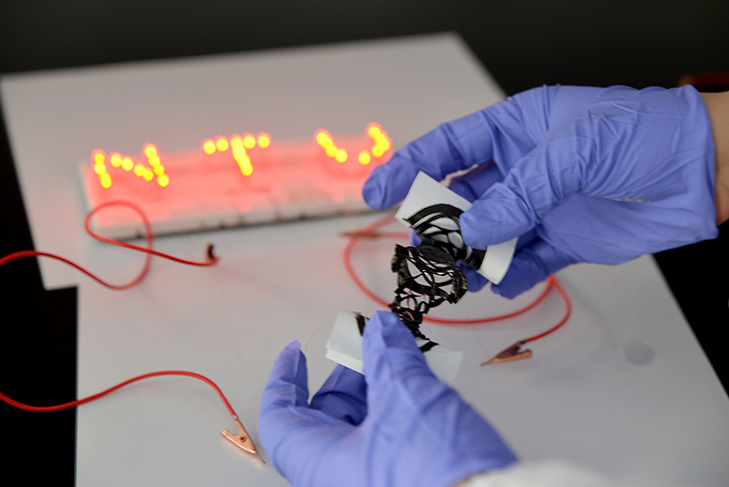
Scientists at Nanyang Technological University, Singapore (NTU Singapore) have created a customizable, fabric-like power source that can be cut, folded, or stretched without losing its function.

Led by Professor Chen Xiaodong, Associate Chair (Faculty) at the School of Materials Science & Engineering, the team reported in the journal Advanced Materials how they have created the wearable power source, a supercapacitor, which works like a fast-charging battery and can be recharged many times.

Crucially, they have made their supercapacitor customizable or “editable,” meaning its structure and shape can be changed after it is manufactured, while retaining its function as a power source. Existing stretchable supercapacitors are made into predetermined designs and structures, but the new invention can be stretched multi-directionally, and is less likely to be mismatched when it is joined up to other electrical components.

The new supercapacitor, when edited into a honeycomb-like structure, has the ability to store an electrical charge four times higher than most existing stretchable supercapacitors. In addition, when stretched to four times its original length, it maintains nearly 98 percent of the initial ability to store electrical energy, even after 10,000 stretch-and-release cycles.
Experiments done by Chen and his team also showed that when the editable supercapacitor was paired with a sensor and placed on the human elbow, it performed better than existing stretchable supercapacitors. The editable supercapacitor was able to provide a stable stream of signals even when the arm was swinging, which are then transmitted wirelessly to external devices, such as one that captures a patient’s heart rate.   

The authors believe that the editable supercapacitor could be easily mass-produced as it would rely on existing manufacturing technologies. Production cost will thus be low, estimated at about 10 cents American (SGD$0.13) to produce 1 cm2 of the material.

The team has filed a patent for the technology.

Chen says, “A reliable and editable supercapacitor is important for development of the wearable electronics industry. It also opens up all sorts of possibilities in the realm of the ‘Internet-of-Things’ when wearable electronics can reliably power themselves and connect and communicate with appliances in the home and other environments.

“My own dream is to one day combine our flexible supercapacitors with wearable sensors for health and sports performance diagnostics. With the ability for wearable electronics to power themselves, you could imagine the day when we create a device that could be used to monitor a marathon runner during a race with great sensitivity, detecting signals from both under and over-exertion.”

The editable supercapacitor is made of strengthened manganese dioxide nanowire composite material. While manganese dioxide is a common material for supercapacitors, the ultralong nanowire structure, strengthened with a network of carbon nanotubes and nanocellulose fibers, allows the electrodes to withstand the associated strains during the customization process.

The NTU team also collaborated with Dr. Loh Xian Jun, Senior Scientist and Head of the Soft Materials Department at the Institute of Materials Research and Engineering (IMRE), Agency for Science, Technology and Research (A*STAR).

Loh says, “Customizable and versatile, these interconnected, fabric-like power sources are able to offer a plug-and-play functionality while maintaining good performance. Being highly stretchable, these flexible power sources are promising next-generation ‘fabric’ energy storage devices that could be integrated into wearable electronics.”

Source: Nanyang Technological University

Related Articles Read More >

MBARI's Monterey Accelerated Research System (MARS) connects seafloor instruments to shore through a roughly 51-kilometer power and fiber-optic cable (red line) ending at a node about 891 meters down. The Geo-Sense system described in the new paper takes the opposite approach: a portable, battery-powered cable that records locally with no link to shore. Researchers used MARS's own fiber data to cross-check Geo-Sense's earthquake detections. Credit: MBARI
How lightweight AI startup Lightscline helped turn one to two years of seafloor data analysis into a two-month sprint
UC Riverside’s $5 fake drug detector uses toy robot sensors to catch counterfeit medications
R&D 100 winner flags even unknown fentanyl analogs
New nanopore sensor paves the way for fast, accurate, low-cost DNA sequencing
rd newsletter
EXPAND YOUR KNOWLEDGE AND STAY CONNECTED
Get the latest info on technologies, trends, and strategies in Research & Development.

R&D World Digital Issues

Fall 2025 issue

Browse the most current issue of R&D World and back issues in an easy to use high quality format. Clip, share and download with the leading R&D magazine today.

R&D 100 Awards
Research & Development World
  • Subscribe to R&D World Magazine
  • Sign up for R&D World’s newsletter
  • Contact Us
  • About Us
  • Drug Discovery & Development
  • Pharmaceutical Processing
  • Global Funding Forecast

Copyright © 2026 Arrowfly LLC. All Rights Reserved. The material on this site may not be reproduced, distributed, transmitted, cached or otherwise used, except with the prior written permission of Arrowfly
Privacy Policy | Advertising | About Us

Search R&D World

  • R&D World Home
  • Topics
    • Aerospace
    • Automotive
    • Biotech
    • Careers
    • Chemistry
    • Environment
    • Energy
    • Life Science
    • Material Science
    • R&D Management
    • Physics
  • Technology
    • 3D Printing
    • A.I./Robotics
    • Software
    • Battery Technology
    • Controlled Environments
      • Cleanrooms
      • Graphene
      • Lasers
      • Regulations/Standards
      • Sensors
    • Imaging
    • Nanotechnology
    • Scientific Computing
      • Big Data
      • HPC/Supercomputing
      • Informatics
      • Security
    • Semiconductors
  • R&D Market Pulse
  • R&D 100
    • 2025 R&D 100 Award Winners
    • 2025 Professional Award Winners
    • 2025 Special Recognition Winners
    • R&D 100 Awards Event
    • R&D 100 Submissions
    • Winner Archive
  • Resources
    • Research Reports
    • Digital Issues
    • Educational Assets
    • Subscribe
    • Video
    • Webinars
    • PharmSci360
    • Content submission guidelines for R&D World
  • Global Funding Forecast
  • Top Labs
  • Advertise
  • SUBSCRIBE