Research & Development World

  • R&D World Home
  • Topics
    • Aerospace
    • Automotive
    • Biotech
    • Careers
    • Chemistry
    • Environment
    • Energy
    • Life Science
    • Material Science
    • R&D Management
    • Physics
  • Technology
    • 3D Printing
    • A.I./Robotics
    • Software
    • Battery Technology
    • Controlled Environments
      • Cleanrooms
      • Graphene
      • Lasers
      • Regulations/Standards
      • Sensors
    • Imaging
    • Nanotechnology
    • Scientific Computing
      • Big Data
      • HPC/Supercomputing
      • Informatics
      • Security
    • Semiconductors
  • R&D Market Pulse
  • R&D 100
    • 2025 R&D 100 Award Winners
    • 2025 Professional Award Winners
    • 2025 Special Recognition Winners
    • R&D 100 Awards Event
    • R&D 100 Submissions
    • Winner Archive
  • Resources
    • Research Reports
    • Digital Issues
    • Educational Assets
    • Subscribe
    • Video
    • Webinars
    • PharmSci360
    • Content submission guidelines for R&D World
  • Global Funding Forecast
  • Top Labs
  • Advertise
  • SUBSCRIBE

Designer Materials Create Miniature Computer Circuits

By University of Manchester | November 22, 2016

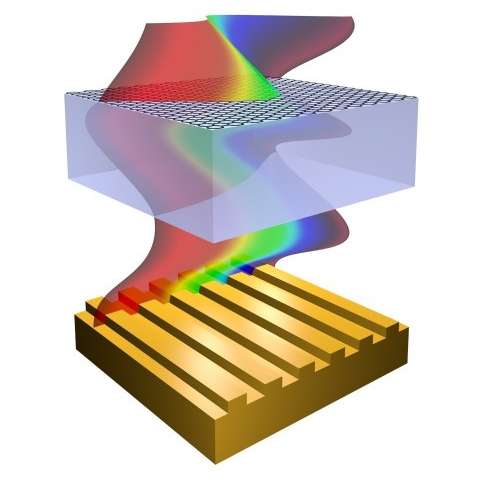
Credit: University of Manchester

Scientists at The University of Manchester have discovered a new method of creating optoelectronic circuits using graphene and other 2D materials that are much smaller than their current counterparts.

Optoelectronics, the technology that uses pulses of light rather than traditional electrical signals, is vital for telecommunication networks.

Modulators are important in optoelectronic circuits as they control the signals passed through optoelectronic devices. Previous attempts to create hybrid modulators incorporating graphene have yielded promising although limited results.

Writing in Nature Communications, researchers led by Professor Sasha Grigorenko have shown it is possible to combine graphene, its sister material boron nitride and a nanoscale gold grating to create a new class of optical modulator.

Graphene is the world’s first two-dimensional material, just one atom thick yet 200 times stronger than steel, more conductive than copper and impermeable to water.

Since then a whole family of 2D materials have been uncovered and are now being used together in order to tailor materials to meet specific requirements.

The proposed device can effectively process information using light much the same way as computers process information using electrons.

Graphene NOWNANO PhD student Philip Thomas, who led the experimental work, said: “This could pave the way for faster circuits, which is the main selling point of using light instead of electrical signals. But probably the bigger result from this work is that it could allow for a dramatic reduction in the size of these circuits. It is rare to have a modulator which both creates a strong modulation effect and is really tiny.”

Professor Sasha Grigorenko said: “It is unprecedented to achieve light modulation in such a wide wavelength range – from visible to infrared light in which human eye, night vision goggles and thermal imaging operate – using just one simple design.”

 

Related Articles Read More >

Researchers developed quantum nanosensors that can measure the temperature of a single cell
Overcoming the 100-nanometer barrier: New microbottle resonators scale up optical trapping
R&D 100 winner LLNL achieves 1,000x speed boost in 3D nanofabrication
CEA-Leti achieves 400°C CMOS fabrication milestone for 3D chip stacking
rd newsletter
EXPAND YOUR KNOWLEDGE AND STAY CONNECTED
Get the latest info on technologies, trends, and strategies in Research & Development.

R&D World Digital Issues

Fall 2025 issue

Browse the most current issue of R&D World and back issues in an easy to use high quality format. Clip, share and download with the leading R&D magazine today.

R&D 100 Awards
Research & Development World
  • Subscribe to R&D World Magazine
  • Sign up for R&D World’s newsletter
  • Contact Us
  • About Us
  • Drug Discovery & Development
  • Pharmaceutical Processing
  • Global Funding Forecast

Copyright © 2026 Arrowfly LLC. All Rights Reserved. The material on this site may not be reproduced, distributed, transmitted, cached or otherwise used, except with the prior written permission of Arrowfly
Privacy Policy | Advertising | About Us

Search R&D World

  • R&D World Home
  • Topics
    • Aerospace
    • Automotive
    • Biotech
    • Careers
    • Chemistry
    • Environment
    • Energy
    • Life Science
    • Material Science
    • R&D Management
    • Physics
  • Technology
    • 3D Printing
    • A.I./Robotics
    • Software
    • Battery Technology
    • Controlled Environments
      • Cleanrooms
      • Graphene
      • Lasers
      • Regulations/Standards
      • Sensors
    • Imaging
    • Nanotechnology
    • Scientific Computing
      • Big Data
      • HPC/Supercomputing
      • Informatics
      • Security
    • Semiconductors
  • R&D Market Pulse
  • R&D 100
    • 2025 R&D 100 Award Winners
    • 2025 Professional Award Winners
    • 2025 Special Recognition Winners
    • R&D 100 Awards Event
    • R&D 100 Submissions
    • Winner Archive
  • Resources
    • Research Reports
    • Digital Issues
    • Educational Assets
    • Subscribe
    • Video
    • Webinars
    • PharmSci360
    • Content submission guidelines for R&D World
  • Global Funding Forecast
  • Top Labs
  • Advertise
  • SUBSCRIBE