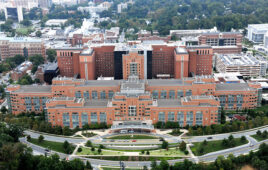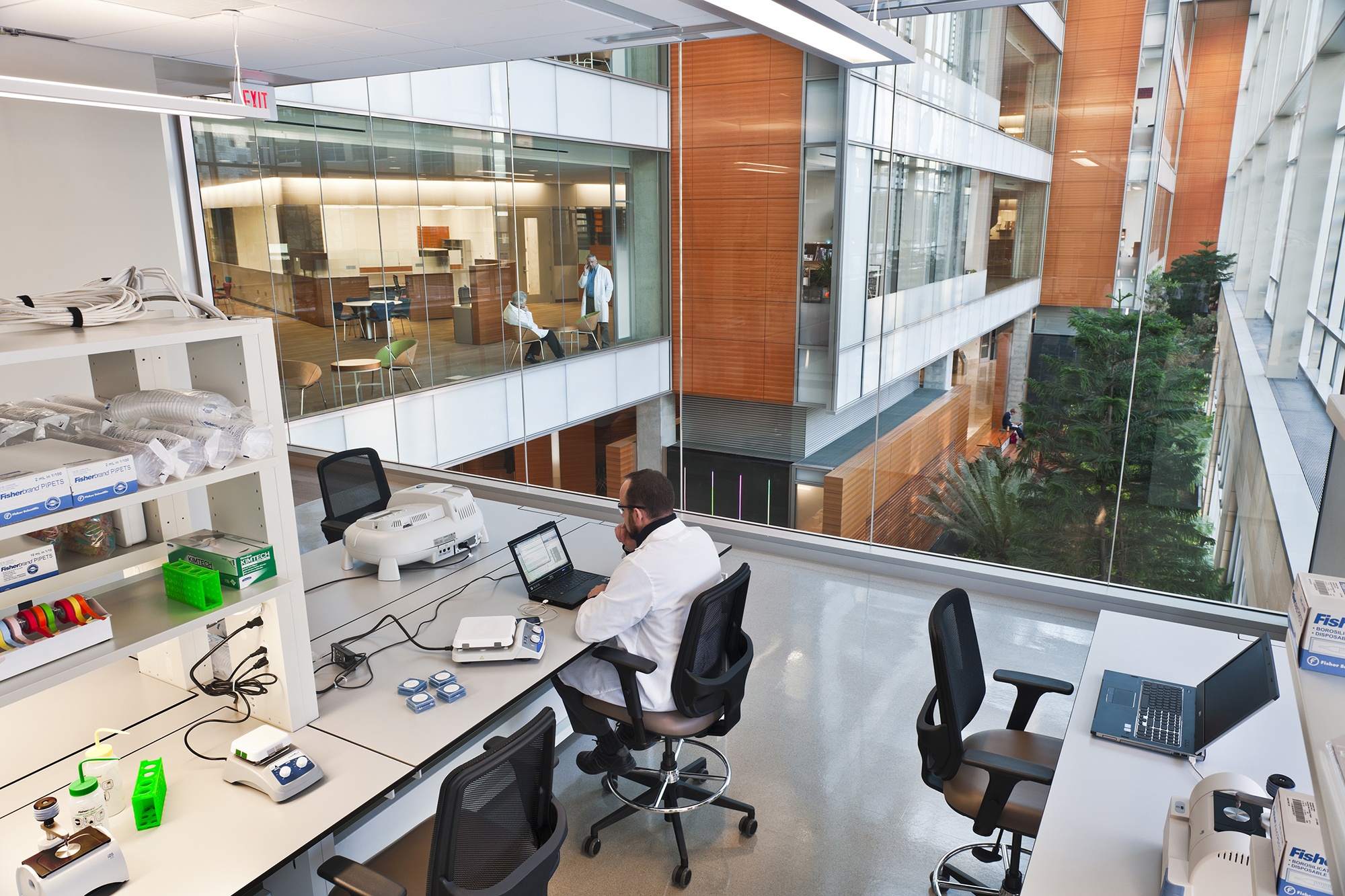
Open, multi-level workspaces at the Wisconsin Institutes for Discovery foster spontaneous encounters across disciplines. Photo by Tom Crane, courtesy of Ballinger.
As research grows more interdisciplinary, the environments built to support it don’t always keep up. Forward-thinking universities are rethinking laboratories not just as technical spaces but as places that shape how scientists interact, focus, and work together. At the University of Maryland and the University of Wisconsin–Madison, new facilities are testing that idea, designing around how researchers actually behave, not just what equipment they need.
Cultural barriers to collaboration
Despite open layouts and transparent façades, cultural silos persist in academic research. Faculty hierarchies, departmental boundaries, and the divide between “wet” and “dry” disciplines can stifle the interdisciplinary work these buildings are supposed to enable.
Some new research buildings are organized around shared purpose rather than departmental identity. At Wisconsin’s Institutes for Discovery, wet and dry laboratories are interlaced with collaboration areas, cafés, and staircases meant to encourage chance encounters, or what designers call “collision zones.” The idea is that proximity builds trust across disciplines.
But collaboration can’t be forced. The challenge is balancing spontaneous interaction with the deep focus that research demands.

The Chemistry Research Building at the University of Maryland features open laboratory layouts with ceiling-mounted utilities, enabling teams to reconfigure spaces as research evolves. Photo by James Ewing, courtesy of Ballinger.
The balance between focus and interaction
At the University of Maryland, A. James Clark Hall was designed as a 300-foot-long “lab loft” with cores and mechanical systems placed at the ends. The uninterrupted span allows open laboratories to be subdivided or merged as research teams and technologies change. Ceiling-mounted utilities let scientists rearrange flexible casework and equipment without major reconstruction.
The building also tries to balance open and enclosed work. Total openness can be as counterproductive as isolation. Movable partitions, modular workstations, and shared support zones give teams some control over their own configurations.
Infrastructure planning extends that flexibility into the future. Air-handling systems and exhaust capacity at Maryland were sized to anticipate emerging sciences. Penthouse levels reserve space for future mechanical units, so the building can scale without costly retrofits.

Flexible bench layouts and movable partitions at Clark Hall balance openness with the ability to create focused work zones. Photo by James Ewing, courtesy of Ballinger.
Designing for complex science
Quantum science is pushing lab design to new extremes. Research at the nanoscale requires absolute control of vibration, light, and temperature. Those are conditions that are hard to achieve above ground.
Several institutions are putting their most sensitive research underground. Subterranean labs naturally minimize vibration and thermal fluctuation. At Maryland and Yale, quantum research suites are now located in basements, where isolation from noise and light supports the delicate measurements these experiments demand.
It’s an inversion of the typical architectural hierarchy, the most valuable research happens below grade, in spaces without daylight.
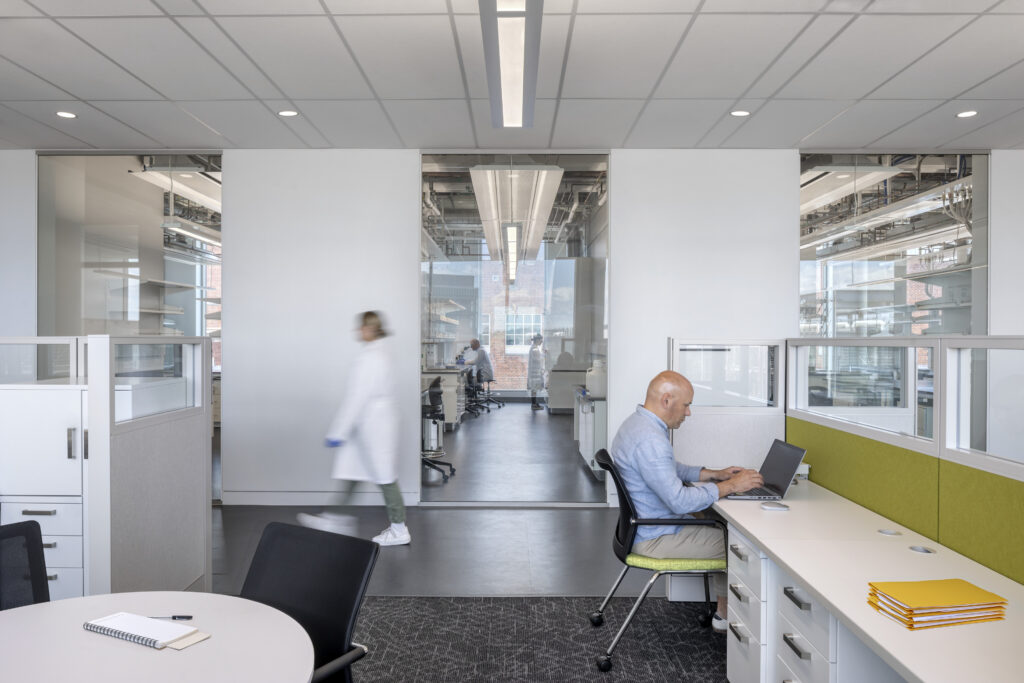
Modern research facilities prioritize natural light and transparent facades to support researcher well-being alongside technical performance. Photo by James Ewing, courtesy of Ballinger.
The emotional dimension of space
Behind every breakthrough are researchers dealing with long hours, high-stakes experiments, and burnout. Some architects are responding by prioritizing well-being alongside technical performance.
Natural light, biophilic materials, and outdoor views are being treated as functional tools for sustaining focus and reducing stress — not amenities. Transparent façades and visually connected work zones bring daylight deeper into floorplates, while social spaces offer decompression.
Sustainability as scientific stewardship
Laboratories are among the most energy-intensive building types. Modern labs are increasingly designed to adjust airflow and energy consumption based on occupancy and activity. Variable air-volume systems throttle down during inactive hours, reducing energy use without compromising safety.
Commissioning is getting more intentional too. Maryland allows time between substantial completion and occupancy to calibrate systems and ensure reliability — measuring success not just at ribbon-cutting but in how well a building actually performs.
Economic and industry pressures
Supply chains for electrical equipment are strained by the explosive growth of data centers and AI infrastructure, leading to long lead times and higher costs. Universities are responding by ordering equipment earlier and building redundancy into critical systems. Labor shortages further complicate projects, especially in regions with limited skilled trades.

Multi-story atrium spaces in contemporary research buildings create visual connections between floors, encouraging interaction among scientists from different disciplines. Photo by James Ewing, courtesy of Ballinger.
The future of interdisciplinary research
The biggest shift in science facilities may be the evolving relationship between physical and digital research. Computational scientists can work anywhere; experimental researchers depend on specialized infrastructure. That imbalance is forcing universities to reconsider how much dry-lab or office space is truly necessary.
Traditional departmental structures — chemistry, physics, biology — are increasingly being augmented with centers and institutes organized around research themes. Architecture plays a role in this shift, providing shared spaces where different disciplines actually overlap rather than just coexist.
Craig S. Spangler, FAIA, is Senior Principal with Ballinger. He can be reached at [email protected].