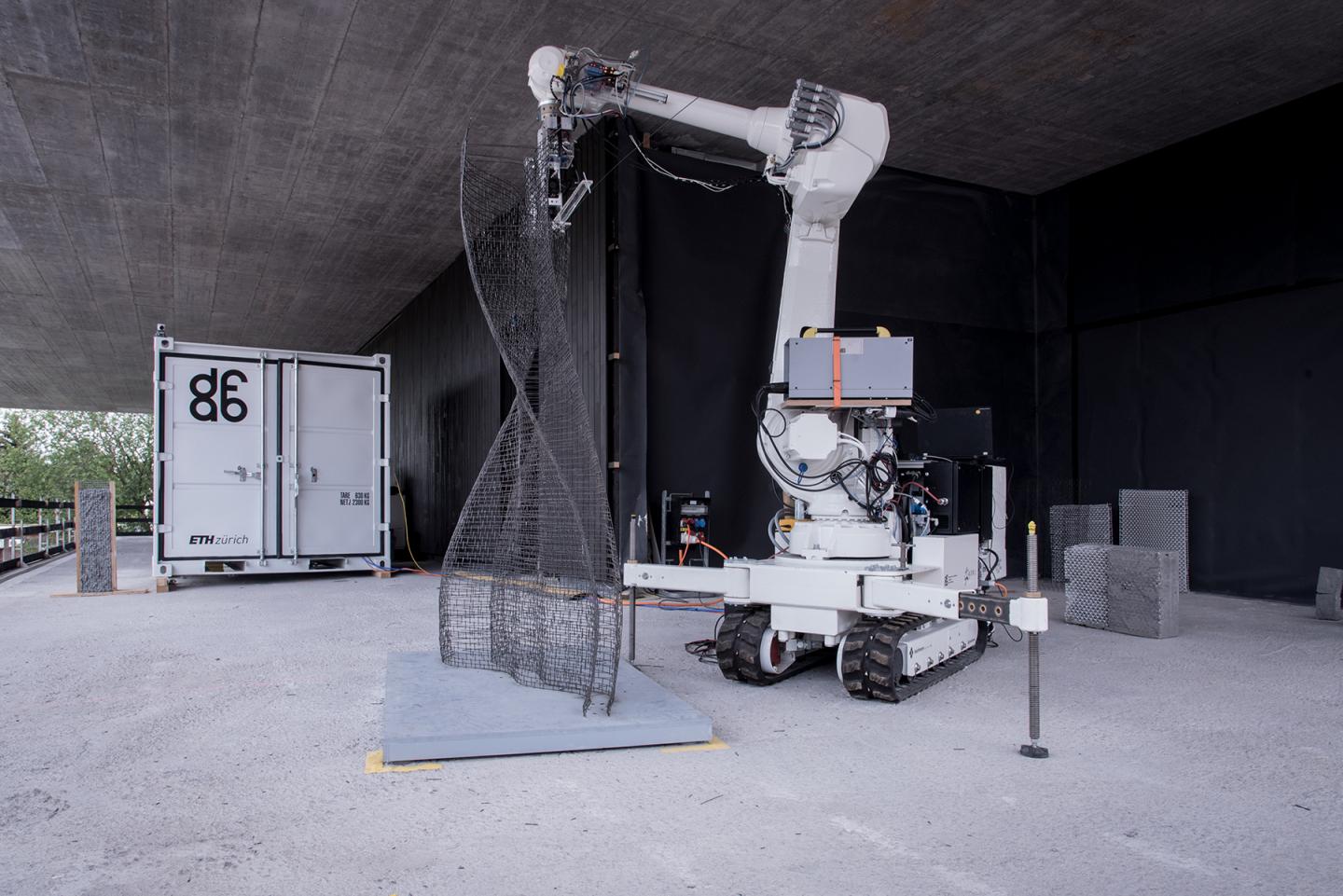
In situ Fabricator (construction robot) is fabricating a doubly curved mesh structure during a fabrication test on the Empa NEST building in Duebendorf, Switzerland. Source: Photo: NCCR Digital Fabrication and ETH Zurich
Many building processes still involve sub-standard working conditions and are not compellingly sustainable. Current research on the integration of digital technologies within construction processes promises substantial contributions to sustainability and productivity, while at the same time enabling completely new forms of architectural expression. The multidisciplinary nature of integrating digital processes remains a key challenge to establishing a digital building culture. In order to fully exploit the potential of digital fabrication, an institutional and funding environment that enables strong interdisciplinary research is required. Traditionally separated disciplines such as: architecture, structural design, computer science, materials science, control systems engineering, and robotics now need to form strong research connections.
During the AAAS 2017 Annual Meeting in Boston, Jonas Buchli, ETH Zurich – The Swiss Federal Institute of Technology in Zurich, Switzerland, Ronald Rael, University of California, Berkeley, U.S.A., and Jane Burry, RMIT University, Melbourne, Australia reveal the latest developments in digital fabrication in architecture at 1:1 building scale. In their presentations, they show digital technologies can be successfully integrated in design, planning, and building processes in order to successfully transform the building industry.
On Site Digital Fabrication for Architecture
Jonas Buchli, Assistant Professor for Agile and Dexterous Robotics at ETH Zurich in Switzerland and principal investigator in the Swiss National Centre of Competence in Research (NCCR) Digital Fabrication is proposing a radical focus on domain specific robotic technology enabling the use of digital fabrication directly on construction sites and in large scale prefabrication. He demonstrates how researchers at ETH Zurich within the NCCR Digital Fabrication – Switzerland’s leading initiative for the development and integration of digital technologies within the field of architecture – are facing the challenge of developing this technology. They bring a comprehensive and interdisciplinary approach that incorporates researchers from architecture, materials science, and robotics. In his presentation, Buchli will provide insight into current research and the future vision and development of the In situ Fabricator, a mobile and versatile construction robot, which in 2017 will be utilized for the first time on an actual building site.
The New Mathematics of Making
Digital computation has freed designers from the constraints of the static 2- and 3- dimensional representational techniques of drawing and physical modelling. Design attributes can be directly linked to extraneous factors: structural or environmental optimization, or fabrication and material constraints. Mathematical design models contain sufficient information even for computer numerical controlled (CNC) fabrication ma-chines and techniques. Jane Burry, Director of the Spatial Information Architecture Laboratory at RMIT University in Melbourne, Australia, explores how these opportunities for automation, optimization, variation, mass-customization, and quality control can be fully realized in the built environment within full scale construction. Burry shows select digital fabrication examples, where research and innovation have changed construction practice. She will draw on prominent case studies such as the design and construction of Antonio Gaudí’s Sagrada Familia.
Building Materials for 3D Printing
Most materials currently used in 3D printing, were developed to print small scale objects. Ronald Rael, Associate Professor for Architecture at University of California, Berkeley, U.S.A., reveals how he is developing new materials that can overcome the challenges of scale and costs of 3D printing on 1:1 construction scale. He demonstrates that viable solutions for 3D printing in architecture involve a material supply from sustainable resources, culled from waste streams or consideration of the efficiency of a building product’s digital materiality. The methods of such architectural additive manufacturing must emerge from interdisciplinary research.