Research & Development World

  • R&D World Home
  • Topics
    • Aerospace
    • Automotive
    • Biotech
    • Careers
    • Chemistry
    • Environment
    • Energy
    • Life Science
    • Material Science
    • R&D Management
    • Physics
  • Technology
    • 3D Printing
    • A.I./Robotics
    • Software
    • Battery Technology
    • Controlled Environments
      • Cleanrooms
      • Graphene
      • Lasers
      • Regulations/Standards
      • Sensors
    • Imaging
    • Nanotechnology
    • Scientific Computing
      • Big Data
      • HPC/Supercomputing
      • Informatics
      • Security
    • Semiconductors
  • R&D Market Pulse
  • R&D 100
    • 2025 R&D 100 Award Winners
    • 2025 Professional Award Winners
    • 2025 Special Recognition Winners
    • R&D 100 Awards Event
    • R&D 100 Submissions
    • Winner Archive
  • Resources
    • Research Reports
    • Digital Issues
    • Educational Assets
    • Subscribe
    • Video
    • Webinars
    • PharmSci360
    • Content submission guidelines for R&D World
  • Global Funding Forecast
  • Top Labs
  • Advertise
  • SUBSCRIBE

DNA Strands Employed to Design New Polymer Materials

By McGill University | December 20, 2017

Image: McGill University

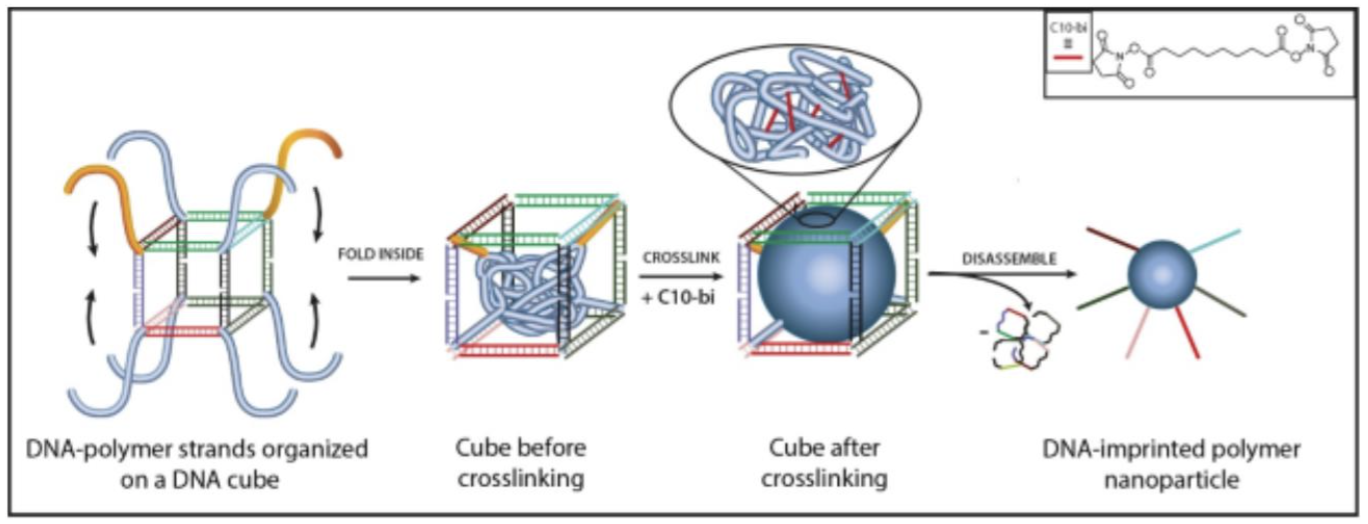
McGill University researchers have chemically imprinted polymer particles with DNA strands — a technique that could lead to new materials for applications ranging from biomedicine to the promising field of “soft robotics.”

In a study published in Nature Chemistry, the researchers describe a method to create asymmetrical polymer particles that bind together in a spatially defined manner, the way that atoms come together to make molecules.

Although polymers are used in everything from clothing and food packaging to 3D printing and electronics, most self-assembled polymer structures have been limited to symmetrical forms such as spherical or cylindrical shapes. Recently, however, scientists have focused on creating non-symmetrical polymer structures — for example, “Janus” particles with two different “faces” — and they are starting to discover exciting new applications for these materials. One example: robotics made with soft, flexible structures that can change shape in response to external stimuli.

The method described in the Nature Chemistry paper “introduces a programmable level of organization that is currently difficult to attain in polymer chemistry,” says McGill Chemistry professor Hanadi Sleiman, senior author of the study. “Chemically copying the information contained in DNA nanostructures offers a powerful solution to the problem of size, shape and directional control for polymeric materials.”

The new study builds on a technique developed in 2013 by Sleiman’s research group to make nanoscale “cages” from strands of DNA, and stuff them with lipid-like polymer chains that fold together into a ball-shaped particle that can contain cargo such as drug molecules.

To take that nano-engineering feat a step further, Sleiman and her PhD student Tuan Trinh teamed up with colleagues at the University of Vermont and Texas A&M University at Qatar. Together, the researchers developed a method to imprint the polymer ball with DNA strands arranged in pre-designed orientations. The cages can then be undone, leaving behind DNA-imprinted polymer particles capable of self-assembling — much like DNA, itself — in pre-designed patterns. Because the DNA cages are used as a “mold” to build the polymer particle, the particle size and number of molecular units in the polymer can be precisely controlled, says Sleiman, who holds the Canada Research Chair in DNA Nanoscience.

The asymmetrical polymer structures could be used eventually in a range of applications, the researchers say.  One potential example: multi-compartment polymer particles, with each compartment encapsulating a different drug that could be delivered using different stimuli at different times. Another possibility: porous membranes that are asymmetric, so they direct molecules along specific paths to separate then.

Funding for the research was provided by the Natural Sciences and Engineering Research Council of Canada, the Canadian Institutes for Health Research, the Centre for Self-Assembled Chemical Structures, the Qatar Research Foundation, and the Canada Research Chairs Program.

Source: McGill University
Related Articles Read More >

Researchers developed quantum nanosensors that can measure the temperature of a single cell
Overcoming the 100-nanometer barrier: New microbottle resonators scale up optical trapping
R&D 100 winner LLNL achieves 1,000x speed boost in 3D nanofabrication
CEA-Leti achieves 400°C CMOS fabrication milestone for 3D chip stacking
rd newsletter
EXPAND YOUR KNOWLEDGE AND STAY CONNECTED
Get the latest info on technologies, trends, and strategies in Research & Development.

R&D World Digital Issues

Fall 2025 issue

Browse the most current issue of R&D World and back issues in an easy to use high quality format. Clip, share and download with the leading R&D magazine today.

R&D 100 Awards
Research & Development World
  • Subscribe to R&D World Magazine
  • Sign up for R&D World’s newsletter
  • Contact Us
  • About Us
  • Drug Discovery & Development
  • Pharmaceutical Processing
  • Global Funding Forecast

Copyright © 2026 Arrowfly LLC. All Rights Reserved. The material on this site may not be reproduced, distributed, transmitted, cached or otherwise used, except with the prior written permission of Arrowfly
Privacy Policy | Advertising | About Us

Search R&D World

  • R&D World Home
  • Topics
    • Aerospace
    • Automotive
    • Biotech
    • Careers
    • Chemistry
    • Environment
    • Energy
    • Life Science
    • Material Science
    • R&D Management
    • Physics
  • Technology
    • 3D Printing
    • A.I./Robotics
    • Software
    • Battery Technology
    • Controlled Environments
      • Cleanrooms
      • Graphene
      • Lasers
      • Regulations/Standards
      • Sensors
    • Imaging
    • Nanotechnology
    • Scientific Computing
      • Big Data
      • HPC/Supercomputing
      • Informatics
      • Security
    • Semiconductors
  • R&D Market Pulse
  • R&D 100
    • 2025 R&D 100 Award Winners
    • 2025 Professional Award Winners
    • 2025 Special Recognition Winners
    • R&D 100 Awards Event
    • R&D 100 Submissions
    • Winner Archive
  • Resources
    • Research Reports
    • Digital Issues
    • Educational Assets
    • Subscribe
    • Video
    • Webinars
    • PharmSci360
    • Content submission guidelines for R&D World
  • Global Funding Forecast
  • Top Labs
  • Advertise
  • SUBSCRIBE