Research & Development World

  • R&D World Home
  • Topics
    • Aerospace
    • Automotive
    • Biotech
    • Careers
    • Chemistry
    • Environment
    • Energy
    • Life Science
    • Material Science
    • R&D Management
    • Physics
  • Technology
    • 3D Printing
    • A.I./Robotics
    • Software
    • Battery Technology
    • Controlled Environments
      • Cleanrooms
      • Graphene
      • Lasers
      • Regulations/Standards
      • Sensors
    • Imaging
    • Nanotechnology
    • Scientific Computing
      • Big Data
      • HPC/Supercomputing
      • Informatics
      • Security
    • Semiconductors
  • R&D Market Pulse
  • R&D 100
    • 2025 R&D 100 Award Winners
    • 2025 Professional Award Winners
    • 2025 Special Recognition Winners
    • R&D 100 Awards Event
    • R&D 100 Submissions
    • Winner Archive
  • Resources
    • Research Reports
    • Digital Issues
    • Educational Assets
    • R&D Index
    • Subscribe
    • Video
    • Webinars
    • Content submission guidelines for R&D World
  • Global Funding Forecast
  • Top Labs
  • Advertise
  • SUBSCRIBE

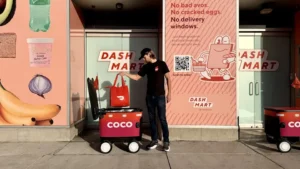
DoorDash and Coco deploy robot fleet with remote operators for urban delivery

By Brian Buntz | April 11, 2025

DoorDash partners with Coco for robot delivery

[Image courtesy of DoorDash/Coco]

San Francisco–based DoorDash has entered the robotics field by launching sidewalk deliveries using Coco Robotics’ remotely-piloted robots in Los Angeles and Chicago, as the LA Times has reported. This initiative represents a pragmatic approach to last-mile automation, utilizing teleoperation rather than pursuing full autonomy for complex city environments immediately. This strategy acknowledges the difficulties of navigating real-world urban logistics—similar to the development path of self-driving cars—by keeping a human-in-the-loop. These remote pilots monitor feeds from cameras and sensors, taking control to navigate unpredictable situations like busy intersections, construction zones, or specific drop-off instructions.

Achieving full sidewalk autonomy remains challenging due to unpredictable pedestrian interactions (including occasional vandalism like kicking or obstructing the robots), navigating obstacles like cracked pavement or missing curb cuts, and handling dynamic clutter. However, the current approach leverages mature technologies: multiple cameras and sensors provide real-time video over reliable LTE/5G to remote operators; efficient batteries enable practical delivery ranges (Coco robots typically handle trips under one mile); and onboard processing manages basic navigation, allowing human pilots to focus on complex maneuvers.

Pragmatism in deployment and multi-modal strategy

DoorDash’s deployment of teleoperated robots, alongside its explorations in drone delivery, signals a move towards integrated, multi-modal delivery networks. Instead of waiting for full autonomy, this approach uses human-assisted solutions like Coco’s to achieve scale in urban areas sooner. This is particularly relevant given the hurdles for full autonomy and the varied, often city-specific regulations for sidewalk robots. Systems with human oversight may find permitting easier in some jurisdictions compared to fully autonomous ones. The focus shifts from perfecting individual autonomous vehicles to developing sophisticated platform software that orchestrates diverse fleets—humans, robots, potentially drones—optimally assigning delivery modes based on factors like distance, order size, weather, and traffic. This contrasts with players like Starship Technologies, pursuing 99%+ autonomy with remote assistance fallback, or Serve Robotics, targeting Level 4 autonomy (handling most situations without intervention) within defined zones.

Coco Robotics has been gaining momentum

Coco, founded in Santa Monica in 2020, is a key partner enabling this scaling. Operating a fleet reported to exceed 1,000 robots, Coco initially partnered with DoorDash’s subsidiary Wolt in Helsinki before launching directly with DoorDash in the U.S. In Los Angeles alone, Coco serves approximately 600 merchants. Their COCO 1 model, co-developed with Segway, features an upgraded drivetrain, larger battery, modular cargo bays (hot/cold), and travels at about 5 mph. Typically handling deliveries within a median distance of one mile, Coco claims its service can save restaurants significantly on delivery costs. Despite completing hundreds of thousands of deliveries across cities like Los Angeles, Chicago, Miami, and Helsinki, Coco robots still face public interference challenges.

This development emerges over a decade after Amazon first publicly showcased its drone delivery ambitions. On December 1, 2013, during a 60 Minutes segment, then-CEO Jeff Bezos revealed the “Octocopter” drone prototype, designed for Prime Air to deliver packages up to five pounds within 30 minutes. While drone delivery exists in limited areas, it has yet to become a standard delivery method.

The current commercialization of robotic delivery relies on readily available technologies: multiple cameras and sensors streaming data over LTE/5G to remote operators, efficient batteries for useful range, and onboard processing for basic navigation and data handling, freeing up human pilots for complex tasks.
Related Articles Read More >

Octopus-inspired robot can change color, grab objects
Grok-5: AGI or battleship Yamato of AI?
Software broke scientific reproducibility. AI hallucinations made it worse. Now the same technology is learning to catch its own mistakes.
Looking around corners: Elsevier’s genAI SVP LeapSpace offers perspective on the future of scientific publishing
rd newsletter
EXPAND YOUR KNOWLEDGE AND STAY CONNECTED
Get the latest info on technologies, trends, and strategies in Research & Development.
RD 25 Power Index

R&D World Digital Issues

Fall 2025 issue

Browse the most current issue of R&D World and back issues in an easy to use high quality format. Clip, share and download with the leading R&D magazine today.

Research & Development World
  • Subscribe to R&D World Magazine
  • Sign up for R&D World’s newsletter
  • Contact Us
  • About Us
  • Drug Discovery & Development
  • Pharmaceutical Processing
  • Global Funding Forecast

Copyright © 2025 WTWH Media LLC. All Rights Reserved. The material on this site may not be reproduced, distributed, transmitted, cached or otherwise used, except with the prior written permission of WTWH Media
Privacy Policy | Advertising | About Us

Search R&D World

  • R&D World Home
  • Topics
    • Aerospace
    • Automotive
    • Biotech
    • Careers
    • Chemistry
    • Environment
    • Energy
    • Life Science
    • Material Science
    • R&D Management
    • Physics
  • Technology
    • 3D Printing
    • A.I./Robotics
    • Software
    • Battery Technology
    • Controlled Environments
      • Cleanrooms
      • Graphene
      • Lasers
      • Regulations/Standards
      • Sensors
    • Imaging
    • Nanotechnology
    • Scientific Computing
      • Big Data
      • HPC/Supercomputing
      • Informatics
      • Security
    • Semiconductors
  • R&D Market Pulse
  • R&D 100
    • 2025 R&D 100 Award Winners
    • 2025 Professional Award Winners
    • 2025 Special Recognition Winners
    • R&D 100 Awards Event
    • R&D 100 Submissions
    • Winner Archive
  • Resources
    • Research Reports
    • Digital Issues
    • Educational Assets
    • R&D Index
    • Subscribe
    • Video
    • Webinars
    • Content submission guidelines for R&D World
  • Global Funding Forecast
  • Top Labs
  • Advertise
  • SUBSCRIBE