 “Will self-driving ‘robot labs’ replace biologists?” That was the headline Nature ran on February 18, reporting on a preprint from Ginkgo Bioworks and OpenAI that used GPT-5 to help design and execute more than 36,000 cell-free protein synthesis experiments. The authors report that the experiment beat the prior state of the art by 40%, but that isn’t to say that AI is singlehandedly responsible for all of the gains. Or that AI and digital models are poised to automate biology writ large.
“I don’t think we’ll ever get to a point where we don’t need wet lab experimentation,” Ginkgo co-founder Reshma Shetty said in an interview with R&D World. “This is actually a pretty controversial topic in science Twitter circles.”
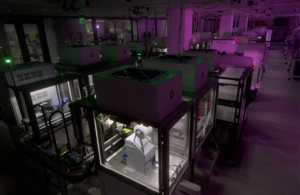
But the result itself is striking, even if it comes with caveats about what the AI actually did versus what the humans around it provided. The headline result: GPT-5, connected to Ginkgo’s robotic cloud lab in Boston, produced superfolder green fluorescent protein at $422 per gram, versus $698 per gram reported by a team led by Michael Jewett. A 40% cost reduction and a 27% titer increase, achieved over six iterative rounds and roughly 150,000 data points in six months.
While GPT-5 played a clear role, so did humans. The Ginkgo and OpenAI collaboration was based on a considerable amount of brainstorming and planning. “The overall scientific direction and objective were conceived of by humans,” Shetty said. “We sat down with OpenAI and brainstormed different problems that we could tackle, and ultimately decided on cell-free protein synthesis.” Shetty also notes: “Humans are still good at picking the scientific questions and problems that we should go after.”
Humans set up the experimental constraints. “We decided where to deploy GPT-5 in terms of experimental design,” she said. A team decided to use GPT-5 to explore different reaction compositions and optimize on dollars per gram of protein. “So setting up the overall scientific objective and experimental guardrails was done by humans up front,” she added. “But then the details of experimental design were done by GPT-5. And execution of the experiments was done by the autonomous lab.”
The biggest performance jump came in the experiment’s Step 3, when the team simultaneously gave GPT-5 access to the internet, a computer and data analysis tools. The Jewett lab’s own preprint describing the very benchmark they were trying to beat. At the same time, the Ginkgo team switched to an improved DNA template and upgraded their cell lysate preparation, which the paper acknowledges: “Together, these changes, along with improvements to the DNA template and cell lysate, enabled a jump in performance.”
Jewett, whose record GPT-5 nominally broke, told Nature the resulting recipe is “broadly similar” to his own. He noted it’s difficult to know how much his lab’s published work helped GPT-5 design its experiments.
Still, the data were unambiguous: of the 480 plates GPT-5 designed across all six steps, the team “only discovered 2 plates with fundamental design flaws post execution.” In one, the model tried to overwrite a fixed buffer volume to free up space for other reagents; in the other, a unit-conversion bug in GPT-5’s code produced plates containing only glucose and ribose. Pydantic, a Python data validation library, provided a validation layer that constrained the model to physically executable experiments. In the end, the experiment yielded more than 29,000 unique reaction compositions versus Olsen’s 1,231.
Before GPT-5 had access to the internet or Jewett’s preprint, it independently proposed replacing expensive NTPs with less-expensive NMPs, the same reagent swap that turned out to be central to Jewett’s cost breakthrough. “Even without access to the preprint, the model was able to anticipate that improvement,” Shetty said.
That finding was among the strongest evidence in the study that an LLM in a wet lab experiment was doing something beyond sophisticated parameter search. But Shetty framed it carefully: the model suggested the swap, but the big leap forward came only after the team “took the gloves off,” handing GPT-5 the published state of the art, internet access, and better raw materials all at once.
“When we first started this project, we didn’t know if GPT-5 could design a cell-free protein synthesis reaction at all,” Shetty said. “It wasn’t a foregone conclusion that it could design an experiment, let alone one that actually works when run in the lab.”