Since the 1990s, scientists across fields have used electronic lab notebooks to record data and take notes. Before that, they used paper records. Now, the next generation of lab notebooks is emerging: AI ELNs.
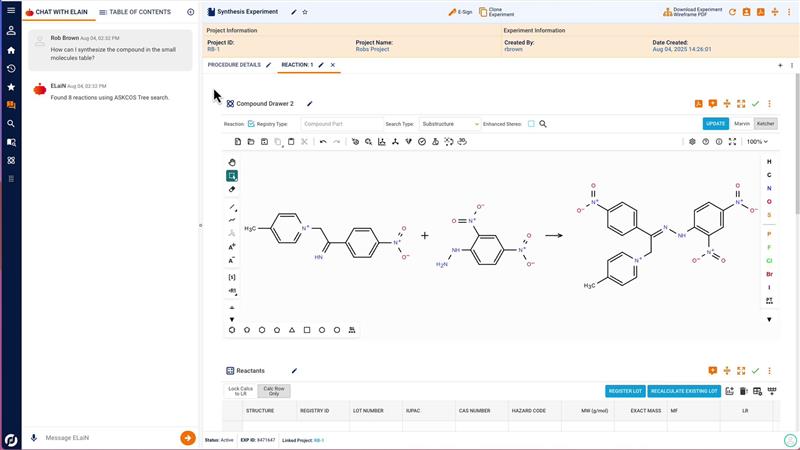
Sapio Sciences’ ELaiN allows scientists to ask questions in natural language. Credit: Sapio Sciences
AI ELNs, sometimes called AILNs, are ELNs with generative AI tools and features built into the user interface. These new programs could speed up the scientific process and allow scientists to ‘chat’ with their notebook through natural language, similar to using a chatbot.
The technical barrier
With a traditional ELN, scientists need to learn each system’s specific interface and workflows. You might need to navigate through several menus, export to Excel or write SQL queries or wait for bioinformatics support. Some scientists even become proficient in languages like Python, R and SQL. This could be a large barrier to experimentation that AI ELNs could remove.
“If I, as a scientist, want to do something in the ELN, I have to take what I want to do and I have to translate it to the software,” Rob Brown, Head of Scientific Office at Sapio Sciences, said, “AI lab notebooks can take that away.”
AI ELNs feature a large language model that knows how to communicate with the software and that the scientist can communicate with in natural language. This could decrease the timeline of scientific discovery by reducing the amount of time scientists need to learn new coding languages. What scientists love most, Brown explained, is getting what they need out of their ELN quickly so they can get back to the lab. AI ELNs could help them do so by quickly extracting the data and analyzing it through natural language, allowing the scientist to get the insights they need to design the next steps of their experiment.
Improving experiment efficiency and quality
“Research is always a cycle,” Brown said, “If you want to go faster, either you go around the cycles faster or you can design better experiments and do less cycles.”
AI ELNs could help scientists do both. An LLM could help design more focused experiments, improving the quality of results and reducing the number of mistakes. It could also decrease the timeline by providing knowledge and expertise in a matter of moments.
Integrating AI into ELNs could also increase the level of activity and interaction between scientists and their lab notebooks. Currently, scientists have to pull the relevant information from their ELN and use it to make decisions. With an LLM, scientists could ask questions in natural language and receive insights and suggestions from the AI ELN. Where an ELN is passive, an AI ELN can be an active participant in the scientific process.
Shifting the balance
“It’s going to change the balance between how much experimentation and how much in silico is done,” Brown said, “The whole dynamic of discovery changes. You’ll explore more ground in silico before you go into the lab.”
AI ELNs are also going to democratize the in silico part of the research and join it to the wet lab, Brown said. In silico and lab processes have always been somewhat separate, with scientists bridging the gap. “It’s the first time I think you can actually see a future where they are just seamless,” he said.
This could also save money, as experiments in the lab are more expensive than simulations. Doing more in silico experiments through computer simulations can make these simulations more powerful, precise and efficient.
ELaiN
AI ELNs, like Sapio’s ELaiN, could become a sort of co-scientist, a concept companies like Google are also exploring. “It’s like your head of med chem or bioinformatics over your shoulder,” Brown said.
Sapio’s ELaiN is an AI co-scientist that “accelerates discovery, automates the grind, and frees scientists to focus on breakthroughs,” according to Sapio’s website. ELaiN can build an experiment based on a Standard Operating Procedure file; plan, document and optimize an experiment; and perform a BLAST search, multisequence alignment and codon optimize it.
“We built a single platform and a common, flexible data model,” Brown said, “One of the things that makes Sapio unique is that we don’t actually have a separate ELN and LIMS (laboratory information management system).”
“If I’d had access to this, I would have been a much better scientist, so much quicker,” Brown said. He’s excited to see what people are going to do with ELaiN, he added.