Interphex 2026 brought over 600 exhibitors to the Javits Center in New York City this week. Among the hundreds of vendors, a few themes emerged: AI and automation, digitalization and sustainability.
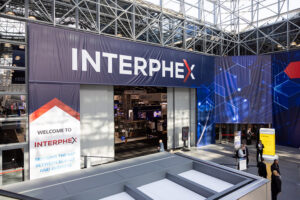
Credit: Interphex
The show indicated that discussions around the digital transformation are turning into action. “I think we’re seeing the transition of the discussion around digital transformation and Pharma 4.0 start to turn into actual checks being written,” said Matt Weaver, global VP of Life Sciences at Rockwell Automation.
AI and automation
Rockwell Automation showcased its AI-driven analytics and OTTO Autonomous Mobile Robots (AMRs), which are designed to help close the gap between data visibility and execution. The robots have helped companies decrease labor by up to 20%, saving more than $1 million annually and achieving an internal rate of return of over 50%, according to Rockwell.
Korber Pharma showed their AI-driven visual inspection system, which is able to distinguish defects from abnormalities like bubbles, reducing the amount of product that is discarded due to false positives. This could be especially important for high-value biologics like GLP-1s.
“The product is so valuable that you don’t want to lose one for the wrong reasons… [AI] allows us to reduce the so-called false rejects to almost zero,” said Jurgen Krebs, CRO of Körber. The system also continuously learns to better interpret the images, he added.
Digitalizing legacy paper systems
At the show, Rockwell introduced an AI-powered tool designed to digitize legacy paper records and automatically convert them into electronic recipes for the manufacturing execution system (MES). The AI conversation agent ingests paper batch records, interprets each step and maps it onto MES building blocks and then outputs a nearly complete electronic recipe. This could eliminate 30% to 40% of the time spent in recipe creation, Weaver estimates. Once the data is digitized, it can be reused across the lifecycle, instead of being constantly recreated on paper.
MasterControl featured its AI-enhanced Manufacturing Excellence (Mx) platform, which is designed to eliminate the paper lag in tech transfer. The system enables paperless data entry and documentation and reduces data input errors and deviations. The Mx platform includes digital production record management, integrated calibration and equipment maintenance and recipe and variant management.
MasterControl also has AI-enabled tools for Quality Excellence (Qx), which features a quality event summarizer. MasterControl’s SOP analyzer and regulatory chat use AI to check procedures and documents for compliance issues.
Decentralized, point-of-use manufacturing
On the manufacturing side, vendors emphasized decentralized, portable tools. Two such tools won Interphex Exhibitor Awards: the Krakatoa K500 and the Versaweld.
The Krakatoa is described as the “Nespresso for bioproduction.” It produces up to 500 liters of GMP-grade media on-site in under three hours. It won the Best in Show award. Each pod contains a pre-formulated powdered media or buffer; once the pod is loaded and single-use tubing is connected, the instrument scans an integrated QR code and automates powder hydration, mixing, sterile filtration and final dispensing in a closed environment.
Ensorcell’s Versaweld won Best New Product. It is a nine-pound, battery-powered sterile tube welder that allows for flexible operation without being tethered to a power source. The platform performs approximately 30-second sterile welds—dry-to-dry, dry-to-wet, and wet-to-wet—without disposable blades. Instead, it uses a specialized stainless steel ribbon housed in a patent-pending cassette that supports up to 120 continuous welds. The auto-feeding ribbon reduces sharp waste and eliminates the risks associated with handling and disposing of blades.
An emphasis on sustainability
Several vendors showcased their latest sustainability advancements. TITAN debuted its Horizon solar-powered cold storage, which uses vacuum-insulated panels and low global warming potential (GWP) refrigerants. The refrigerants used have a GWP of 0.5, compared to the GWP in previous models, which was about 2,000.
“We’ve actually reinvented the technology from the ground up… even if you’re not using the solar, the unit itself is 55% more efficient,” said Aaron Shovlar, director of business development at TITAN.
The model works even with limited sun, as it is designed to capture sun from the top and bottom of the panels. Sunlight hits the white roof of the unit and reflects onto the back of the tilted panels, allowing for power even on cloudy days.
MECART released a peer-reviewed Life Cycle Assessment (LCA) showing that its modular cleanroom systems produce 33% fewer greenhouse gas emissions than North American averages on April 22, during Interphex.
The IMA Group featured its KryoAir technology, which won the Best New Product Award at Interphex 2024. The product uses air as a natural refrigerant, cooling it to as low as minus 100 degrees Celsius for industrial freeze-drying.
Vendors at Interphex this year were largely focused on using AI to finally move away from paper systems once and for all. There was also a clear enthusiasm around using AI for data analytics, collecting and using data in ways that have not previously been possible. Several products showed movement towards decentralization in manufacturing and sustainability, particularly in cold storage, which is vital for pharmaceutical applications as well as other uses.