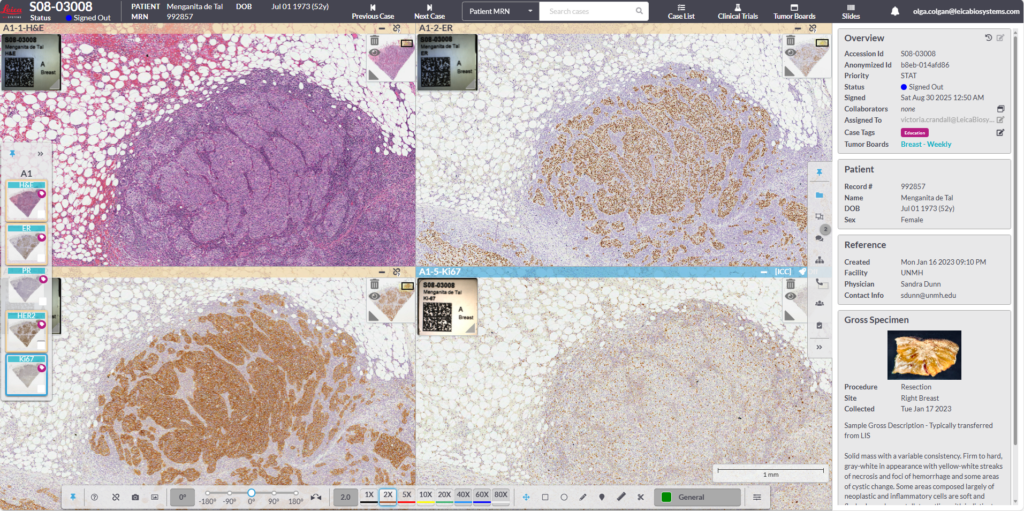
Digital pathology enables high-resolution imaging of slides, allowing users to zoom in and align images side-by-side for more effective comparison across tissue sections and IHC markers. (Credit: Leica Biosystems)
Digital pathology matured quickly during the pandemic, when remote work needs and temporary FDA enforcement discretion lowered the perceived barriers to whole-slide imaging. Capital followed. Roche’s May agreement to acquire PathAI for up to $1.05 billion, pending closing, is only the most recent sign of how much money is chasing the field. The most valuable unlock may still be ahead: teaching software to read a slide and quantify the biomarkers that decide which cancer patients get which drugs.
“What AI does is drive consistency and put a quantitative layer on top of the expert pathology review,” said Karan Arora, SVP of Advanced Assays, AI, and Pharma Partnerships at Leica Biosystems. He sees the pathologist’s role shifting. “Today you manually look at the slide under a microscope, estimate the tumor percentage, and figure out the cutoff,” Arora said. The AI, in his account, takes over that first read and hands the pathologist a quantitative result to confirm.
An open store on a workflow Leica owns

Karan Arora
Leica is laying the groundwork for that shift in digital pathology infrastructure. In late May, Leica Biosystems, a Danaher company, joined the digital-pathology software maker Indica Labs and the Seoul-based AI cancer-diagnostics company Lunit to develop AI image-analysis algorithms for PD-L1 and other immunohistochemistry (IHC) biomarkers used in cancer research.
The collaboration’s first product, Lunit SCOPE PD-L1 CAL10 NSCLC, a scoring algorithm built for Leica’s PD-L1 primary antibody (CAL10), is already available through Leica’s Aperio AI Store. The collaboration combines Leica’s PD-L1 IHC assay and Aperio GT 450 scanner, Indica Labs’ Aperio HALO AP image-management software, and Lunit’s SCOPE algorithm into one workflow. The aim is to cut the variability of manual biomarker scoring under a microscope.
Leica owns the workflow end to end. Arora said Leica holds “a large equity position” in Indica Labs, following a January 2025 strategic investment that paired Leica’s Aperio scanners with a customized version of HALO AP. Building on Indica’s image-management system, it created a clinically validated version it distributes exclusively for clinical use, spanning core histology, the sectioning and priming of samples, through staining to visualization on its scanners. The Aperio AI Store sits on top of that layer, giving Leica a way to host third-party algorithms inside its installed workflow.
Other AI algorithms can plug into Leica’s integrated pipeline through standard software development kits and APIs, whether they come from Lunit, the Hamburg-based pathology-AI firm MindPeak, Indica’s own tools, pharma companies, or large commercial and clinical labs. “So what you’re controlling for is standardization and the end-to-end workflow, while still building an open, best-of-breed environment through the app store,” Arora said. He described a revenue-share model in which third-party developers reach customers through Leica’s installed base.
Reading a slide once, the same way everywhere
The open-platform pitch only holds if the scoring underneath can be trusted, and PD-L1 is where Arora makes the case. “Today’s scoring still has meaningful disagreement, inter-observer variability. If you and I are both pathologists, we have different experiences of how we read these slides, and there are binary cutoffs today for PD-L1, at 1% and 50%, that make someone eligible for therapy, and not just for therapy but for the sequence of treatment, whether it’s chemotherapy then therapy with an ADC, or an ADC straight on. That matters, because if you don’t do it the right way the first time, it affects how the patient is treated and their outcome. If you do the analysis, you may set a different cutoff than I would, which means the treatment paradigm for that patient would vary.”
The answer to that variability is to read the slide once and read it the same way everywhere. “We scan that slide into a whole-slide image, the AI does the first analysis and gives you a quantitative read of tumor presence, and you, as the pathologist, combine that insight with your own observation.” The approach reduces inter-observer variability, providing consistent reads between readers, objective and reproducible results. “You can standardize interpretation across sites,” Arora said. It also reduces the variability between centers “because the expertise is in the whole-slide image read by AI, which doesn’t care where it’s being read,” he added.
Reimbursement, and a vertically integrated rival
Despite its consistency advantages, adoption of digital workflows remains early. In its 2024 Practice Characteristics Survey, the College of American Pathologists (CAP) reported that 28% of practice leaders said their practice digitizes slides with whole-slide imaging, up from 20% in 2022, while 10% reported pathologists using remote sign-out for primary diagnosis. Citing CAP’s data, Arora put it plainly: “We’ve made meaningful progress in digital and computational pathology, but it’s not at scale. We’re still in the first innings of this game.”
But adoption could build, Arora said, because of growing traction for computational companion diagnostics. “You’re seeing the emergence of the first computational CDx biomarkers.” Arora notes that this development could force clinical utility in the lab, which could translate into reimbursement for computational pathology. “And reimbursement has been the single biggest barrier to uptake, massive capital investment with no upside in reimbursement,” Arora said. “Now, with reimbursement coming, the clinical need, and the exposure of precision therapies, you’re in a perfect storm that’s driving adoption.” At ASCO this year, Arora said, the new therapies on display increasingly arrive paired with biomarkers that will require computational scoring to guide their use.
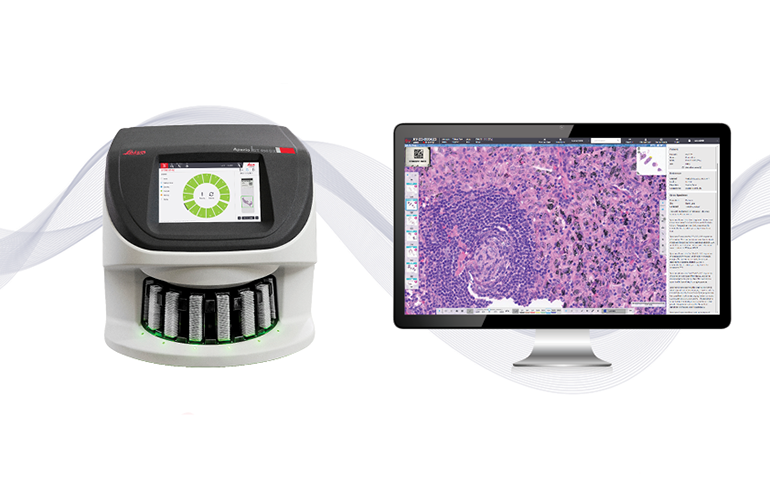
The Aperio GT 450 DX scanner (left) and the browser-based Aperio HALO AP DX image-management software, the FDA-cleared clinical digital pathology workflow Leica Biosystems and Indica Labs launched in the U.S. in March 2026. (Leica Biosystems)
The first computational-pathology companion diagnostic to receive FDA Breakthrough Device Designation, the VENTANA TROP2 (EPR20043) RxDx, is Roche’s: the FDA granted the designation in April 2025, which Roche called the first such designation for a computational-pathology CDx. The device selects previously treated, advanced or metastatic non-squamous NSCLC patients for datopotamab deruxtecan (Dato-DXd), the TROP2-directed ADC from AstraZeneca and Daiichi Sankyo, and it runs AstraZeneca’s Quantitative Continuous Scoring algorithm. Arora credits the biomarker to AstraZeneca, while the productized diagnostic runs through Roche’s own diagnostic stack: navify Digital Pathology, Roche scanners, the Ventana assay and BenchMark ULTRA staining. That gives Roche a vertically integrated CDx implementation, even as Roche also markets navify as an open environment for third-party algorithms.
Ultimately, pharma wants the best tool for each biomarker, and labs want one integrated workflow, Arora said. “We’re creating something where the algorithms are swappable and scalable while the workflow stays consistent and standardized, with our quality behind it.”
Regulatory status: Lunit SCOPE PD-L1 CAL10 NSCLC, Leica’s PD-L1 IHC assay platform and Aperio GT 450 are for research use only and not for diagnostic procedures. Aperio HALO AP is CE-IVDR marked for in vitro diagnostic use in Europe, the UK and Switzerland, while in the U.S. it is research-use-only and not FDA cleared for clinical diagnostic use.