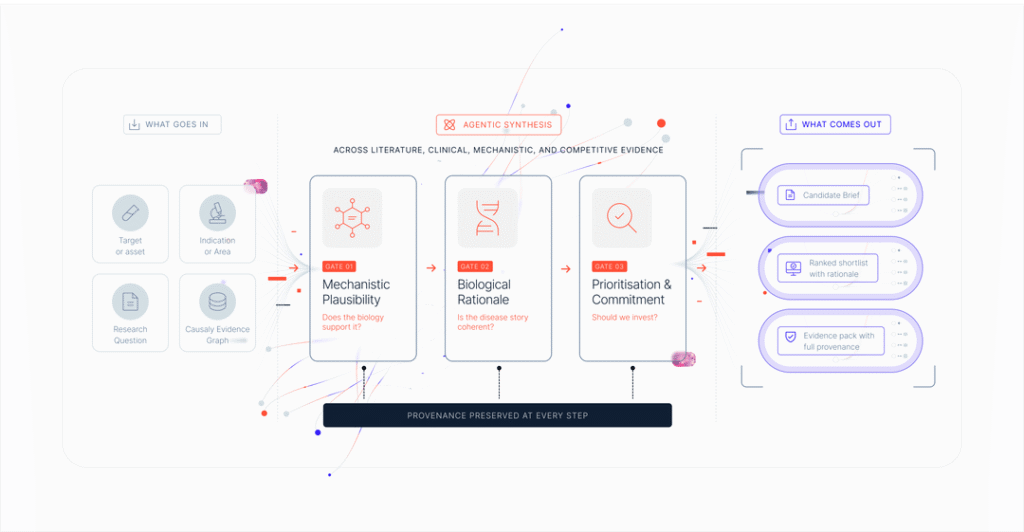
Causaly’s “Scientific Workflows” diagram lays out how the platform moves from inputs such as a target and a research question through three evidence gates, mechanistic plausibility, biological rationale, and prioritization, to a ranked shortlist with the provenance preserved at each step. (Credit: Causaly)
At Microsoft Build 2026, the software giant’s annual developer conference, held June 2 and 3 in San Francisco, the life sciences AI company Causaly announced a collaboration with Microsoft aimed at one of drug discovery’s earliest and most consequential decisions: which biological targets are worth pursuing. Causaly runs an agentic AI platform that reads across the external scientific literature and a customer’s internal data, then interprets what it finds through curated biomedical knowledge graphs. It is one of a fast-growing cluster of companies selling AI-enabled scientific evidence tools, lab-data platforms, and agentic R&D workflows. Its claimed edge is that scientists can see the reasoning. “Everything needs to be inspectable,” co-founder and CEO Yiannis Kiachopoulos said. “You don’t want black boxes.”
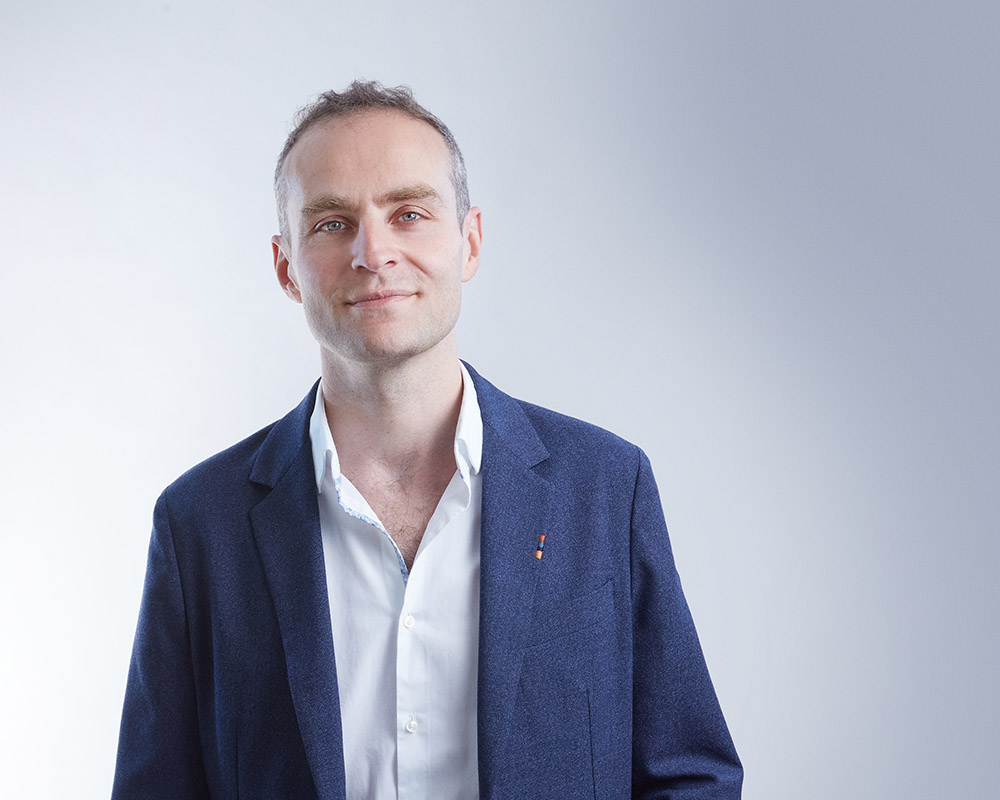
Yiannis Kiachopoulos
In terms of the product split, Microsoft Discovery produces the computational signal, Causaly judges whether it is worth believing. Aseem Datar, the Microsoft Discovery executive who leads product innovation, described Causaly in the announcement as the layer that determines “whether these insights are biologically meaningful and consistent with an organization’s existing use cases and institutional knowledge.” Microsoft brings the infrastructure layer: enterprise data, governance, high-performance computing, and eventually quantum. The goal, Kiachopoulos said, is to move “from data to signal, and then from signal to insight.”
Causaly supplies the prior knowledge meant to determine whether a given signal is biologically plausible and worth acting on. “One of our core competences in the market is the scientific interpretation of information and data,” Kiachopoulos said. “You think about what is known outside, what you know from your internal data, and then you start connecting the dots and interpreting.” That premise traces to the company’s founding in 2018, when Kiachopoulos and co-founder Artur Saudabayev, who had met at Singularity University in California, set out to teach machines to read the scientific literature far faster than any human and pull out the cause-and-effect relationships buried in the text. The name followed from that goal. The biomedical knowledge graphs and the agentic platform built on top of them are the architecture that grew out of it.
The broader agentic push is heating up in life sciences
Causaly is entering that Microsoft partnership from a crowded position in the life sciences AI market. BenchSci, BenevolentAI, CAS, Clarivate, Elsevier, Dotmatics and IQVIA all sell overlapping pieces of the same ambition: helping R&D teams search, structure, interpret or act on biomedical evidence. Causaly’s narrower claim is that it can serve as an inspectable interpretation layer between computational output and a scientist’s next decision, especially when the question is which target, biomarker or candidate deserves scarce experimental capacity. The stakes there are not abstract: when Bayer researchers tried to reproduce the published data behind 67 of their own drug-target projects, the in-house results matched only about a quarter of the time.
A similar agentic pattern is also moving downstream into clinical development: Veeva is pitching Falcon for document intake and quality control, health-authority correspondence and safety case triage; Medidata is positioning Dot around trial risk and next-best actions and ConcertAI is applying agentic oncology AI to trial matching through CancerLinQ.
Why drug discovery resists the coding playbook
Causaly’s focus is on the knowledge work wrapped around a target decision, the reading and ranking an agent can do faster than any person, up to the point where the biology demands proof. Whether to chase a given target turns on mechanistic biology, feasibility, epidemiology, and market size, and as Kiachopoulos put it, “those are all knowledge questions.” The platform can propose and rank hypotheses for a scientist to weigh. It cannot confirm them, though, the way an agent writing code can run a unit test and watch it pass. “In biomedicine you have a non-verifiable system,” he said. “The system produces an idea, say five or 500 ideas, but it can’t verify them itself. You have to go into the lab, run an assay, run an animal experiment.”
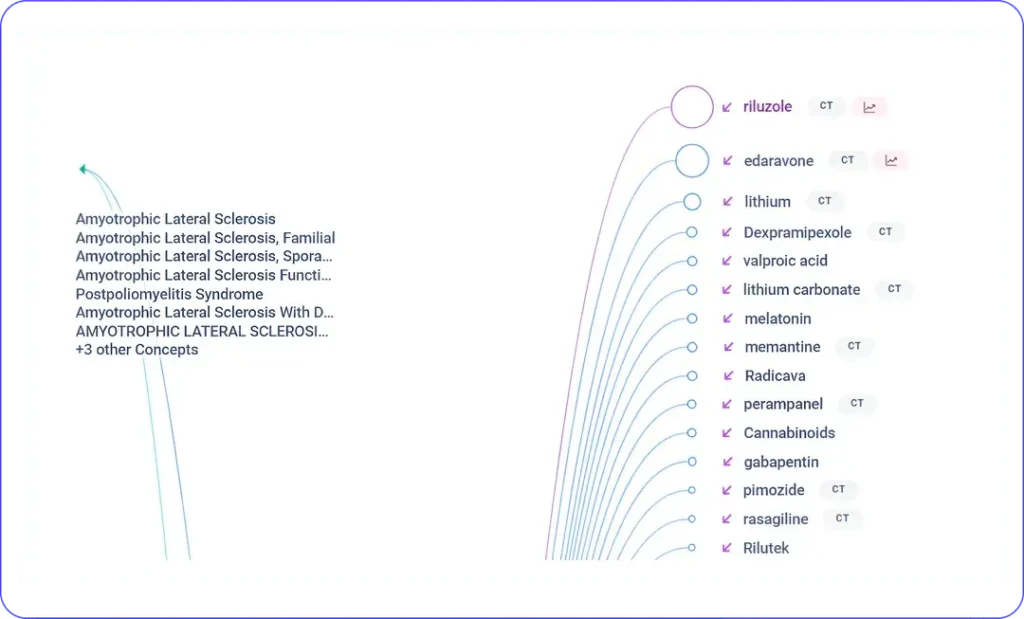
A view of Causaly’s Bio Graph centered on amyotrophic lateral sclerosis, with directional links to drugs studied against it, from approved therapies like riluzole and edaravone to candidates such as lithium and memantine. (Credit: Causaly)
Two graphs and an agent on top
The reasoning that precedes all that lab work runs on two knowledge graphs. The first, which Causaly calls its Bio Graph, maps drugs, targets, diseases and pathways together across what the company says are 70 million directional relationships. “You can see what up-regulates or down-regulates what,” Kiachopoulos said. That graph is intended to shed light on mechanistic biology and the use cases around it, including target identification, biomarker discovery and on-target safety. The second, the Pipeline Graph, focuses on competitive intelligence. “It captures what company is working on which drug, on what target, and in what phase,” Kiachopoulos said. The data in that graph includes scientific data as well as press releases and other non-peer-reviewed sources.
These knowledge graphs sit in the background, and on top of them is Causaly’s agentic AI platform. “It uses those graphs, plus internal data from our customers, to interpret information and solve problems,” Kiachopoulos said. One problem area is interpretation itself. Another is search and synthesis, work Causaly did before the Microsoft partnership and is known for: “how you find information inside an enterprise and outside, how you summarize it scientifically, and how you make it transparent, verifiable, and trustworthy for scientists. We already do that for many of our large pharma and life sciences customers.”
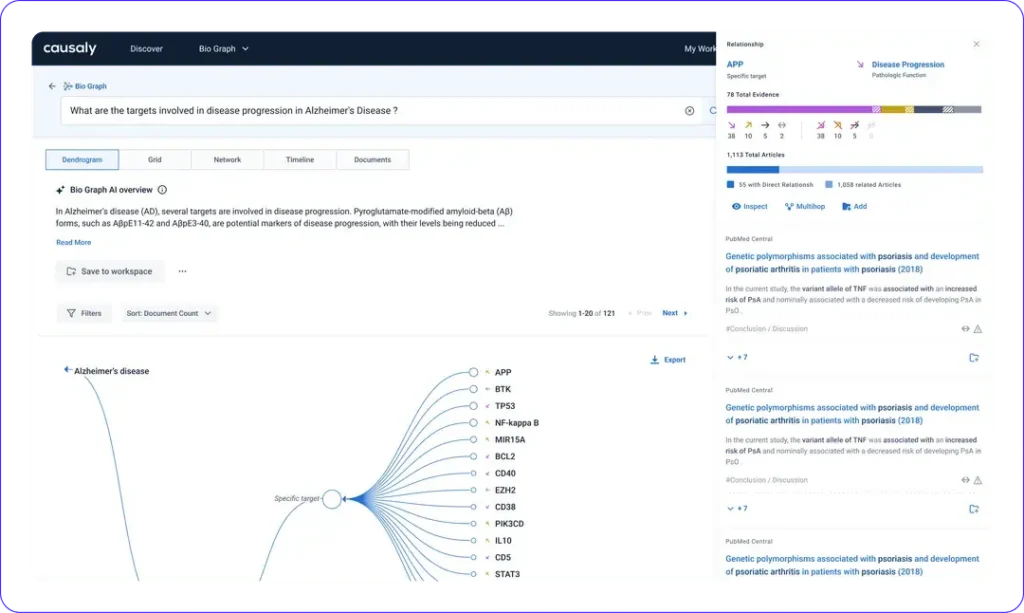
The Causaly interface answering a plain-language query, “what are the targets involved in disease progression in Alzheimer’s disease?”, with a ranked list of targets including APP, BTK and TP53. The panel at right traces a selected relationship back to its underlying evidence, here 78 supporting items drawn from more than 1,000 articles, the kind of sourcing the company points to when it argues its outputs are inspectable rather than black boxes. (Credit: Causaly)
The parts of a drug program AI can speed up
AI helps on two axes, Kiachopoulos said: speed, and the success rate, “being not just faster but more right than wrong.” The constraint is that only part of drug development is the kind of work AI can touch. A cardiovascular trial “will take months or years,” he said, and “AI can’t speed that up materially.” You wait to see whether a drug works.
What compresses is the knowledge work, the analytical layer that sits on a program’s critical path: building a baseline of what’s known, drafting protocols, reviewing safety, selecting candidates. Causaly’s agentic platform automates much of that, according to Kiachopoulos, shaving days or weeks off steps like protocol design and pulling in a trial’s start date. What it does not automate is the call on what to pursue. “Hypotheses cannot be automated, and they should not be,” he said. “You need a judgment loop there, for scientists to decide where to place their bets.”