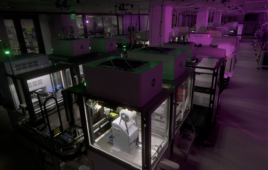
Elsevier, founded in 1880, is going all in on AI and data. In addition to publishing, Elsevier now offers several databases, learning resources and AI tools all aimed at supporting researchers. The latest release in this vein is a new AI-powered search engine for its chemistry database, Reaxys, which represents a fresh take on its mission to “advance human progress together,” as it notes on its website.

Credit: Elsevier
Elsevier reveals an AI search for its chemistry database
Reaxys contains 121 million data points, including 46 million patents as well as articles and other content. The database is searchable by keyword or drawn molecule structures, and now natural language queries, thanks to generative AI. “Reaxys AI Search avoids the need to construct complex keyword searches,” as a press release put it.
The new AI search is designed to improve the precision and recall of results, said Mirit Eldor, managing director of life sciences at Elsevier. The feature will also allow non-expert users to search the database more easily.
“With this wealth of information, no matter how many filters you build for the keyword searches, there’s always more in there. When it comes to going very deep or sometimes going more broad, there’s only so much that you can do with a structured search,” Eldor said. The AI search is designed to fill this gap.

Mirit Eldor, Managing Director, Life Sciences, Elsevier
The new AI search levels up the relevancy, quality and speed of the results, Eldor said. “You can get to answers much quicker, and that frees up time for other higher-value tasks,” she added.
Reaxys AI Search is still in its infancy, and plans for new features are already in the works. “We want to add summaries,” Eldor said, “We are also looking at adding follow-up questions and AI-generated suggestions to users.”
Elsevier is also working on integrating the AI search into an intuitive interface with the existing search options to enable an easier user experience.
Reducing hallucinations and gaining trust
At this point, hallucinations are still a large concern with LLMs — especially more general-purpose models with widely divergent training data. Elsevier took measures to prevent inaccurate results in its AI search. The model can only retrieve information from the Reaxys database; it has no access to the web, said Eldor. The search results are also accompanied by a confidence score, indicating to users how reliable they are.
The company has responsible AI principles, including a requirement to always have a human in the loop. To this end, Elsevier has a team of experts as well as LLMs continually testing the model.
While there are exceptions like random-forest-based models, many AI systems are something of a black box, leaving users, and even AI specialists, somewhat ignorant about their decision-making processes. At Elsevier, one of their responsible AI principles includes explainability and transparency around their AI solutions.
“In every AI solution that we launch, we explain exactly what we are doing there and how it works,” Eldor said, “It shouldn’t ever be a closed box.”
Elsevier: ‘AI helps us do what we’ve always wanted to do better’
Many are worried about jobs being replaced by artificial intelligence. Lists from sources such as Forbes, Newsweek and more are ranking jobs most likely to be replaced. Eldor has a different view.
“I don’t think AI will replace people. I think AI will help people work better,” she said, “I think AI helps us do what we’ve always wanted to do better.”
Over Elsevier’s 180 years, several technological advancements emerged that changed how knowledge was gathered and disseminated. These advancements made the collection and spreading of knowledge easier and faster, and Eldor thinks AI will do the same.
AI will allow scientists to spend less time on the manual processing of information and more time investigating, according to Eldor.
“For us, new technologies have always been a blessing,” she said, “a way to help our customers better.”