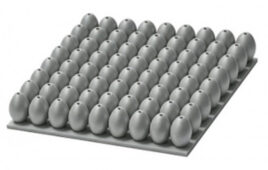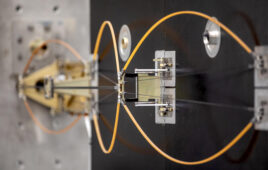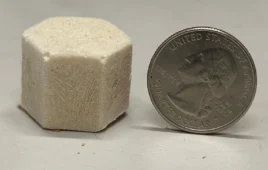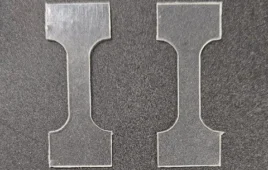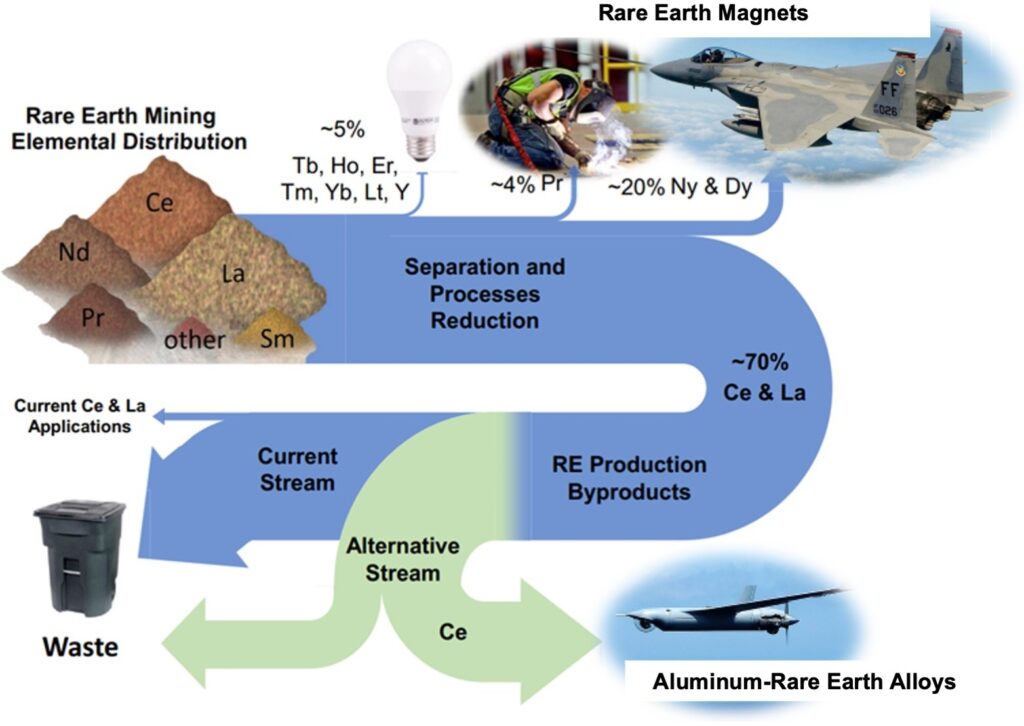
Alternative production pathway for rare earth magnets reduces waste. Courtesy of Gadolyn Inc.
Making industrial and military magnets from rare earth metals is a dirty job, often relegated to countries with limited environmental oversight.
Now, Gadolyn Inc., headquartered in Austin, Texas, has developed a way to do it cleanly, paving the way to bringing production back to the U.S.
The traditional molten salt electrolysis method, used around the world, produces CO2, carbon tetrafluoride and other hazardous emissions.
Gadolyn’s D-DIRECT technology is a gas-liquid phase metallization platform that converts rare earth and transition metal oxide powders into high-purity metallic alloys. The only byproduct of Gadolyn’s D-DIRECT method is water. There is no direct production of CO₂ or byproducts such as carbon tetrafluoride.
Asia-Pacific manufacturers currently dominate the production of high-performance magnet alloys, used in the making of automobiles as well as military and commercial jets, missiles and drones.
As global demand for rare earth alloy manufacturing grows, the need for secure and sustainable production methods becomes increasingly urgent.
Redefining the industry
Transforming a technical concept into an industrial process was a daunting task, but the 2025 R&D 100 Award-winning company took it on.
Led by a multidisciplinary team of industry leaders, rare earth technologists and former venture capitalists, Gadolyn redefined how rare earth magnets and strategic alloys are produced.
It has become the world’s first and only company that directly reduces multiple rare earth and transition metal oxides into finished alloys in a single step. In other words, it’s not only environmentally responsible but also economically sustainable.
Gadolyn is also a modern example of how targeted government investment can catalyze private-sector innovation in critical materials.
The company’s early technical success might have remained confined to the laboratory without public-sector support. Federal research programs in advanced manufacturing buoyed its progress from concept to demonstration, making scientific uncertainty and commercialization a less risky prospect.
Spark of innovation
The idea that sparked Gadolyn began as a question: Could metal oxides—the most stable and abundant form of metallic elements—be transformed directly into alloys without multiple intermediate refining steps?
This became the foundation of D-DIRECT, short for Decarbonized Direct Reduction for Clean Transformation. The technology demonstrated that oxide feedstocks could be reduced in a single pass, without the use of hazardous fluoride salts or carbon-based reductants.
Early Gadolyn experiments explored the use of reactants to activate reduction reactions. The principle proved sound; under the right thermodynamic conditions, metal oxides could be reduced directly, producing pure metal alloys with water as the only byproduct.
Over time, refinements in thermal management, process control and reactor design transformed a laboratory experiment into a repeatable, scalable process.
The most significant leap forward came when researchers discovered that multiple metal oxides could be reduced together. This co-reduction pathway allowed stoichiometric alloys—compositions that typically require several melting and refining steps—to form directly within a single reduction cycle.
By achieving this, D-DIRECT bypassed the multi-stage sequence of extraction, refining and alloying that defines traditional metallurgy. The implications were multiple: lower energy consumption, smaller equipment footprint, reduced capital and operational expenditures and cleaner manufacturing.
Beginnings in collaboration
The company’s beginnings can be traced to a collaboration within the United States Department of Energy’s Critical Materials Institute led by Dr. Chris Haase at Ames National Laboratory between 2018 and 2019. As CMI director, he oversaw more than 30 projects that advanced domestic innovation in rare earth and strategic materials.
Haase, now president and CEO of Gadolyn, connected with Dr. Orlando Rios and Mr. David Weiss, who made up one of CMI’s highest-performing, award-winning teams at that time. Their work on aluminum-cerium alloys achieved early technical and commercial success, culminating in a 2017 R&D 100 Award for innovation and impact.
Inspired by a shared vision for breakthrough innovation, Haase visited Orlando and Weiss’s Ce-Ri-SS LLC laboratory in late 2024, a visit that proved pivotal.
Rios and Weiss were leading a DARPA-funded project exploring advanced routes for producing rare-earth alloys directly from oxide feedstocks, towards a cleaner and more efficient production alternative to molten salt electrolysis.
That meeting led to the idea of forming a company that would transform this concept, forged in a research notebook, into a scalable commercial platform for clean alloy manufacturing. It would be structured to integrate best practices in science, engineering and commercialization within a unified, mission-driven framework.
From vision to incorporation
Between February and March 2025, the three worked intensely together to continue experiments, secure business resources and an entrepreneur-focused law firm ready to turn their shared vision into reality.
On March 17, 2025, Gadolyn Inc. was incorporated as an equal partnership built on a foundation of complementary strengths. Rios was named chief technology officer, and Weiss became its VP of engineering and chief operating officer.
Haase brought strategic leadership, venture finance fluency and startup experience. Rios contributed scientific vision, materials innovation and rapid prototyping capabilities. Weiss added engineering expertise, manufacturing scale-up, customer engagement and operational focus.
The founders emphasized lean structure, aligned incentives and early planning to smooth out the research, business and legal workflows. Every decision, whether technical or organizational, advanced the technology and its commercial readiness.
Even its name reflected its focus. Gadolyn was named in honor of Johan Gadolin (1760-1852), a Finnish chemist and mineralogist who discovered the first rare earth element, yttrium.
Demonstration and validation
By June 2025, the team hosted an in-person demonstration for world-renowned rare earth industrial expert, Mr. Jack Lifton. During his visit, the team demonstrated the platform’s performance and market potential, which led Lifton to join the company as Gadolyn Advisory Board chair.
Soon after, Dr. Gareth Hatch, former Interim Secretary General of the Rare Earth Industry Association in Europe and global expert on rare earth processing, also joined, which brought additional technical depth and industry connectivity.
Securing such an advisory board within weeks of incorporation underscored Gadolyn’s credibility and its deliberate focus on assembling experienced leadership early on.
Early preparation was key
Throughout the process, Gadolyn learned that a great idea alone was not enough to ensure success.
From the outset, Gadolyn pursued parallel progress across technical, financial and commercial fronts. The company submitted its technology for R&D 100 Award consideration, applied for non-dilutive funding through the U.S. Department of Defense, engaged a reputable law firm to structure governance and intellectual property protection and developed investor-ready documentation and data rooms to support early-stage investor engagement.
By the end of the third quarter of 2025, Gadolyn had conducted more than 20 substantive investor meetings. More than 90% of investors contacted expressed interest and wanted to hear more. Moving from concept to serious capital discussions in less than five months illustrated the benefit of early planning and unified execution.
Early engagement with future customers and strategic partners ensured alignment between process capabilities and market requirements. The company’s roadmap includes multiple products, both onsite or at customer locations, as well as market entry pathways to rare earth miners and magnet producers who seek quality, secure and resilient supply chains in the face of dynamic geopolitical conditions.
Each pathway reflects the same principle: early, cross-functional alignment of science, manufacturing and customer engagement to identify and mitigate risk while accelerating return on innovation.
Lessons from Gadolyn
- Integrate early. Focus on commercialization during discovery, not after it.
- Build on trust. Proven collaboration and clear accountability accelerate execution.
- Stay lean: Structure follows purpose. Deliverables drive expenses. Overhead follows traction.
- Communicate relentlessly: Err on overcommunication and transparency as a team and assure transparency with investors and partners to sustain momentum.
- Begin early: Legal, technical and market readiness should advance together.
Conclusion
A successful transition from innovation to market requires more than a technical breakthrough. Gadolyn’s experience shows that an early alliance between scientific vision, operational excellence and commercial foresight often determines whether an innovation reaches the market or stays on the lab bench.
In a world where secure and sustainable materials are strategic imperatives, Gadolyn’s cross-functional collaboration serves as a success story from discovery to deployment.
Editor’s Note: Gadolyn Inc. is a 2025 R&D 100 Award winner. This article was contributed by the company’s leadership team.