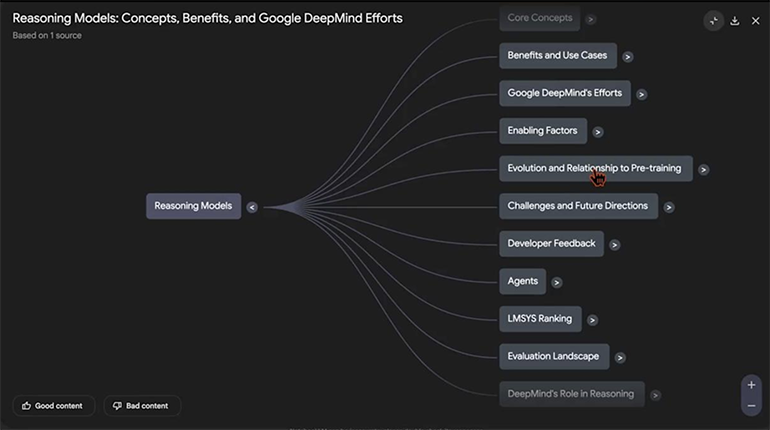
Google’s popular NotebookLM service, which can create audio podcast-like recordings based on information your feed it, recently introduced Interactive mind maps as a way to visually organize and explore information in a user’s notebook. This feature can automatically generate a branching diagram of main topics and subtopics from the documents you upload. See the example below for an example.
In the feature, each mind map starts with a central concept (often the notebook title or overarching theme) and branches out into key ideas discovered across your notes — similar to an octopus tentacles. The system visually summarizes your source materials. It highlights relationships between ideas in a hierarchical node structure.
The company is in the process of rolling out the feature, a process that began on March 19.
AI/NLP processing of notes and node generation
Under the hood, NotebookLM taps Google Gemini’s large language model (LLM) series, which parses the text to identify important concepts, topics, and how they relate. In essence, it performs an outline or concept extraction: the model might be prompted to “summarize the key topics and subtopics present in these notes.” Each node in the mind map represents a concept drawn from the content, with subnodes breaking down more detailed subtopics. For example, if a student’s notebook is about coral reef ecosystem decline, the AI might generate top-level nodes like “Ocean Acidification,” “Rising Sea Temperatures,” “Pollution,” etc., each with further branches, an example Google offers on its website.
To ensure accuracy, NotebookLM’s AI focuses on grounded information from the user’s sources. It may cross-reference multiple documents in the notebook to find common themes. This can also reveal how different sources intersect, and capture whether they agree or conflict.
Each node is linked to the content that inspired it. That is, NotebookLM keeps track of which source or section of text supports a given node. This allows it to provide context when you interact with the node. Once the AI has constructed the mind map data (topics, subtopics, relationships), the presentation layer renders it as an interactive diagram.
There’s also an option to download the mind map as an image for sharing. Also, nodes are interactive: hovering might highlight the node or show which source it’s based on, and clicking triggers further actions.
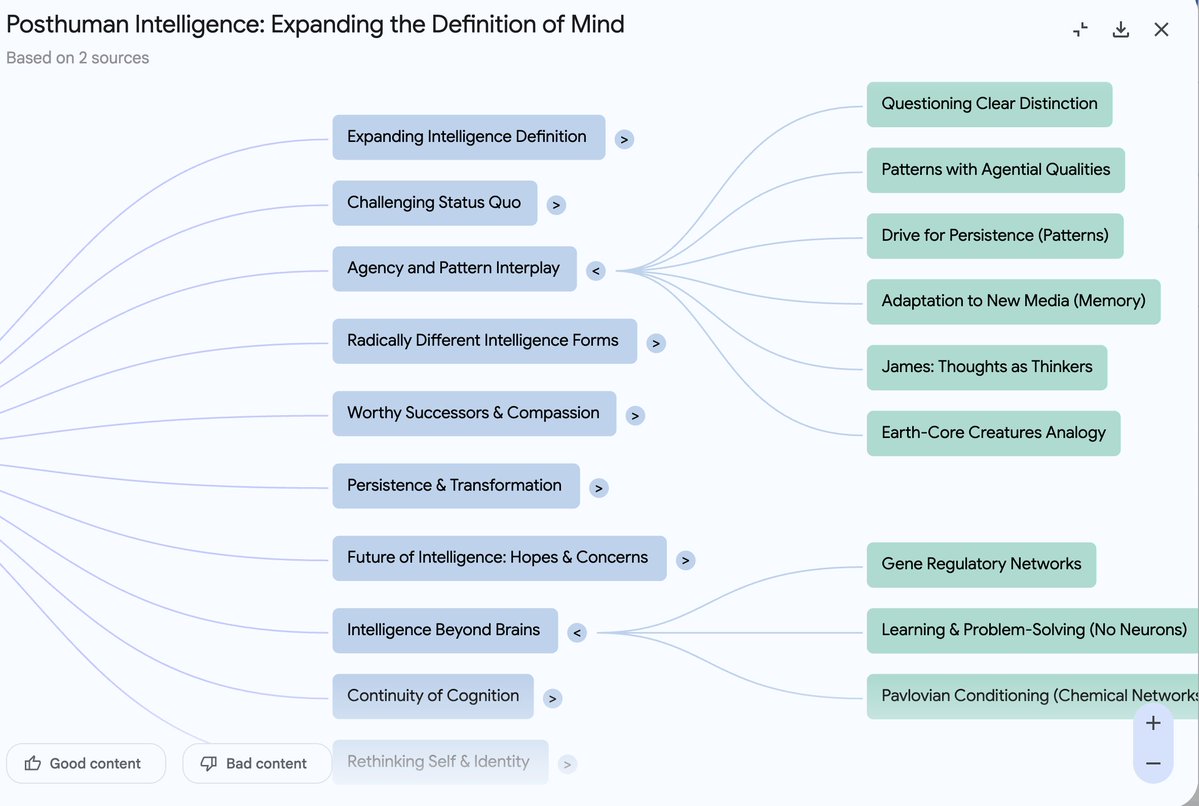
Expanding nodes and Q&A integration
One of the novel aspects of NotebookLM’s mind maps is how they tie into the AI assistant capabilities of the app. The mind map isn’t isolated; it’s linked with the NotebookLM chat interface. Clicking on a node can pose a question to the AI or retrieve relevant information about that topic. In practice, when a user selects a node (say “Overfishing” on the coral reef map), NotebookLM will generate an immediate response in the chat panel, explaining that subtopic with details drawn from the sources. This is effectively a context-aware Q&A: the system knows which concept you clicked, so it can either pull up a prepared summary or dynamically query the LLM for an explanation, constrained to the relevant source material.
Comparison with other knowledge mapping tools
Knowledge mapping tools are widely available. For instance, there are several free options in Python such as PyDot, Pymindmap, and NetworkX with Graphviz. In addition, several Python libraries work with established mind mapping formats. Examples include pymm, freeplane2md and md2mm. But the Notebook LM is more comparable to other pre-existing tools with an integrated UI. While Notion is an all-in-one workspace that supports note-taking and AI-assisted writing, it does not have a built-in mind map view. And in terms of AI integration, Notion AI focuses on content generation within notes but doesn’t automatically visualize relationships. NotebookLM is built around AI-driven mapping.
Meanwhile, the notetaking app Obsidian features a global network graph showing relationships between notes. That approach differs from NotebookLM’s hierarchical mind maps of document contents. Obsidian’s connections are manually created through links, while NotebookLM automatically generates nodes and relationships. In addition, Obsidian’s graph view provides an overview of your entire vault, while NotebookLM offers a focused view for a particular set of sources. Obsidian’s Canvas allows manual creation of visual maps, but lacks AI summarization.
There is also MindMeister, a dedicated mind mapping tool where users manually add nodes with extensive formatting options. It offers some AI-powered suggestions for new nodes but doesn’t automatically generate entire maps from documents like NotebookLM does.