Research & Development World

  • R&D World Home
  • Topics
    • Aerospace
    • Automotive
    • Biotech
    • Careers
    • Chemistry
    • Environment
    • Energy
    • Life Science
    • Material Science
    • R&D Management
    • Physics
  • Technology
    • 3D Printing
    • A.I./Robotics
    • Software
    • Battery Technology
    • Controlled Environments
      • Cleanrooms
      • Graphene
      • Lasers
      • Regulations/Standards
      • Sensors
    • Imaging
    • Nanotechnology
    • Scientific Computing
      • Big Data
      • HPC/Supercomputing
      • Informatics
      • Security
    • Semiconductors
  • R&D Market Pulse
  • R&D 100
    • 2025 R&D 100 Award Winners
    • 2025 Professional Award Winners
    • 2025 Special Recognition Winners
    • R&D 100 Awards Event
    • R&D 100 Submissions
    • Winner Archive
  • Resources
    • Research Reports
    • Digital Issues
    • Educational Assets
    • Subscribe
    • Video
    • Webinars
    • Content submission guidelines for R&D World
  • Global Funding Forecast
  • Top Labs
  • Advertise
  • SUBSCRIBE

Gut Bacteria Can Produce Electricity

By Kenny Walter | September 12, 2018

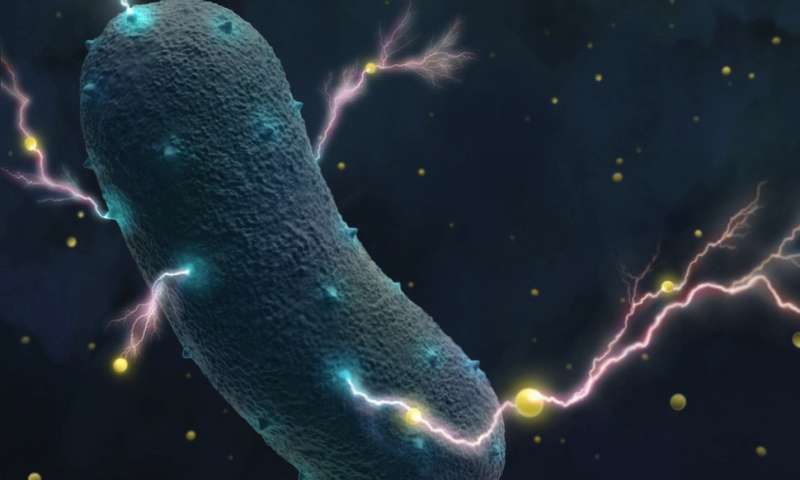
Listeria bacteria transport electrons through their cell wall into the environment as tiny currents, assisted by ubiquitous flavin molecules (yellow dots). Credit: Amy Cao. Copyright UC Berkeley.

Researchers have discovered that bacteria that are part of the human gut microbiome have the ability to produce electricity, using techniques that differ from known electrogenic bacteria.

Scientists from the University of California Berkeley have found that Listeria monocytogenes and hundreds of other bacterial species produce electricity, a discovery that could yield living batteries from microbes.

“The fact that so many bugs that interact with humans, either as pathogens or in probiotics or in our microbiota or involved in fermentation of human products, are electrogenic—that had been missed before,” Dan Portnoy, a UC Berkeley professor of molecular and cell biology and of plant and microbial biology, said in a statement. “It could tell us a lot about how these bacteria infect us or help us have a healthy gut.”

Bacteria generates electricity to remove electrons produced during metabolism and support energy production. While animals and plants transfer their electrons to oxygen inside the mitochondria of every cell, bacteria must find another electron acceptor in environments with no oxygen, like the human gut, alcohol and cheese fermentation vats and acidic mines. In geologic environments, that has often been a mineral —- iron or manganese, for example —- outside the cell. In some sense, these bacteria “breathe” iron or manganese.

Transferring electrons out of the cell to a mineral requires a cascade of special chemical reactions called an extracellular electron transfer chain that will carry the electrons as a small electrical current. Some researchers have used the chain to develop a battery by sticking an electrode in a flask of the bacteria to generate electricity.

However, the new extracellular electron transfer system is only used by bacteria when necessary, including when oxygen levels are low and has only been found in bacteria with a single cell wall that live in an environment with lots of flavin.

“It seems that the cell structure of these bacteria and the vitamin-rich ecological niche that they occupy makes it significantly easier and more cost effective to transfer electrons out of the cell,” first author Sam Light, a postdoctoral fellow, said in a statement. “Thus, we think that the conventionally studied mineral-respiring bacteria are using extracellular electron transfer because it is crucial for survival, whereas these newly identified bacteria are using it because it is ‘easy’.”

The researchers then explored the interactions between living microbes and inorganic materials for possible applications in carbon capture and sequestration and bio-solar energy generation. Biogenetic technologies could produce electricity from bacteria in waste treatment plants.

They used an electrode to measure the electric current that streams from the bacteria—up to 500 microamps—to confirm that the bacteria is electrogenic.

The study was published in Nature.
Related Articles Read More >

Genetically modified hookworms could produce and deliver therapeutics within a host
Five costly mistakes when scaling spray drying from lab to commercial production
Leica, Indica Labs and Lunit team up as AI biomarker scoring moves toward clinical scale
Beyond the sequence: how Ötzi the Iceman exposed the blind spots of pure metagenomics
rd newsletter
EXPAND YOUR KNOWLEDGE AND STAY CONNECTED
Get the latest info on technologies, trends, and strategies in Research & Development.

R&D World Digital Issues

Fall 2025 issue

Browse the most current issue of R&D World and back issues in an easy to use high quality format. Clip, share and download with the leading R&D magazine today.

R&D 100 Awards
Research & Development World
  • Subscribe to R&D World Magazine
  • Sign up for R&D World’s newsletter
  • Contact Us
  • About Us
  • Drug Discovery & Development
  • Pharmaceutical Processing
  • Global Funding Forecast

Copyright © 2026 WTWH Media LLC. All Rights Reserved. The material on this site may not be reproduced, distributed, transmitted, cached or otherwise used, except with the prior written permission of WTWH Media
Privacy Policy | Advertising | About Us

Search R&D World

  • R&D World Home
  • Topics
    • Aerospace
    • Automotive
    • Biotech
    • Careers
    • Chemistry
    • Environment
    • Energy
    • Life Science
    • Material Science
    • R&D Management
    • Physics
  • Technology
    • 3D Printing
    • A.I./Robotics
    • Software
    • Battery Technology
    • Controlled Environments
      • Cleanrooms
      • Graphene
      • Lasers
      • Regulations/Standards
      • Sensors
    • Imaging
    • Nanotechnology
    • Scientific Computing
      • Big Data
      • HPC/Supercomputing
      • Informatics
      • Security
    • Semiconductors
  • R&D Market Pulse
  • R&D 100
    • 2025 R&D 100 Award Winners
    • 2025 Professional Award Winners
    • 2025 Special Recognition Winners
    • R&D 100 Awards Event
    • R&D 100 Submissions
    • Winner Archive
  • Resources
    • Research Reports
    • Digital Issues
    • Educational Assets
    • Subscribe
    • Video
    • Webinars
    • Content submission guidelines for R&D World
  • Global Funding Forecast
  • Top Labs
  • Advertise
  • SUBSCRIBE