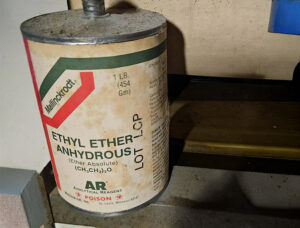
 When a new homeowner in Southwest Michigan posted a photo of a vintage can of ethyl ether found in their basement to a large online chemistry forum on Reddit, the poster was just looking for cheap disposal advice. What they got instead was a chorus of terrified chemists and former hazardous waste technicians telling them to back away slowly. Local police, fire and hazmat teams had already declined to intervene, leaving the buyer unwittingly holding what amounted to an unexploded bomb. As the solvent had aged over several decades, it had likely formed shock-sensitive peroxides. In other words, a single drop, bump, or twist of the cap could trigger a potential explosion.
The ticking clock in your stockroom: Legacy chemical incidents
Some old chemicals can be dangerous. Here’s what’s gone wrong when forgotten containers were finally disturbed.
Diethyl Ether & THF (Peroxide Formers)
UC Berkeley: An undergraduate was injured when a rotary evaporator flask detonated. The culprit: peroxide-contaminated THF and diethyl ether that had concentrated to instability. Glass fragments struck the student’s face and goggles. (UC Berkeley EH&S)
UCSF: During a routine lab cleanout, a worker placed two cans of ether, untouched since 1985, into a fume hood and vented the lids. He heard a “pop,” turned toward it, and was knocked down by the blast. A nearby bottle of nitric acid also exploded, spraying acid onto his face and hair. He walked himself to the ER. (UCSF Synapse)
University of Edinburgh: An unopened, nearly full 2-liter bottle of diethyl ether exploded inside a solvent storage cupboard after just seven months under cool, dark conditions. No one was injured, but broken glass and ether vapor flooded the room. The university concluded peroxide formation was the most likely cause. (U. Edinburgh Safety Dept.)
Picric Acid (Dried Crystals)
High schools across the U.S.: After World War II, the U.S. government distributed surplus picric acid to school chemistry labs nationwide. Most of it was never used. Decades later, dried-out bottles began turning up during cleanouts. Dry picric acid is a Class A explosive that detonates at 572°F and is sensitive to shock and friction. Fire departments still field calls from schools discovering forgotten bottles. (Fire Engineering)
Ontario, Canada: A provincial safety alert warned all educational, healthcare, and research facilities after old laboratory samples stored in picric acid were discovered at a facility. Some had been stored in glass jars with metal lids, allowing picrate salts to form on the threads. (Ontario Ministry of Labour)
Mercury (Elemental)
New York school: A student took a jar of liquid mercury from a storage cabinet. Multiple students tossed it around the classroom. The room was closed for three months during contractor cleanup. Total cost: $24,000. Contaminated clothing, shoes, and backpacks all required hazardous waste disposal. (NY State DOH)
Indian Head Naval Ordnance Station, MD: Seven pounds of mercury that had leaked into a 30-year-old sewer pipe was discovered when a contractor ruptured the line during construction. The spill contaminated over 20 tons of soil. Cleanup cost exceeded $100,000. (Washington Post)
Mixed Unknown Chemicals
Louisville, KY (2023): EPA crews spent ten days dismantling a residential home after discovering over 100 different chemicals stockpiled inside, including mercury, poison-inhalation compounds, and Grignard reagents. The house had to be taken apart piece by piece, with materials placed in a steel tank for processing before transport. An EPA official called it rare to encounter hoarding, explosives, and a basement chemistry lab all at one site. (WHAS11)
Mixed Acid Waste (Overpressurization)
UCLA: A chemical waste bottle containing a mixture of nitric, sulfuric, and hydrochloric acid (similar to aqua regia) exploded from overpressurization. The blast was heard across the floor and the floor below. Glass shards and corrosive liquid scattered across the lab. No one was present at the time. (UC Center for Laboratory Safety)
If you find an old, unknown, or suspicious chemical container: do not open it, do not move it, and contact your institution’s EH&S office or a licensed hazardous waste disposal company immediately. For emergency guidance, call ChemTrec at 1-800-424-9300.
For lab safety directors, the opacity of an old metal can or amber bottle is a liability because there is no way to visually check for friction-sensitive crystals. As a university chemical safety officer on the Reddit thread warned, when a container is too old to safely inspect, preparing for anything less than a detonation is dangerous. “While it’s in an opaque container, it has undoubtedly been exposed to air and the age alone has made it unsafe,” the chemist wrote, adding that “it basically has to be assumed worst-case scenario because preparing for anything less would be irresponsible.”
Diethyl ether is one of the most widely used solvents in chemistry, and one of the most dangerous to forget about. When exposed to air, ether undergoes a radical autooxidation reaction that produces organic peroxides. These peroxides accumulate over time and are responsible for the explosive compounds that slowly form when diethyl ether is left in ambient conditions.
The resulting peroxides are sensitive to shock, heat and friction. They can detonate with extreme violence when concentrated, combined with other compounds, or disturbed by unusual heat, shock or friction.
Steel containers, like the vintage can in the Reddit post, present a specific complication. Iron in steel containers actually inhibits peroxide formation in diethyl ether. As Donald E. Clark, Ph.D., FAIC, BSP Chemical and Biological Safety Officer Texas A&M University noted in 2000, “Peroxides, in contact with inorganic cobalt and copper compounds, iron or iron compounds, acetone, metal oxide salt, and acids or bases can react with rapid, uncontrolled decomposition of peroxides leading to fires and explosions.”
The consequences of getting this wrong are well-documented. At UC Berkeley, an undergraduate researcher was injured when a rotary evaporator flask exploded after peroxide-contaminated solvents concentrated to the point of instability. Across the Bay at UCSF in 2019, a lab worker setting old ether cans, stored since 1985, into a fume hood during a routine cleanout triggered an explosion that sent him to the emergency room with chemical burns.