 Modern AI adoption is something of a paradox. Almost everyone is using it; almost no one trusts it.
This tension is perhaps clearest in fields like in science and engineering.
Software developers are at once the most impacted by generative AI tools and the biggest adopters of them. Stack Overflow’s 2025 Developer Survey found that 84% of developers are using or planning to use AI tools in their workflow, with 51% of professional developers using them daily. A Sonar 2026 State of Code survey put the share even higher among committed users: 72% of developers who have tried AI coding tools now use them every day, and developers estimate that 42% of committed code is now AI-generated or AI-assisted. The footprint of AI-written code is growing fast. A Complexity Science Hub study published in Science found that AI-assisted coding in the U.S. rose from roughly 5% of new Python code on GitHub in 2022 to 29% by late 2024. The number has only continued since with more developers and sometimes companies saying that their developers are using AI tools to write the bulk of their code these days. In February 2026, Spotify co-CEO Gustav Söderström revealed during an earnings call that the company’s most senior engineers have not manually written a single line of code since December 2025, according to Fast Company.
But adoption and efficiency are not the same thing. In a recent episode of the Lex Fridman Podcast, developer Peter Steinberger, whose open-source AI agent OpenClaw went viral, described the cognitive overhead of managing agentic coding workflows. At any given time, he said, he juggles between four and 10 agents simultaneously. “It needs a different level of thinking,” Steinberger said. “You have to learn the language of the agent.” The productivity gains are often real, but there is an onboarding cost, an attention-fragmentation tax, and a workflow-refactoring phase that doesn’t show up in the benchmarks.
And agents, for all the hype, are not yet universal. Stack Overflow’s survey found that 52% of developers either don’t use agents at all or stick to simpler AI tools, and 38% have no plans to adopt them.
The engineering parallel
 The pattern playing out in software development, high adoption, conditional trust, uneven governance, is not confined to code. An Omni Calculator survey of 403 U.S.-based engineers and engineering students, conducted in January 2026, reveals a similar landscape in engineering disciplines.
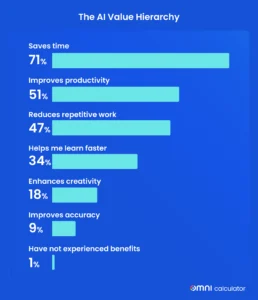
Adoption is high, and it saves time. Sometimes. Among the 403 respondents, 86.1% report using AI tools in their engineering work or studies. Of those AI users (n=347), 93.4% say AI has saved them time. The most commonly cited benefits were time savings, improved productivity, and reduced repetitive work.
Trust is conditional. Among AI users, 88.8% say they trust AI-generated results only with verification, nearly nine in ten. Just 5.8% trust results without hesitation, and 5.5% say they don’t trust them at all. That verification-conditional trust mirrors the developer-side findings almost exactly.
How engineers verify matters. The survey broke down verification methods: 52.4% of AI users default to performing a sanity-check calculation by hand, while 29.4% cross-reference with a manual or textbook. Only 13.8% say they trust the result if the reasoning and steps look correct. Engineers, in other words, are still doing the math themselves to double-check the machine.
AI is the first tool off the shelf for math, barely. When asked what their first choice is for solving a technical math problem, 40.9% of AI users now reach for an AI tool like ChatGPT, Gemini, or Copilot first. That narrowly edges out a dedicated engineering calculator or manual at 39.8%, with 13.5% preferring to write their own script. The fact that AI has pulled roughly even with traditional tools as the default starting point, while still being verified against those same tools — captures the current moment precisely.
 Governance is a patchwork. Half of all respondents (49.9%) say AI is allowed at their workplace or school only with specific approved tools. Another 22.3% say use is open and encouraged. But 19.6% describe the policy as a “gray area,” and 5.5% aren’t sure what the rules are. Just 2.7% say AI is strictly prohibited. That means roughly a quarter of engineers are operating without clear institutional guidance on how, or whether, to use the tools they’re already using.
The outlook is augmentation, not replacement. When asked what AI will do to engineering over the next five to ten years, 52.6% chose “augment engineers and increase productivity.” Another 22.1% said it would “fundamentally change what engineers do,” and 20.3% said it would replace some engineering roles. Only 5% said it would have little to no impact. When forced to choose between AI-assisted and traditional tools, 67.7% chose “a mix of both.”
ChatGPT dominates the toolbox. Among AI users, ChatGPT was cited by far the most frequently, followed by Gemini, Grok, Claude, Copilot, and DeepSeek. The most common engineering tasks performed with AI were coding or debugging (cited by 232 users), calculations or problem solving (199), documentation or reporting (150), learning or studying engineering concepts (147), and design or concept generation (137).
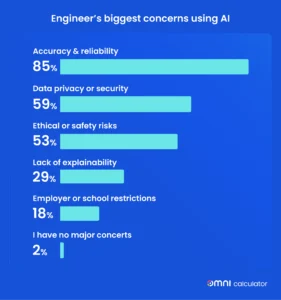
Concerns center on accuracy. The top concern among AI-using engineers was accuracy and reliability (295 citations), followed by data privacy or security (205) and ethical or safety risks (184). Lack of explainability, the “black box” problem, was cited 100 times.
The bench science parallel: shadow AI and the governance gap
The trust-but-verify pattern extends beyond software and engineering into laboratory science, where the stakes around unverified AI output can be even higher.
A Sapio Sciences survey found that 45% of scientists use public generative AI tools through personal accounts to support their work, despite intellectual property and compliance risks that most institutional policies haven’t caught up with. A broader WalkMe survey of U.S. workers who use AI on the job found that 78% admit to using unapproved AI tools, a phenomenon the industry has taken to calling “shadow AI.”
The dynamic rhymes with what the Omni Calculator survey found among engineers: nearly 20% say their workplace AI policy is a gray area, and another 5.5% don’t know what the policy is. When adoption outpaces governance, people improvise, and improvisation in safety-critical fields looks different than it does in a code editor.
Methodology: The Omni Calculator AI and Engineering Survey was fielded online from Jan. 20 to Feb. 12, 2026, among 403 U.S.-based respondents who self-identified as engineers or engineering students. Unless otherwise noted, results on AI usage, trust, verification, tools, tasks, benefits, and concerns refer to AI users only (n=347); governance and future-outlook questions were asked of all respondents (n=403). For select questions, respondents could choose up to three options, so totals may exceed 100%. Percentages are self-reported and rounded to one decimal place.