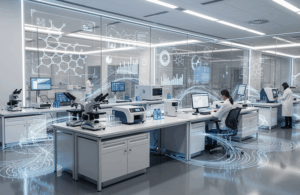
 Picture this: the alarm on a ULT freezer storing valuable samples at low temperatures goes off at 2 a.m. on a Saturday, or maybe the alarm battery is dead entirely. No one is notified of the freezer failure, and the entire inventory is compromised.
Alternatively, a digitalized lab avoids this crisis. In this scenario, a lab manager receives a notification on their phone warning that the freezer is at risk of breaking down before the equipment starts to fail. The needed parts are ordered and replaced before the temperature rises, securing the samples.
Laboratory 4.0
Laboratory information management systems (LIMS) and electronic lab notebooks (ELNs) have been used in R&D labs for decades. However, they have always been separate systems, where data needs to be transferred from one to the other. Now, labs are increasingly using integrated systems where the LIMS and the ELNs are in communication with each other. Data from the ELN is automatically uploaded to the LIMS, which has a central dashboard view.
Physical lab equipment is also increasingly able to automatically populate ELNs with measurements, eliminating human reading errors. Everything in the lab will be connected in constant communication. Data will no longer be trapped in disconnected systems or paper notebooks.
We are currently in the midst of the fourth industrial revolution: the emergence of automation and robotics, Industry 4.0. Labs are part of this transformation. Lab 4.0 has intelligent technology, automated processes and optimized workflows, increasing productivity and efficiency. Early use cases have already delivered 30% to 40% productivity gains in pharmaceutical QC labs, according to McKinsey. Digitalized labs can more efficiently generate and analyze complex data, such as multiomics data, which is a rising trend in biological research.
The transition doesn’t have to be overnight, and it doesn’t have to involve complete demolition. Equipment can be replaced with newer, smarter versions as instruments fail. As a lab becomes more connected, the LIMS becomes more powerful, transforming into a center for data, analysis and oversight instead of a static storage folder.
Right now, approximately 50% of a scientist’s time is spent transcribing data manually, according to Ken Fountain, vice president of scientific applications at TetraScience. An integrated LIMS could solve this problem, allowing data to be automatically available for whatever operation a researcher might need.
Making good on IoT’s promise
Internet of things (IoT) platforms connect physical lab equipment and deliver data to a dashboard. They often have corresponding cellphone apps so lab managers can easily get relevant notifications even when they aren’t in the lab. Some IoT services can be integrated with existing LIMS, allowing everything to be stored in one central location.
Using an IoT, labs can monitor maintenance schedules, ensuring that equipment is regularly updated based on usage rather than every year or every six months. Lab managers can see which equipment is used, when and for how long, allowing them to make more informed decisions when purchasing.
Both LIMS and IoT can be integrated with AI, including an LLM. Together, these technologies can provide more powerful information than ever before.


Tell Us What You Think!
You must be logged in to post a comment.