[Adobe Stock]
2025 put life sciences labs through the wringer. Venture funding tightened. Layoff emails piled up from Boston to South San Francisco. Clinical timelines slipped, capital projects were paused and plenty of once white-hot markets started to feel a little oversupplied. For lab managers and R&D leaders, the year perhaps felt less like a “soft landing” and more like a year spent juggling everything from budget cuts to hiring freezes and pressure to deliver the same pipeline with fewer resources.
According to new research from JLL, 2026 is poised to be a realignment year for life science labs, where AI adoption, geopolitical risk and shifting capital flows could combine to redraw the map. JLL’s “2026 Life Sciences Real Estate Trends to Watch,” part of its broader 2026 Global Corporate Real Estate Trends series, argues that the industry is entering one of the most significant shifts in lab strategy in recent memory.
The report points to several fault lines that are already visible on the ground. China’s rise from generics producer to innovation hub is changing where IP is created. AI-native biotechs are squeezing more science into less space while pouring capital into compute. U.S. pricing and manufacturing policy is pulling billions of dollars of new investment toward domestic facilities. Put together, those forces are starting to determine which labs grow, which shrink, and which markets emerge as the next generation of global life science hubs.
Innovation could shift to the East
The most striking long-term trend in JLL’s data is the rise of Asia-Pacific as a life sciences innovation center. Since regulatory reforms in 2015, China’s licensing deal value has surged from $3.7 billion to $63.7 billion as of November 2025, reflecting a shift from generics manufacturer to globally recognized source of innovative treatments. APAC now leads both the U.S. and Europe in medtech and biopharma patent publications.
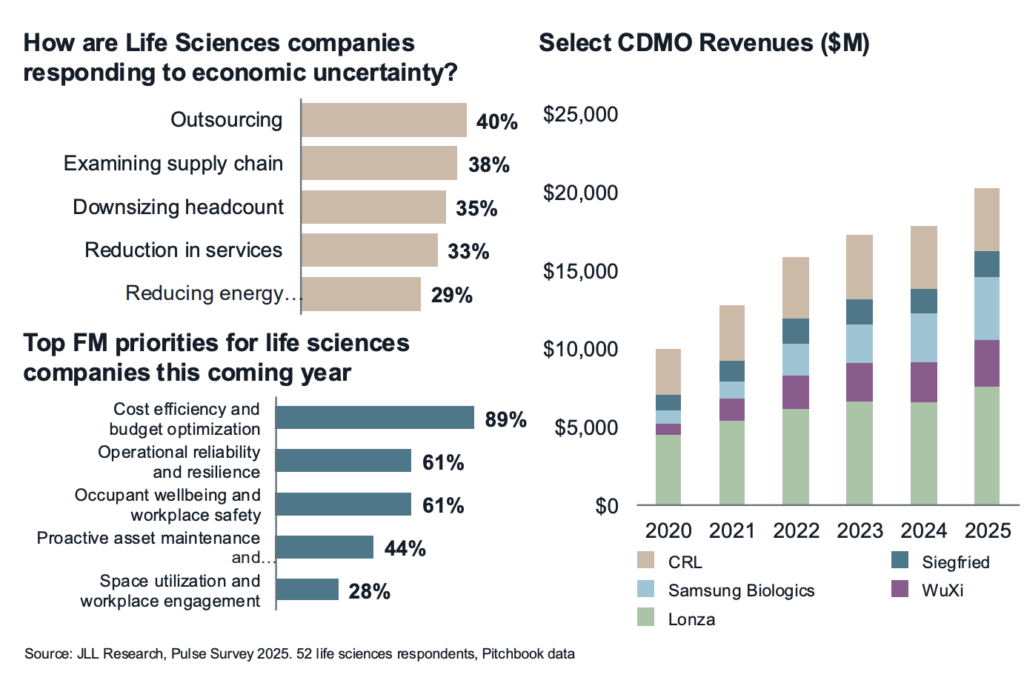
Outsourcing tops the list of how life sciences firms are weathering uncertainty, and CDMO revenues show it. Source: JLL Research, Pitchbook
For lab strategy, JLL sees two immediate effects. First, investment is shifting toward high-spec biomanufacturing facilities across the region. Second, companies are building ” and “India+1” supply chains by investing in South Korea, Singapore, and other hubs to hedge geopolitical risk without losing access to Asian innovation.
Policy could continue to reshape the manufacturing map
At the same time, U.S. policy is pulling investment in the opposite direction. The Trump administration’s tariff reviews and drug pricing negotiations aim to “rebalance” branded drug prices while penalizing biopharmas that do not manufacture in the U.S. JLL notes that 22 companies have already announced more than $25 billion in new U.S. manufacturing commitments. Europe, which ran a $181 billion pharma trade surplus in 2023, faces the prospect of a structural rebalancing as high-growth and underserved markets in Asia see more inflows.
For lab real estate, the manufacturing push likely will mean more process development and quality control facilities tied to new domestic plants, along with softer demand at some overseas sites as incentives shift.
The CDMO era arrives
Caught between tighter funding and policy uncertainty, life sciences companies are leaning harder on outsourcing (see the image above). Contract research and manufacturing organizations are absorbing work that once stayed in-house, and JLL expects revenues at large publicly traded CDMOs to have roughly doubled over five years when Q4 2025 numbers are final. Facilities management is following a similar approach, with first-generation FM outsourcing deals delivering cost reductions of 15% to 30%, according to JLL research and market data.
AI could continue rewriting the space equation
Perhaps the most immediate change is what AI-native biotechs are doing to space requirements. JLL finds that AI-first startups use roughly 25% less space per employee and 15% to 20% less wet lab within their footprints compared to traditional biotechs. Meanwhile, venture funding per leased square foot in the U.S. has doubled over eight years as investors demand capital efficiency.
The shift is reshaping what landlords need to deliver: higher power and floor loads for compute and robotics, and flexible layouts that blend wet lab, dry lab, and office in new proportions. JLL argues that landlords who future-proof for these requirements will win the next cycle of demand from both biotech and the broader innovation and knowledge economy.