Research & Development World

  • R&D World Home
  • Topics
    • Aerospace
    • Automotive
    • Biotech
    • Careers
    • Chemistry
    • Environment
    • Energy
    • Life Science
    • Material Science
    • R&D Management
    • Physics
  • Technology
    • 3D Printing
    • A.I./Robotics
    • Software
    • Battery Technology
    • Controlled Environments
      • Cleanrooms
      • Graphene
      • Lasers
      • Regulations/Standards
      • Sensors
    • Imaging
    • Nanotechnology
    • Scientific Computing
      • Big Data
      • HPC/Supercomputing
      • Informatics
      • Security
    • Semiconductors
  • R&D Market Pulse
  • R&D 100
    • 2025 R&D 100 Award Winners
    • 2025 Professional Award Winners
    • 2025 Special Recognition Winners
    • R&D 100 Awards Event
    • R&D 100 Submissions
    • Winner Archive
  • Resources
    • Research Reports
    • Digital Issues
    • Educational Assets
    • Subscribe
    • Video
    • Webinars
    • Content submission guidelines for R&D World
  • Global Funding Forecast
  • Top Labs
  • Advertise
  • SUBSCRIBE

JWST spots a 6-mile moon hiding in Uranus’ rings

By Brian Buntz | August 25, 2025

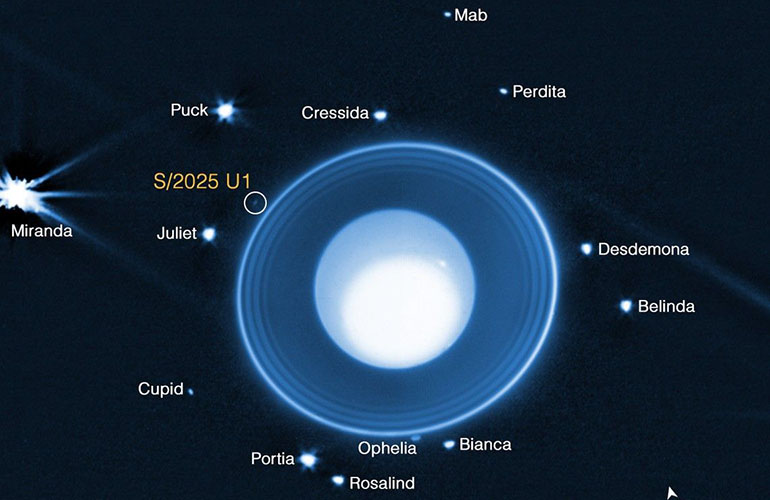
NIRCam view of Uranus showing the new moon S/2025 U 1 (circled). Composite processing reveals the atmosphere, rings, and faint satellites. Data: F150W2 filter, 1.0–2.4 microns.

NIRCam view of Uranus showing the new moon S/2025 U 1 (circled). Composite processing reveals the atmosphere, rings, and faint satellites. Data: F150W2 filter, 1.0–2.4 microns. [Credit: NASA, ESA, CSA, STScI, M. El Moutamid (SwRI), M. Hedman (University of Idaho)]

Astronomers have reported a previously unknown moon orbiting Uranus in James Webb Space Telescope (JWST) imagery from February 2, 2025. The object, provisionally named S/2025 U 1, is roughly 6 miles (about 10 km) in diameter, making it the smallest known Uranian satellite and the 29th overall. NASA notes the result is science in progress (pre-peer review).

S/2025 U 1 travels on a nearly circular, equatorial path about 56,250 km (34,950 miles) from Uranus’ center, between Ophelia and Bianca at the outer edge of the inner ring system. Based on its distance, the satellite completes an orbit in about 9.6 hours.

By convention, Uranian moons are named for characters from Shakespeare and Alexander Pope. Once follow-up observations and orbit solutions are finalized, the IAU will consider a formal name for S/2025 U 1.

How it was detected

The team, led by Maryame El Moutamid of Southwest Research Institute, used JWST/NIRCam to take ten 40-minute exposures spanning roughly 6 hours (Program ID 6379). The discovery sequence was taken with the F150W2 wide-band filter (about 1.0–2.4 μm) and processed as composites to manage the extreme dynamic range of Uranus, its rings, and faint moons—conditions that likely hid the object from Voyager 2 and Hubble. Assuming a typical dark albedo for inner Uranian moons, the size estimate is ~10 km; the object appears at roughly 25th magnitude in the near-IR.

Why this matters for R&D

From an R&D standpoint, the observation pushes JWST’s practical limits in a glare-dominated field. NIRCam delivered the contrast and sensitivity needed to pick out a ~10 km, likely low-albedo body close to a bright primary, a geometry directly relevant to future surveys of small moons and ring particles. On the data-reduction side, the team combined ten 40-minute exposures into high-dynamic-range composites and used point-spread-function modeling, glare suppression and artifact rejection to separate faint sources from Uranus’ rings and atmosphere. Post-processing choices of that kind can recover signals below nominal dynamic-range thresholds. On system dynamics, S/2025 U 1 becomes the 14th inner moon of Uranus, reinforcing evidence for a crowded, interacting population coupled to the rings and consistent with a stirred, collisionally evolved inner system. Additional sub-10 km satellites are likely as JWST data accumulate.

Related Articles Read More >

Perseverance uncovers buried evidence of Mars’ ancient water history using ground-penetrating radar
University of Michigan researchers identify higher-order protein rings that regulate programmed cell death
DNA microscope offers new 3D view of organisms from the inside out
A tale of two industries: How manufacturing and medical imaging experts can learn from each other
rd newsletter
EXPAND YOUR KNOWLEDGE AND STAY CONNECTED
Get the latest info on technologies, trends, and strategies in Research & Development.

R&D World Digital Issues

Fall 2025 issue

Browse the most current issue of R&D World and back issues in an easy to use high quality format. Clip, share and download with the leading R&D magazine today.

R&D 100 Awards
Research & Development World
  • Subscribe to R&D World Magazine
  • Sign up for R&D World’s newsletter
  • Contact Us
  • About Us
  • Drug Discovery & Development
  • Pharmaceutical Processing
  • Global Funding Forecast

Copyright © 2026 WTWH Media LLC. All Rights Reserved. The material on this site may not be reproduced, distributed, transmitted, cached or otherwise used, except with the prior written permission of WTWH Media
Privacy Policy | Advertising | About Us

Search R&D World

  • R&D World Home
  • Topics
    • Aerospace
    • Automotive
    • Biotech
    • Careers
    • Chemistry
    • Environment
    • Energy
    • Life Science
    • Material Science
    • R&D Management
    • Physics
  • Technology
    • 3D Printing
    • A.I./Robotics
    • Software
    • Battery Technology
    • Controlled Environments
      • Cleanrooms
      • Graphene
      • Lasers
      • Regulations/Standards
      • Sensors
    • Imaging
    • Nanotechnology
    • Scientific Computing
      • Big Data
      • HPC/Supercomputing
      • Informatics
      • Security
    • Semiconductors
  • R&D Market Pulse
  • R&D 100
    • 2025 R&D 100 Award Winners
    • 2025 Professional Award Winners
    • 2025 Special Recognition Winners
    • R&D 100 Awards Event
    • R&D 100 Submissions
    • Winner Archive
  • Resources
    • Research Reports
    • Digital Issues
    • Educational Assets
    • Subscribe
    • Video
    • Webinars
    • Content submission guidelines for R&D World
  • Global Funding Forecast
  • Top Labs
  • Advertise
  • SUBSCRIBE