Many R&D labs are relatively static environments where the infrastructure dictates the pace of innovation. At Boston Scientific’s new 400,000-square-foot Arbor Lakes campus, the architecture is designed to get out of the researchers’ way. By moving beyond rigid lab footprints and achieving a 50 to 70% equipment reuse rate, the facility is itself something of a reconfigurable tool for the Interventional Cardiology, Vascular Therapies, and Interventional Oncology and Embolization teams. Stephanie Board, group vice president, Research & Development, Interventional Cardiology & Vascular Therapies, explains how this ‘modular-first’ philosophy is shortening the distance between a prototype and a clinically ready device.
The Maple Grove campus, which opened in October, consolidates R&D operations that had previously shared space with manufacturing at Boston Scientific’s nearby Weaver Lake site. In addition to a rapid prototyping lab and a new systems engineering, measurement and electronics lab for next-generation device development, Arbor Lakes houses a customer experience center with bioskills labs and C-arm rooms, designed to keep physician feedback close to the design process. Board discusses the facility’s “science on display” layout, the role of the training center in product iteration, and the central collaboration spaces that form what she calls “the heart of the building.”
Boston Scientific purchased the recently completed 400,000-square-foot Maple Grove campus for $188.8 million. Boston Sci is already planning to expand. On Jan. 12, the Maple Grove Planning Commission voted 6-0 to recommend Phase II of the Arbor Lakes campus to the City Council, a four-story addition that would nearly double the facility’s size.
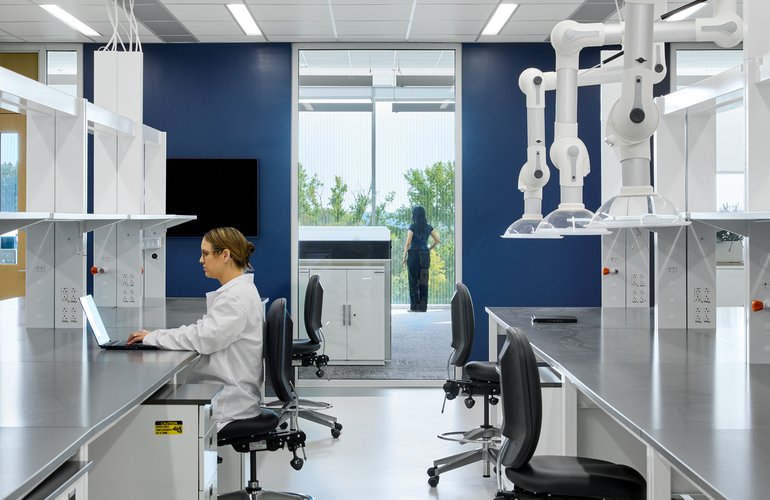
Arbor Lakes’ modular labs keep device R&D moving. Image courtesy of Gaffner Photography
What was the core vision behind the Arbor Lakes campus, and how does the facility’s design support Boston Scientific’s R&D priorities?

Stephanie Board
Board: Across Boston Scientific, we continuously align our real estate and workspace to support our business strategy, as well as our growth. Our new Arbor Lakes campus houses a 400,000-square-foot facility that expands our presence in the Minnesota region and is designed to support organic and acquisition-based growth, foster cross-divisional collaboration and enable continued device innovation with opportunities for future expansion. The new site features a state-of-the-art customer experience center inclusive of a bioskills lab, model and simulation training space, two C-arm rooms and additional training spaces to host healthcare professionals and support sales and physician training.
Can you walk us through the key lab spaces and capabilities housed in the facility? Are there any specialized environments or equipment worth highlighting?
Board: We’ve strategically interwoven the training and R&D lab spaces at the facility, which are intended to foster collaboration and innovation. While each lab is tailored to the specific demands of its research program, they are all designed to be modular or plug-and-play. For example, if we’re planning a device iteration, the team may be able to reuse 50-70% of the prior testing equipment. The modular approach saves both time and money by re-using the current equipment.
Specialized environments such as the bioskills lab, isotope lab, C-arm labs, particulate lab, cath labs and wet-table are used to support advanced research and training requirements.

Atrium at Boston Scientific’s Arbor Lakes. Image courtesy of Gaffner Photography
Our new systems engineering, measurement and electronics (EME) lab at this facility is particularly exciting as this lab will be dedicated to developing and evaluating our next-generation medical devices for the company’s Interventional Cardiology & Vascular Therapies business. Engineers and technicians will use this lab to design specialized hardware and software, such as computers for data acquisition, imaging systems and physician consoles, while leveraging cutting-edge technologies like 3D printing, anatomical modeling and computer-aided design (CAD). The lab also focuses on creating and validating test equipment and methods to ensure product safety, efficacy and performance, including the use of anatomical models and tissue-mimicking materials to replicate clinical scenarios.
The rapid prototyping lab within the space will give our teams access to dedicated equipment to efficiently explore concepts, build prototypes and advance design solutions. It supports product improvements, new product development and next‑generation enhancements for the Interventional Heart Failure, Renal Denervation and Structural Heart programs. The lab enhances the ability to create concept builds, proof‑of‑concept testing and imaging, root‑cause analysis, troubleshooting and data acquisition to bridge exploratory work from early concept to final product design.
The breadth of state-of-the-art technology within the new space is exciting and will be critical for continued meaningful innovation for patients with cardiovascular disease who can benefit from our devices.
How does the campus layout encourage collaboration, both among internal teams and with external partners or clinicians?
Board: Global collaboration and meaningful innovation are core values of Boston Scientific and key priorities for this new facility. The open office areas are organized into neighborhoods, each surrounded by a variety of informal and reservable spaces – including phone rooms, huddle rooms and conference rooms – to support both focused individual work and collaboration. A central atrium connects all three floors of the building, anchored by an open staircase that brings employees together around shared collaboration spaces and amenities. Mini cafés serve as secondary connection points between floors. Together, these elements create ample meeting areas and accessible opportunities for cross-collaboration both across each floor and vertically throughout the building.
The customer experience center will be an important location for soliciting meaningful feedback from healthcare professionals as we develop new products. The space supports a variety of physician customer training starting with the model and simulation training room, the dedicated c-arm lab and the new bioskills lab. The ability to use this space for both customer training and learning will help ensure we’re meeting physicians’ needs and supporting them as they treat their patients with our devices.
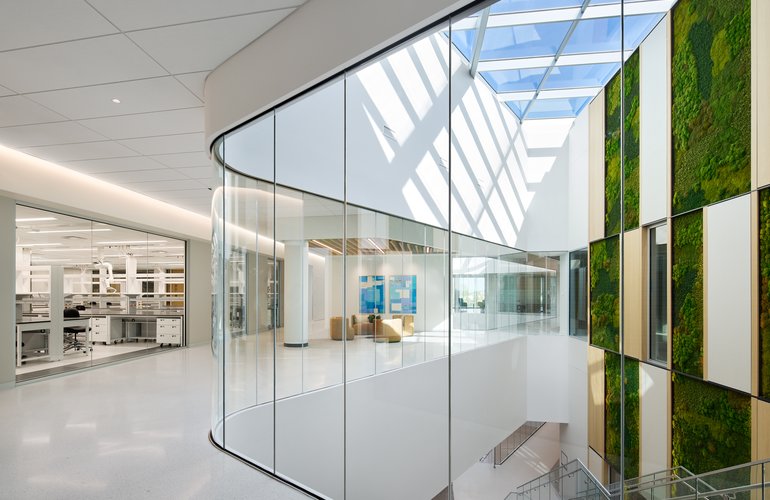
Glass corridor beside the lab core. Image courtesy of Gaffner Photography
Medical device development often requires rapid iteration between design, prototyping, and testing. How does the facility streamline that workflow?
Board: We adopted the concept of “science on display” to organize the new product development labs within the core of the building, surrounded by workspaces to showcase innovation and support efficient movement between the labs and other workplaces throughout the day. The labs are modular by design, supporting efficient utility distribution, adaptability and long-term flexibility. Laboratory benches are movable and feature adjustable components to accommodate changing equipment and evolving layouts. In addition, partitions between lab spaces are demountable, allowing the environment to be easily reconfigured as research needs develop over time.
The area where research meets the workspace was designed as a flexible collaboration area internally called the “shoreline.” This space includes project flex rooms, storage and areas that can be reserved by specific teams for defined periods of time. The shoreline supports hands-on prototyping, testing and short-term project work while maintaining proximity to both labs and workplace. Having cross-functional teams sit together as a unit helps streamline workflow, iteration and stronger employee connections. For example, if an engineer has a challenge, they can easily discuss with a team member or go directly to the lab for a hands-on look at the design challenge. This allows for rapid iteration and understanding.
What’s one feature of the campus you’re most excited about from an innovation standpoint?
Board: The central collaboration spaces form the heart of the building, drawing key team members together and creating spontaneous interactions that spark conversation, excitement and discovery. At the same time, the innovation center is a great space to meet with our customers, learn from their feedback, walk them through design features and requirements and discuss their technology needs as they treat their patients with cardiovascular disease.
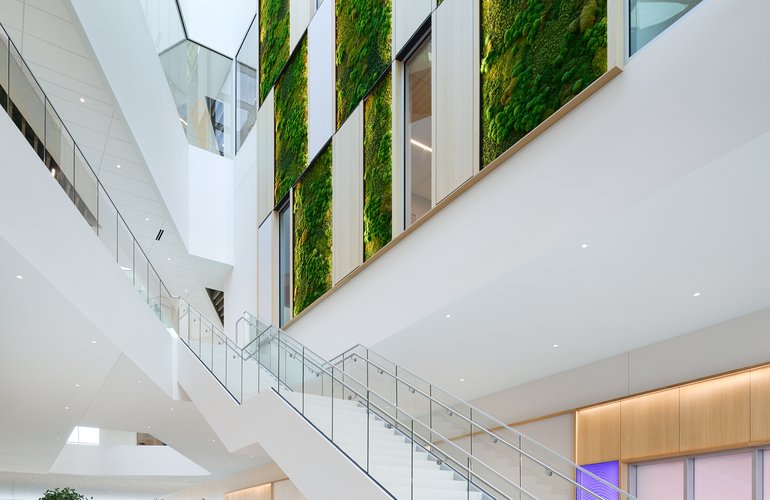
Open staircase in the Arbor Lakes atrium Image courtesy of Gaffner Photography