Scientists have designed and developed a proprietary non-precious metal oxygen evolution reaction (OER) catalyst featuring a layered structure optimized for anion exchange membrane water electrolysis (AEMWE) environments. The study proposes a novel catalyst design strategy capable of simultaneously achieving high efficiency and durability while reducing reliance on expensive precious metal catalysts.
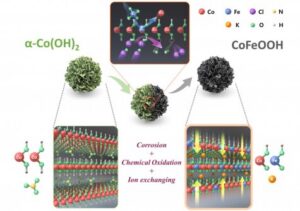
Schematic Illustration of the Structural Evolution of the Layered Oxyhydroxide (CoFeOOH) Catalyst. Credit: KIMS
AEMWE operates under alkaline conditions, allowing for the use of lower-cost non-precious metal catalysts instead of expensive precious metals. However, the lack of non-precious metal OER catalysts capable of long-term stable operation in alkaline environments has prevented the complete elimination of reliance on precious metal catalysts in practical systems. Conventional transition metal-based catalysts have faced challenges in achieving durability, as prolonged operation leads to structural degradation, metal dissolution and a decline in catalytic activity.
Engineering the layered oxyhydroxide structure for enhanced charge transfer
To address these challenges, the research team engineered a cobalt and iron-based oxyhydroxide catalyst (CoFeOOH) with a layered structure and introduced a strategy capable of simultaneously controlling the electronic structure of the catalytically active surface and the reaction pathways. They demonstrated that a structurally stable catalytically active layer can be formed while facilitating efficient charge transfer during the oxygen evolution reaction process.
The research team introduced iron into the layered oxyhydroxide structure to effectively modulate the electronic state of the cobalt centers and to lower the energy barrier associated with the adsorption-desorption steps of reaction intermediates, which are critical to OER. As a result, the catalyst achieved high current densities even at low overpotential and maintained stable performance without structural degradation under prolonged operating conditions.
To suppress catalyst corrosion and structural degradation, the team developed a proprietary technique involving controlled chemical oxidation of the catalyst surface. Through this approach, they established a stable catalyst surface structure favorable for OER under alkaline conditions.
Validating performance and durability in industrial-scale unit cells
The new catalyst was directly applied to a unit cell of AEMWE, which achieved a current density of 2.0 A/cm2 at a voltage of 1.8 V at 50 °C in 1 M KOH. The catalyst exhibited an overpotential 33 mV lower than Co(OH)2 and 56 mV lower than CoOOH, with a long-term durability of 2,100 hours and a voltage degradation rate of 49 mV/kh.
The researchers demonstrated that non-precious metal OER catalysts can be practically implemented in AEMWE systems, thereby advancing the prospects for commercialization. Once commercialized, this technology could enable the development of cost-effective, high-efficiency AEMWE systems with minimized reliance on precious metals. It could also contribute to the expansion of clean hydrogen production and to strengthening technological self-reliance in key water electrolysis catalyst materials.