Ryan Davis and Nathan Bays, scientists at Sandia National Laboratories, set out to find a better way to absorb and degrade per- and polyfluoroalkyl substances (PFAS) in water sources, but quickly discovered that detecting the chemicals in the water took too long. They pivoted and have developed a faster, cheaper way to test for PFAS in water, and the method could be adapted to other uses.
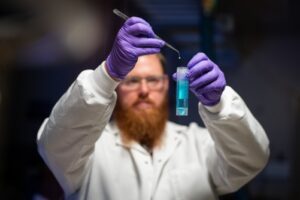
Nathan Bays adds a tiny adsorbent particle to a solution containing an analyte of interest (e.g. PFAS) for analysis using their developed ISA-DESI technique. Credit: (Craig Fritz/Sandia National Laboratories)
PFAS are commonly found in drinking water, soil, waste sites, foods and food packaging, household products and more. Studies have shown that exposure to certain levels of PFAS can cause reproductive effects such as decreased fertility, developmental effects in children, increased risk of cancer, reduced immune response and increased cholesterol. PFAS break down very slowly, which is why they have been nicknamed “forever chemicals,” and can build up in humans, animals and the environment.
Davis has spent years developing technologies that can eliminate PFAS. But his research has been time-consuming, largely because of the time it takes to test a sample for PFAS. Depending on the concentration, it can take anywhere from hours to days to test a single sample.
The current method, solid-phase extraction (SPE), involves draining the liquid through a column to concentrate the sample for testing. “We were running into the same issues as everyone else,” Bays explained. “We have a lot of samples to test and a very slow flow of analysis going on.”
Enabling faster testing with less sample
Davis and Bays developed a new method that uses desorption electrospray ionization (DESI) mass spectrometry, which sprays electrically charged microdroplets at a surface.
“You have this concentrated PFAS sample being bombarded with this electrically charged spray, and then that charge transfers to the PFAS, which then comes off the surface and gets sucked up into the instrument. And so it’s a way that we can indirectly analyze a solution, but do it much more quickly,” Bays said.

An adsorbent particle containing the analyte of interest (e.g. PFAS) is sprayed with charged droplets which splash off the surface and are captured by a metal tube and carried into a mass spectrometer for analysis. A process known as desorption electrospray ionization. Credit: (Craig Fritz/Sandia National Laboratories)
To test a sample for PFAS, a scientist would take a small adsorbent particle, let it sit in the sample for a few minutes and then put the particle in front of the nozzle on the spectrometer.
“We envision this being the field-deployable technique, where you could take it up to a river or a body of water outside of the lab and do your sampling,” Davis said. “And previously, if you want to do your sampling and take it back to the lab, you’d be carrying liters and liters of water back. So it’s going to enable some PFAS testing in a much easier way than before as well.”
The particle grabs onto molecules in the water sample, including PFAS. Then the mass spectrometer sorts the molecules based on their mass, allowing the scientists to see if PFAS are present and their concentrations.
It took the team months to make this test almost as sensitive as the Environmental Protection Agency (EPA) standard. The DESI method has a sensitivity of five parts per trillion (ppt) while the standard is four ppt. One of the ways they improved the sensitivity was by removing contamination inside the mass spectrometer, Davis said. They did so by ensuring that the instrument was only used for the PFAS test.
Looking ahead: working in tandem with SPE
The scientists also tested the method’s ability to detect ibuprofen as well as some personal care products and other pharmaceuticals. While the technique is optimized for PFAS, it was able to detect other contaminants.
The researchers are looking for commercial partners to bring the test to market. They are also hoping to benchmark the technique against the standard EPA methods. They see their test as a complementary method to the standard technique.
“I still think there’s always going to be that EPA industry standard. It’s very slow. It’s methodical. It will work. But in tandem with that, having a process like this that we can get results and turn over data faster, I think they work very well together,” Davis said.