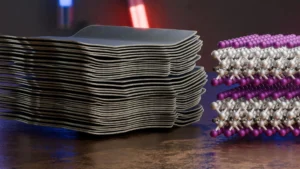
A composite view of a synthesized MXene, combining a model based on scanning electron microscopy at left with a visualization of the underlying crystal lattice. The triphasic etching method produces the uniform halogen surface terminations shown in the atomic model. Credit: HZDR/B. Schröder
MXenes, a family of two-dimensional transition metal carbides and nitrides, have drawn interest for applications including EMI shielding, energy storage, electrocatalysis and high-speed optoelectronics. But a persistent surface chemistry problem has limited their performance. Standard synthesis routes typically leave MXene surfaces with a disordered mix of oxygen, hydroxyl and fluorine terminations, which can trap and scatter electrons, reduce conductivity and accelerate oxidation in air.
A team led by Xinliang Feng of TU Dresden and the Max Planck Institute of Microstructure Physics, Minghao Yu of TU Dresden and Hai I. Wang of the Max Planck Institute for Polymer Research has now developed a gas-liquid-solid triphasic etching strategy that produces MXenes with uniform halogen terminations. Reporting in Nature Synthesis, the researchers found that the cleaner surface chemistry delivered a 160-fold increase in macroscopic conductivity relative to a Cl/O-mixed reference material, along with markedly better air stability.
The team synthesized Ti3C2Cl2, Ti3C2Br2 and Ti3C2I2 from Ti3AlC2, reporting single-batch yields of 81%, 83% and 85%, respectively. The approach also extended to seven additional MAX phases and was demonstrated at a 10 g single-batch scale. That data suggests a broader route to MXenes with more controlled surface chemistry.
In film measurements, Ti3C2Cl2 lost only 12.5% of its conductivity after four weeks of air exposure, while the Cl/O-mixed comparison material dropped 86.5% over the same period. The paper also reports controlled dual- and triple-halogen terminations. This points to a wider design space for tuning MXene properties for electronic and electromagnetic applications.