Research & Development World

  • R&D World Home
  • Topics
    • Aerospace
    • Automotive
    • Biotech
    • Careers
    • Chemistry
    • Environment
    • Energy
    • Life Science
    • Material Science
    • R&D Management
    • Physics
  • Technology
    • 3D Printing
    • A.I./Robotics
    • Software
    • Battery Technology
    • Controlled Environments
      • Cleanrooms
      • Graphene
      • Lasers
      • Regulations/Standards
      • Sensors
    • Imaging
    • Nanotechnology
    • Scientific Computing
      • Big Data
      • HPC/Supercomputing
      • Informatics
      • Security
    • Semiconductors
  • R&D Market Pulse
  • R&D 100
    • 2025 R&D 100 Award Winners
    • 2025 Professional Award Winners
    • 2025 Special Recognition Winners
    • R&D 100 Awards Event
    • R&D 100 Submissions
    • Winner Archive
  • Resources
    • Research Reports
    • Digital Issues
    • Educational Assets
    • R&D Index
    • Subscribe
    • Video
    • Webinars
    • Content submission guidelines for R&D World
  • Global Funding Forecast
  • Top Labs
  • Advertise
  • SUBSCRIBE

Liquid’s Structure Holds Secret to Metallic Glass

By William Weir, Yale University | February 26, 2019

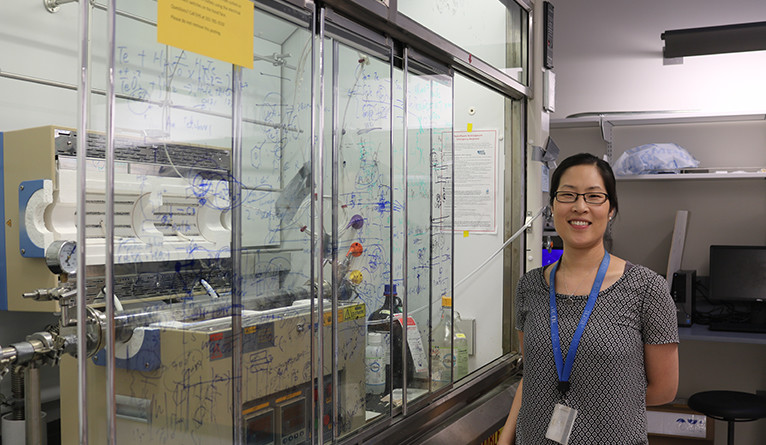
Judy Cha in her Yale lab. Image: Yale University

Researchers have found that liquid has structure in certain circumstances, and that this structure significantly influences the mysterious and complex formation of metallic glasses.

Moldable like plastic but strong like metal, metallic glasses are a relatively new class of materials made from complex, multicomponent alloys. Their unique properties come from how their atoms settle into a random arrangement when they cool from a liquid to a solid. But controlling this process — and fully capitalizing on these materials—has proved tricky, since so much is still unknown about what happens in the cooling process.

A new study, published in Nature Communications, provides some answers.

The researchers, led by Judy Cha, the Carol and Douglas Melamed Assistant Professor of Mechanical Engineering & Materials Science, found that metallic glasses in the liquid state will periodically form crystalline structures—their freely moving atoms arrange themselves into certain patterns. This happens at the interface of the liquid and the solid—that is, when the molten material has partially solidified, the adjacent liquid forms a structure that causes the solid portion to grow up to 20 times faster than it otherwise would.

“We’re highlighting that gap in our knowledge,” said Cha, who’s also a member of Yale’s Energy Sciences Institute on the West Campus. “The field of crystallization is very mature, but the fundamental questions remain open.”

For the study, the researchers used transmission electron microscopy to observe in real time the crystallization process in nanoscale-sized rods of metallic glass. Being able to observe the material at the atomic scale, they found that the metallic glass would crystallize at a rate of 15 to 20 atoms per second if the liquid formed a structure. When it didn’t have a structure, the rate was about three to five atoms per second.

Yujun Xie, a Ph.D. candidate in Cha’s lab and lead author of the paper, said the next step is to broaden the applications of what they’ve learned.

“How does our study give some insight into the formation of other materials, and how can we engineer other materials’ formation and structure?” he said. 

The study’s other authors are Sungwoo Sohn, Minglei Wang, Huolin Xin, Mark D. Shattuck, Corey S. O’Hern, and Jan Schroers.

Related Articles Read More >

R&D 100 winner LLNL achieves 1,000x speed boost in 3D nanofabrication
CEA-Leti achieves 400°C CMOS fabrication milestone for 3D chip stacking
The 2025 R&D 100 Finalists are here
New nanotechnology method increases microalgae biofuel yield by 300%
rd newsletter
EXPAND YOUR KNOWLEDGE AND STAY CONNECTED
Get the latest info on technologies, trends, and strategies in Research & Development.
RD 25 Power Index

R&D World Digital Issues

Fall 2025 issue

Browse the most current issue of R&D World and back issues in an easy to use high quality format. Clip, share and download with the leading R&D magazine today.

R&D 100 Awards
Research & Development World
  • Subscribe to R&D World Magazine
  • Sign up for R&D World’s newsletter
  • Contact Us
  • About Us
  • Drug Discovery & Development
  • Pharmaceutical Processing
  • Global Funding Forecast

Copyright © 2026 WTWH Media LLC. All Rights Reserved. The material on this site may not be reproduced, distributed, transmitted, cached or otherwise used, except with the prior written permission of WTWH Media
Privacy Policy | Advertising | About Us

Search R&D World

  • R&D World Home
  • Topics
    • Aerospace
    • Automotive
    • Biotech
    • Careers
    • Chemistry
    • Environment
    • Energy
    • Life Science
    • Material Science
    • R&D Management
    • Physics
  • Technology
    • 3D Printing
    • A.I./Robotics
    • Software
    • Battery Technology
    • Controlled Environments
      • Cleanrooms
      • Graphene
      • Lasers
      • Regulations/Standards
      • Sensors
    • Imaging
    • Nanotechnology
    • Scientific Computing
      • Big Data
      • HPC/Supercomputing
      • Informatics
      • Security
    • Semiconductors
  • R&D Market Pulse
  • R&D 100
    • 2025 R&D 100 Award Winners
    • 2025 Professional Award Winners
    • 2025 Special Recognition Winners
    • R&D 100 Awards Event
    • R&D 100 Submissions
    • Winner Archive
  • Resources
    • Research Reports
    • Digital Issues
    • Educational Assets
    • R&D Index
    • Subscribe
    • Video
    • Webinars
    • Content submission guidelines for R&D World
  • Global Funding Forecast
  • Top Labs
  • Advertise
  • SUBSCRIBE