Research & Development World

  • R&D World Home
  • Topics
    • Aerospace
    • Automotive
    • Biotech
    • Careers
    • Chemistry
    • Environment
    • Energy
    • Life Science
    • Material Science
    • R&D Management
    • Physics
  • Technology
    • 3D Printing
    • A.I./Robotics
    • Software
    • Battery Technology
    • Controlled Environments
      • Cleanrooms
      • Graphene
      • Lasers
      • Regulations/Standards
      • Sensors
    • Imaging
    • Nanotechnology
    • Scientific Computing
      • Big Data
      • HPC/Supercomputing
      • Informatics
      • Security
    • Semiconductors
  • R&D Market Pulse
  • R&D 100
    • 2025 R&D 100 Award Winners
    • 2025 Professional Award Winners
    • 2025 Special Recognition Winners
    • R&D 100 Awards Event
    • R&D 100 Submissions
    • Winner Archive
  • Resources
    • Research Reports
    • Digital Issues
    • Educational Assets
    • R&D Index
    • Subscribe
    • Video
    • Webinars
    • Content submission guidelines for R&D World
  • Global Funding Forecast
  • Top Labs
  • Advertise
  • SUBSCRIBE

Live Long and Diagnose

By University of Glasgow | September 24, 2018

A Star Trek-inspired handheld device based on a silicon chip could help make rapid, sophisticated medical diagnostics more accessible to people around the world, scientists say.

In a new paper published in the journal Biosensors and Bioelectronics, researchers from the University of Glasgow describe the latest development in their “multicorder” project, inspired by Star Trek’s famous tricorder device, which the show’s medics use to make quick and accurate diagnoses.

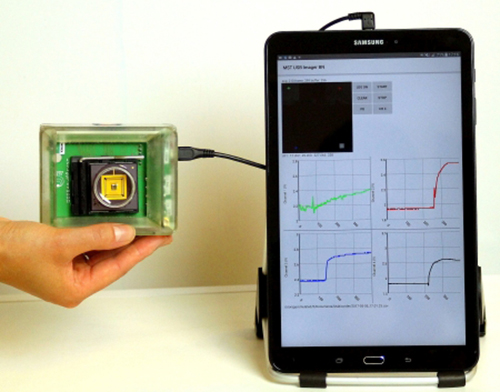
Their new device which pairs a handheld sensor with a smartphone app to measure the levels of various metabolites in fluid samples from patients.

Metabolites are small molecules found in fluids from the human body. By measuring and monitoring their relative abundance, scientists can keep track of general heath or the progression of specific diseases.

The ability to rapidly detect and quantify multiple metabolite biomarkers simultaneously makes this device particularly useful in cases of heart attack, cancer and stroke, where rapid diagnosis is vital for effective treatment.

While metabolites can currently be measured by existing processes such as nuclear magnetic resonance and hyphenated mass spectrometry techniques, both approaches are expensive and require bulky equipment which can be slow to offer diagnostic results.

The researchers’ new device is built around a new form of complementary metal oxide semiconductor (CMOS) chip. CMOS chips are inexpensive to produce and are often used in imaging devices.

The chip is smaller than a fingertip and is divided into multiple reaction zones to detect and quantify four metabolites simultaneously from body fluid such as serum or urine. The device can be operated via any Android-based tablet or smartphone which provides data acquisition, computation, visualization and power.
Dr. Samadhan Patil of the University of Glasgow’s School of Engineering is lead author on the paper.

Patil says: “We have been able to detect and measure multiple metabolites associated with myocardial infarction, or heart attack, and prostate cancer simultaneously using this device. This device has potential to track progression of the disease in its early phase and is ideally suited for the subsequent prognosis.”

Professor David Cumming, Principal Investigator of the project from University’s School of Engineering, says, “Handheld, inexpensive diagnostic devices capable of accurately measuring metabolites open up a wide range of applications for medicine, and with this latest development we’ve taken an important step closer to bringing such a device to market.”

“It’s an exciting breakthrough and we’re keen to continue building on the technology we’ve developed so far.”

Professor Mike Barrett of the University’s School of Life Sciences, co-investigator of the project, says, “This new handheld device offers democratization of metabolomics, which is otherwise confined within the laboratory, and offers low cost alternative to study complex pathways in different diseases”.

The paper, titled “An integrated portable system for single chip simultaneous measurement of multiple disease associated metabolites,” is published in Biosensors and Bioelectronics.

The project was supported by funding from the Engineering and Physical Sciences Research Council (EPSRC).

Source: University of Glasgow
Related Articles Read More >

R&D 100 winner flags even unknown fentanyl analogs
New nanopore sensor paves the way for fast, accurate, low-cost DNA sequencing
IoT
Sensor data, reimagined: When 90% less data can fuel 100x gains in efficiency in AI projects
Sandia Labs joins with other institutions to tackle AI energy challenges with microelectronics research
rd newsletter
EXPAND YOUR KNOWLEDGE AND STAY CONNECTED
Get the latest info on technologies, trends, and strategies in Research & Development.
RD 25 Power Index

R&D World Digital Issues

Fall 2025 issue

Browse the most current issue of R&D World and back issues in an easy to use high quality format. Clip, share and download with the leading R&D magazine today.

R&D 100 Awards
Research & Development World
  • Subscribe to R&D World Magazine
  • Sign up for R&D World’s newsletter
  • Contact Us
  • About Us
  • Drug Discovery & Development
  • Pharmaceutical Processing
  • Global Funding Forecast

Copyright © 2025 WTWH Media LLC. All Rights Reserved. The material on this site may not be reproduced, distributed, transmitted, cached or otherwise used, except with the prior written permission of WTWH Media
Privacy Policy | Advertising | About Us

Search R&D World

  • R&D World Home
  • Topics
    • Aerospace
    • Automotive
    • Biotech
    • Careers
    • Chemistry
    • Environment
    • Energy
    • Life Science
    • Material Science
    • R&D Management
    • Physics
  • Technology
    • 3D Printing
    • A.I./Robotics
    • Software
    • Battery Technology
    • Controlled Environments
      • Cleanrooms
      • Graphene
      • Lasers
      • Regulations/Standards
      • Sensors
    • Imaging
    • Nanotechnology
    • Scientific Computing
      • Big Data
      • HPC/Supercomputing
      • Informatics
      • Security
    • Semiconductors
  • R&D Market Pulse
  • R&D 100
    • 2025 R&D 100 Award Winners
    • 2025 Professional Award Winners
    • 2025 Special Recognition Winners
    • R&D 100 Awards Event
    • R&D 100 Submissions
    • Winner Archive
  • Resources
    • Research Reports
    • Digital Issues
    • Educational Assets
    • R&D Index
    • Subscribe
    • Video
    • Webinars
    • Content submission guidelines for R&D World
  • Global Funding Forecast
  • Top Labs
  • Advertise
  • SUBSCRIBE