Exploring SiC, GaN and 2D materials in high-power and high-frequency applications

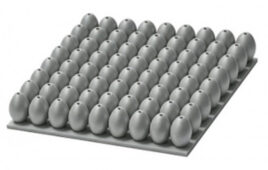
Image of a silicon carbide wafer processed at X-Fab. Image from the U.S. Department of Energy.
For more than half a century, silicon has been the primary material in semiconductor technology. Its mature processing infrastructure and favorable electronic properties made it the default choice for most electronic devices. As demands for higher power density, faster switching and greater energy efficiency grow, particularly in electric vehicles (EVs), renewable energy systems and 5G/6G communications, silicon is approaching practical performance limits.
A new generation of materials is extending performance beyond silicon. Wide-bandgap semiconductors such as silicon carbide (SiC) and gallium nitride (GaN), along with emerging 2D materials including graphene and transition-metal dichalcogenides (TMDs), are moving into high-power and high-frequency applications.
The shift to wide bandgap semiconductors
Central to the shift is the bandgap, the energy difference between the valence and conduction bands that governs electrical conduction. Silicon has a bandgap of 1.1 eV; SiC is about 3.3 eV and GaN about 3.4 eV. A wider bandgap supports higher breakdown voltages, faster switching and greater thermal stability.
As a result, SiC- and GaN-based devices can operate at higher voltages and temperatures with lower power loss, enabling smaller, lighter, more efficient systems. In EVs, renewable power inverters and industrial drives, this delivers tangible gains in efficiency, power density and thermal margin.
Silicon carbide is driving the electrification era
SiC has emerged as the leading candidate for high-power applications due to its ability to withstand extreme conditions. In power modules for EV traction inverters, SiC devices can operate at temperatures above 200°C and at voltages exceeding 1.2 kV with lower switching losses than their silicon IGBT counterparts.
The benefits extend beyond efficiency. The higher switching frequency of SiC MOSFETs reduces the size and weight of passive components, such as inductors and capacitors, leading to more compact, lighter systems. This reduction in system-level losses directly contributes to extended EV range and faster charging.
Materials and manufacturing challenges, however, persist. SiC substrates are difficult to grow defect-free; micropipes, basal plane dislocations and stacking faults can significantly degrade device performance and reliability. Advanced crystal growth techniques such as physical vapor transport (PVT) and improved epitaxial growth control have been key to enhancing wafer quality and yield.
Testing and characterization also play a vital role. Deep-level transient spectroscopy (DLTS), transmission electron microscopy (TEM) and cathodoluminescence mapping are among the tools now used to identify defect types and densities in SiC wafers. These diagnostic methods are helping manufacturers refine processes and predict long-term reliability, especially under thermal and electrical stress.
Gallium nitride: The high-frequency workhorse
While SiC dominates in high-voltage, high-power applications, GaN is proving indispensable in high-frequency domains: from RF amplifiers and satellite communications to fast chargers and data centers.
GaN’s electron mobility is more than five times that of silicon, allowing faster switching and lower conduction losses. Its high electron saturation velocity enables operation at GHz frequencies, making it ideal for 5G base stations and radar systems.
The key device architecture in power electronics is the GaN-on-Si HEMT (High-Electron-Mobility Transistor). This heterostructure, combining a GaN layer grown on silicon, provides both performance and cost advantages. However, mismatches in lattice constants and thermal expansion coefficients between GaN and Si result in stress-induced dislocations. Alternative substrates such as SiC and sapphire mitigate these issues, but at a higher cost.
Reliability remains a significant focus. GaN HEMTs are susceptible to dynamic RON degradation, trapping effects, and gate leakage.
Accelerated stress testing — including HTRB and step-stress gate-voltage testing — is used to model long-term performance.
New passivation schemes and advanced buffer layers are helping to suppress trapping phenomena, improving stability under repetitive switching.
Why 2D materials are the frontier of nanoelectronics
Beyond SiC and GaN lies a class of two-dimensional (2D) materials that could revolutionize semiconductor performance in ways even wide bandgap materials cannot. Graphene, with its exceptional carrier mobility (up to 200,000 cm²/V·s) and transition-metal dichalcogenides (TMDs) such as MoS₂ and WS₂ are being explored for ultra-thin transistors, sensors and flexible electronics.
Unlike bulk materials, 2D materials can be stacked into atomic layers, enabling unprecedented control over their band structures and electronic properties. For example, MoS₂ offers a direct bandgap of ~1.8 eV in monolayer form, making it suitable for digital logic and optoelectronic applications.
However, integrating 2D materials into existing semiconductor manufacturing flows is a formidable challenge. Uniform wafer-scale growth, defect control and reproducible contact formation remain unresolved. Chemical vapor deposition (CVD) processes are being refined for scalable production. At the same time, metrology techniques like Raman spectroscopy and atomic force microscopy (AFM) are crucial for assessing layer thickness, uniformity and defect density.
In power and high-frequency electronics, research efforts are focusing on heterogeneous integration — combining 2D materials with SiC or GaN devices to create hybrid architectures that leverage the advantages of each material system. This could pave the way for low-loss, high-efficiency systems that surpass today’s performance benchmarks.
Thermal management and reliability
As power density increases, thermal management becomes a critical limiting factor. Even though wide bandgap materials can operate at higher junction temperatures, maintaining consistent thermal performance is vital for long-term reliability.
Advanced thermal interface materials (TIMs), diamond composites and microfluidic cooling solutions are being explored to manage heat dissipation in SiC and GaN devices. Material characterization, including thermal conductivity measurement (using laser flash analysis) and interfacial resistance testing, ensures that new packaging architectures can support higher power densities without degradation.
Reliability testing, such as power cycling, thermal shock and high-temperature gate bias stress, provides essential data on device lifetime. Incorporating these metrics early in the design phase allows manufacturers to build predictive reliability models, reducing field failures and qualification time.
Toward a post-silicon ecosystem
The transition beyond silicon is a redefinition of the entire semiconductor value chain. From substrate growth and wafer processing to packaging and reliability validation, each stage demands new process innovations and testing methodologies.
Collaboration between material scientists, device engineers and system designers will be essential. For instance, integrating SiC and GaN into the same power module (so-called hybrid modules) allows optimization of both high- and low-voltage sections of a system. Similarly, embedding 2D materials for on-chip sensing or thermal monitoring can provide real-time data feedback for adaptive control.
Standardization will also be critical. Developing unified test protocols and reliability standards for wide bandgap and 2D materials will accelerate commercialization while ensuring interoperability across supply chains.
The materials race for the future
The semiconductor industry is entering an era where materials science is the new Moore’s Law. As transistor scaling reaches physical limits, breakthroughs in materials, not lithography, will dictate progress.
Silicon carbide is electrifying vehicles, gallium nitride is empowering communications and 2D materials are expanding the horizon of nanoelectronics. The convergence of these materials, coupled with advances in testing, metrology and manufacturing, could shape a post-silicon future. That future could be defined not only by how small we can make transistors, but by how intelligently we can design and qualify the materials that power them.
Pradyumna (“Prady”) Gupta, Ph.D., is founder and chief scientist of Infinita Lab, a materials-testing marketplace connecting engineers with 2,000-plus metrology and product-validation labs across semiconductors, batteries, EVs and aerospace.