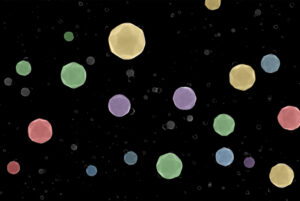
Colored scanning electron microscopy image showing multiple high-index-facet high-entropy alloy nanoparticles. Image courtesy of Northwestern.
High-entropy alloys have long looked promising as catalysts because combining five or more metals can create unusually rich reactive surfaces. But researchers have struggled to control the nanoscale surface structures that shape how those particles perform. Now, a Northwestern team reports a three-step synthesis that controls both composition and surface facets in HEA nanoparticles. Applied to the group’s megalibrary platform, the method generated about 36 million nanoparticles across 90,000 compositions on a single chip.
A team led by Chad Mirkin and Christopher Wolverton at Northwestern reports a synthesis that solves both halves of the problem at once, controlling composition and surface faceting simultaneously. The work appears in the Journal of the American Chemical Society.
In the three-step route, target metals are first alloyed into liquid gallium, which acts as a nanoscale solvent and produces a well-mixed particle. A volatile element (tellurium, antimony or bismuth) is then alloyed into the particle. Most of the volatile species is evaporated at high temperature. That leaves a trace surface layer that shifts the surface energy landscape and locks the particle into a tetrahexahedral shape with exposed high-index facets. Density functional theory calculations from the Wolverton group confirmed the mechanism, and the team demonstrated the approach across seven different multi-metallic systems.
High-index facets, with stepped and kinked atomic arrangements, expose a higher density of undercoordinated atoms than the flatter low-index faces that most syntheses default to. They are more reactive and harder to stabilize, which is why prior HEA syntheses essentially could not get them.
“High-entropy alloys have been a black box for catalysis because you could never control the surface,” Mirkin said in a statement. “We fixed that, and we did it in a way that works across different metals and different chemistries.”
The synthesis was then ported onto Mirkin’s megalibrary platform, which uses polymer pen lithography and scanning probe block copolymer lithography to deposit millions of distinct nanoreactors on a single centimeter-scale chip. Each nanoreactor produces one composition-defined particle. The resulting chip carries roughly 36 million HEA nanoparticles spanning 90,000 unique compositions, now with controllable high-index surfaces.
HEA composition space is enormous by design. A five-element alloy drawn from the usual transition-metal palette produces a combinatorial explosion that conventional one-at-a-time synthesis cannot meaningfully sample. Megalibraries previously identified a non-iridium replacement catalyst for the oxygen evolution reaction, a bottleneck in clean hydrogen production, in roughly an afternoon. Extending the platform to faceted HEAs broadens the accessible catalyst space rather than just sampling it more densely.
The research was supported by the U.S. Army DEVCOM Army Research Office, the Air Force, BioMADE, the Department of Energy, Toyota Research Institute, and Mattiq Inc. Mirkin has financial interests in Mattiq, a Northwestern spinout commercializing megalibrary-derived catalysts, and Northwestern holds related IP.