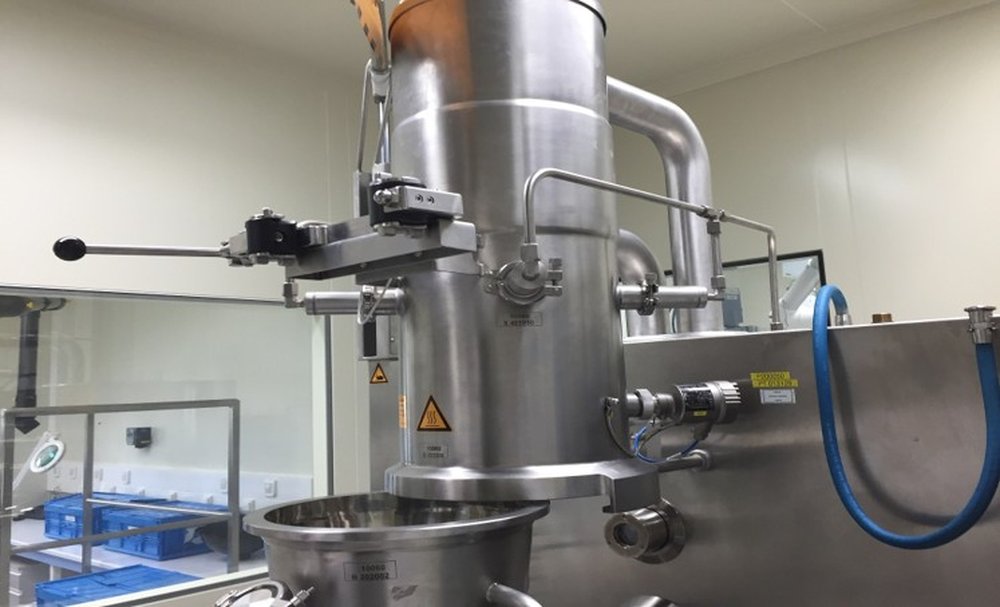
A pharmaceutical spray dryer installed in a cleanroom environment. The transition from lab-scale to commercial spray drying introduces challenges including wall sticking, agglomeration, and particle size distribution changes that can reduce commercial yield. Image courtesy of Genesis AEC.
How facility design, containment, and cleaning validation decisions determine commercial yield and time-to-market.
Scaling spray drying from lab success to commercial production is one of the most complex transitions in pharmaceutical manufacturing. While early-stage results may appear promising, many organizations underestimate how facility design, safety systems, and day-to-day operations affect performance at scale. These oversights are among the most common spray drying scale-up mistakes and often lead to delays, failed validation efforts, and reduced commercial yield.
It is critical to avoid these five pitfalls.
1. Falling for the “scale-up illusion”
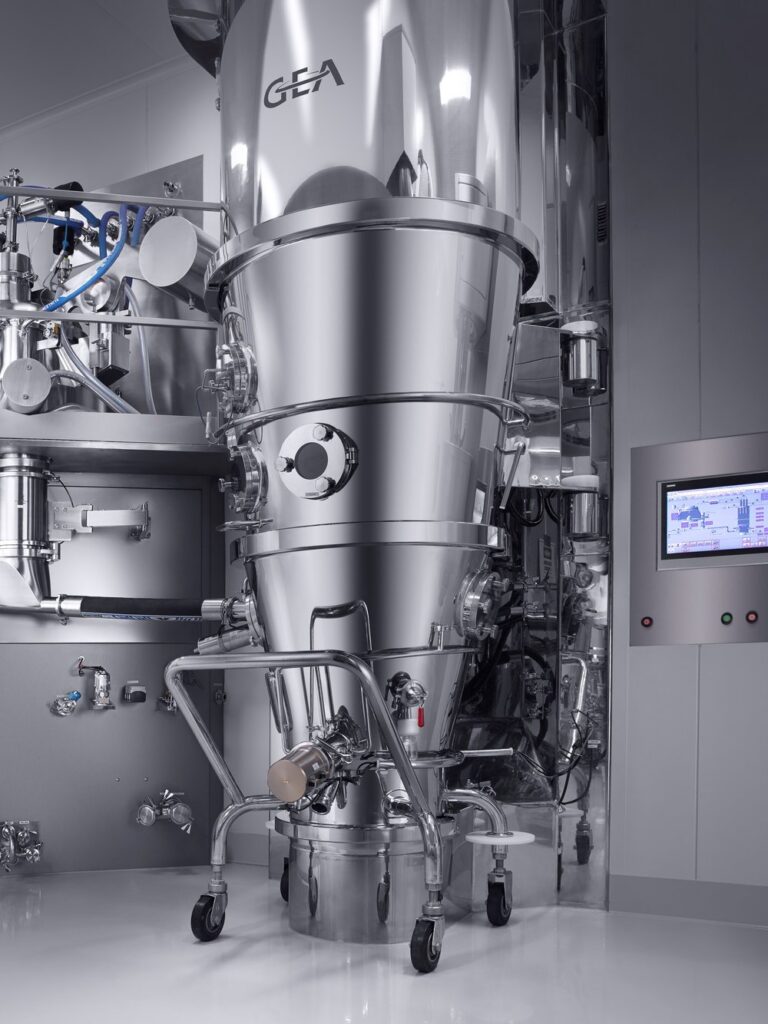
A commercial-scale spray dryer. At this size, factors such as airflow dynamics, heat transfer, and slurry homogeneity introduce challenges not seen at the lab scale, including wall sticking, agglomeration, and particle size distribution shifts. (Genesis AEC)
Processes that perform well in a lab environment often struggle in a 20-foot drying chamber, where airflow, heat transfer, slurry homogeneity, and particle behavior introduce new challenges such as wall sticking, agglomeration, atomizer or nozzle clogging, and out-of-parameter particle size distribution. The result is often a significant drop in commercial yield. A 20% loss in yield at scale does not just impact efficiency; it can severely undermine the return on a large capital investment and threaten the long-term viability of the product.
2. Underestimating infrastructure and safety risks
Spray drying with organic solvents at scale introduces serious explosion hazards that are not always present during lab testing. Designing equipment and facilities to manage these risks safely requires more than minor upgrades. It often calls for major capital investments in fire and explosion suppression and nitrogen inerting systems, as well as accurate electrical classification and division design for the drying chamber and associated areas, sealed conduits, controlled access, and strict adherence to regulatory standards and operating procedures. Overlooking these factors in the early design phase can lead to hidden costs, late-stage redesigns, and permitting delays that push product launch back by six to twelve months, with direct impact on revenue and market competitiveness.
3. Fragmented procurement and specification gaps
One recent example of a foreseeable delay involved a secondary dryer purchased for final drying of a spray-dried product. The factory built the dryer to the explosion-proof design specification and conducted a witnessed factory acceptance test (FAT). After installation in a Class I, Division 2 room adjacent to the spray dryer, a third party executing the site acceptance test (SAT) discovered that the electrical components within the secondary dryer control cabinet were not rated for Class I, Division 2 service. This caused a significant startup delay that could have been prevented by rigorous equipment specifications and a thorough review of submittals.
4. Treating containment as an afterthought
When working with high-potency APIs, containment must be a core component of pharmaceutical facility design, not a late-stage add-on. Retrofitting equipment with split butterfly valves (SBVs), upgrading material dispensing stations to include isolators, adding floor drains for contained process waste, or finding space for additional gowning and airlocks in an existing spray drying operation is not only expensive but often impractical because of space, airflow, and compliance constraints. Mid-project retrofits can trigger cascading delays, budget overruns, and increased regulatory scrutiny. Designing for containment and hazard control from the outset is significantly more cost-effective and supports operator safety, regulatory compliance, and smoother project execution.
5. Ignoring operational friction and cleaning validation
Spray-dried powders can be difficult to handle, particularly when formulations have a low glass transition temperature. Without appropriate system controls and facility design, cleaning becomes a major operational bottleneck. Cleaning validation can quickly turn into a prolonged, resource-intensive effort, with equipment sitting idle for days between batches. This downtime reduces production capacity, disrupts scheduling, increases labor costs, and limits a facility’s ability to meet market demand.
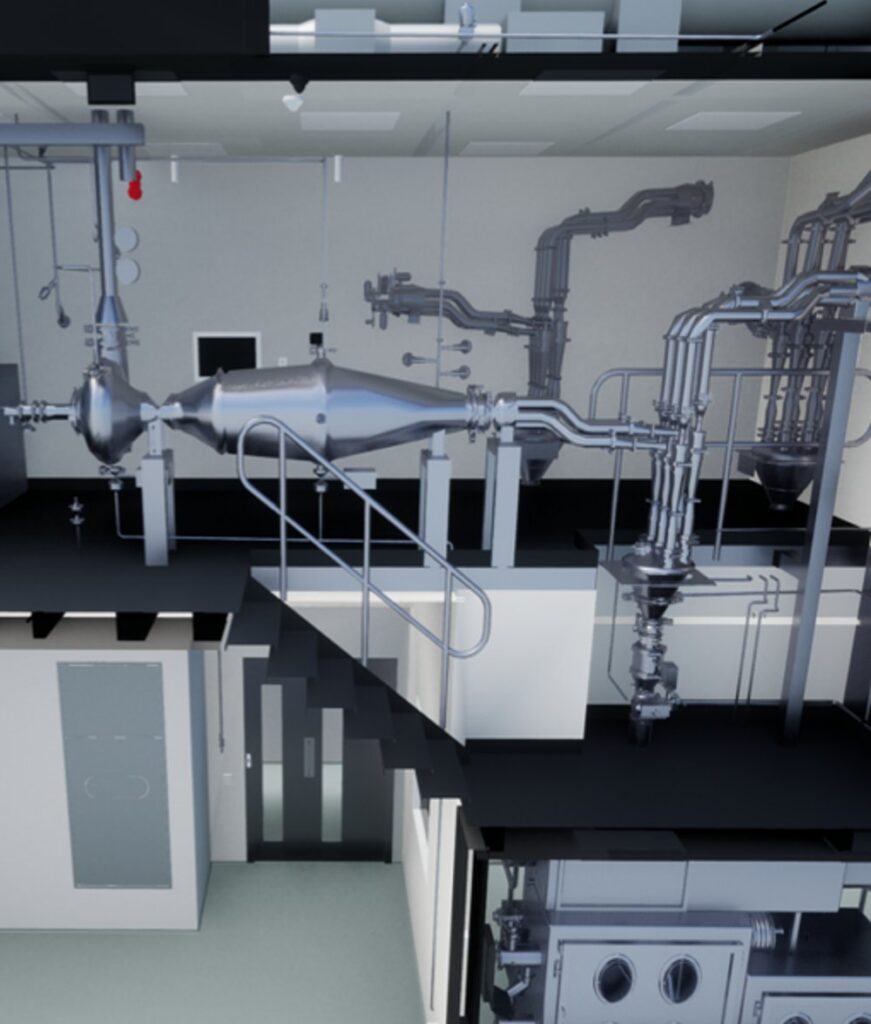
A 3D rendering of a commercial spray drying facility layout, illustrating the integrated process train including the drying chamber, cyclone separator, powder handling, and associated piping and safety infrastructure. (Genesis AEC)
The path forward: integrated design
Avoiding these mistakes requires a holistic approach that integrates process knowledge with pharmaceutical facility design expertise. A process-led strategy that addresses solvent handling, containment, cleaning validation, and infrastructure planning early in the project lifecycle helps organizations move beyond simply “building a facility” to protecting commercial yield, ensuring operational predictability, and safeguarding the business case for the product. Success in large-scale spray drying depends on more than the equipment on the floor; it requires cross-disciplinary foresight to understand how today’s technical decisions influence tomorrow’s market performance.



Tell Us What You Think!
You must be logged in to post a comment.