Research & Development World

  • R&D World Home
  • Topics
    • Aerospace
    • Automotive
    • Biotech
    • Careers
    • Chemistry
    • Environment
    • Energy
    • Life Science
    • Material Science
    • R&D Management
    • Physics
  • Technology
    • 3D Printing
    • A.I./Robotics
    • Software
    • Battery Technology
    • Controlled Environments
      • Cleanrooms
      • Graphene
      • Lasers
      • Regulations/Standards
      • Sensors
    • Imaging
    • Nanotechnology
    • Scientific Computing
      • Big Data
      • HPC/Supercomputing
      • Informatics
      • Security
    • Semiconductors
  • R&D Market Pulse
  • R&D 100
    • 2025 R&D 100 Award Winners
    • 2025 Professional Award Winners
    • 2025 Special Recognition Winners
    • R&D 100 Awards Event
    • R&D 100 Submissions
    • Winner Archive
  • Resources
    • Research Reports
    • Digital Issues
    • Educational Assets
    • Subscribe
    • Video
    • Webinars
    • PharmSci360
    • Content submission guidelines for R&D World
  • Global Funding Forecast
  • Top Labs
  • Advertise
  • SUBSCRIBE

Microscale Energy Storage Units Advance Wearables, Electronics

By King Abdullah University of Science & Technology | November 21, 2016

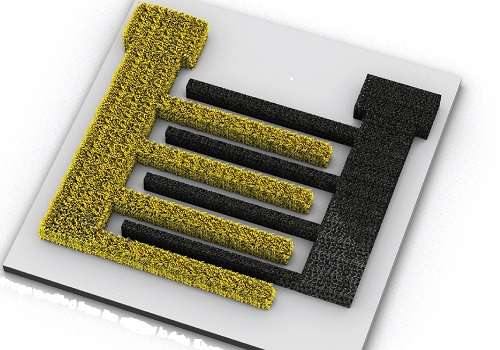
Three-dimensional porous electrodes could lead to smaller and efficient integrated power sources. Image: John Wiley and Sons

Energy storage units that can be integrated into wearable and flexible electronic systems are becoming increasingly important in today’s world. A research team from King Abdullah University of Science and Technology (KAUST) has now developed a microsupercapacitor that exploits three-dimensional porous electrodes. These micropower units are expected to enable a new generation of “smart” products, such as self-powered sensors for wearables, security, structural health monitoring, and “Internet of things” applications.

However, for these units to be tiny yet still efficient, the highest energy density must go into the smallest area.

One approach to carrying this out is to construct microbatteries using films with a thickness of just a few micrometers or less and to replace traditional electrolytes with solid-state ones. Thin film batteries have demonstrated relatively high energy density, which is the amount of energy they can store in a given area. However, they are afflicted by limited cycle life and poor power density, meaning they are slow to charge and discharge.

Microsupercapacitors are a faster alternative, and these may prove suitable for applications requiring power pulsing and very long cycle life.

“Also, while batteries must be charged at a constant voltage, a supercapacitor charges most efficiently by drawing the maximum current that the source can supply, irrespective of voltage,” says KAUST Professor of Material Science and Engineering Husam Alshareef from the University’s Functional Nanomaterials & Devices group.

This makes supercapacitors more appealing for self-powered system applications where the power source may be intermittent.

Alshareef’s team has now developed integrated microsupercapacitors with vertically-scaled three-dimensional porous current collectors made from nickel foams to improve microsupercapacitor performance. The pores in the foam work to increase the surface area.

“This three-dimensional porous architecture allows excellent electrolyte permeability, good conductivity and faster ion transportation with maximum mass-loading of active material, which increase energy and power density in a given area,” Alshareef says.

The microsupercapacitors were also asymmetric, using two different electrode materials for the cathode (nickel cobalt sulfide) and anode (carbon nanofiber), which nearly doubled the operating voltage. As a result, while delivering high power density (four milliwatts per square centimeter), the microsupercapacitors had an energy density of 200 microwatt-hours per square centimeter.

This is superior to state-of-the-art microsupercapacitors, which achieve between one and forty microwatt-hours per square centimeter, and is comparable to various types of thin film batteries. These high capacities were maintained even after 10,000 operating cycles.

“The high energy and power density achieve in these devices may meet the demand of on-chip storage for various types of integrated microsystems,” notes KAUST Ph.D. student Qiu Jiang, the lead author of the study.
Source: King Abdullah University of Science and Technology

Related Articles Read More >

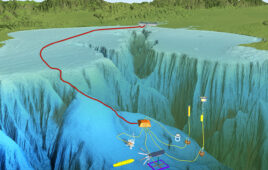
MBARI's Monterey Accelerated Research System (MARS) connects seafloor instruments to shore through a roughly 51-kilometer power and fiber-optic cable (red line) ending at a node about 891 meters down. The Geo-Sense system described in the new paper takes the opposite approach: a portable, battery-powered cable that records locally with no link to shore. Researchers used MARS's own fiber data to cross-check Geo-Sense's earthquake detections. Credit: MBARI
How lightweight AI startup Lightscline helped turn one to two years of seafloor data analysis into a two-month sprint
UC Riverside’s $5 fake drug detector uses toy robot sensors to catch counterfeit medications
R&D 100 winner flags even unknown fentanyl analogs
New nanopore sensor paves the way for fast, accurate, low-cost DNA sequencing
rd newsletter
EXPAND YOUR KNOWLEDGE AND STAY CONNECTED
Get the latest info on technologies, trends, and strategies in Research & Development.

R&D World Digital Issues

Fall 2025 issue

Browse the most current issue of R&D World and back issues in an easy to use high quality format. Clip, share and download with the leading R&D magazine today.

R&D 100 Awards
Research & Development World
  • Subscribe to R&D World Magazine
  • Sign up for R&D World’s newsletter
  • Contact Us
  • About Us
  • Drug Discovery & Development
  • Pharmaceutical Processing
  • Global Funding Forecast

Copyright © 2026 Arrowfly LLC. All Rights Reserved. The material on this site may not be reproduced, distributed, transmitted, cached or otherwise used, except with the prior written permission of Arrowfly
Privacy Policy | Advertising | About Us

Search R&D World

  • R&D World Home
  • Topics
    • Aerospace
    • Automotive
    • Biotech
    • Careers
    • Chemistry
    • Environment
    • Energy
    • Life Science
    • Material Science
    • R&D Management
    • Physics
  • Technology
    • 3D Printing
    • A.I./Robotics
    • Software
    • Battery Technology
    • Controlled Environments
      • Cleanrooms
      • Graphene
      • Lasers
      • Regulations/Standards
      • Sensors
    • Imaging
    • Nanotechnology
    • Scientific Computing
      • Big Data
      • HPC/Supercomputing
      • Informatics
      • Security
    • Semiconductors
  • R&D Market Pulse
  • R&D 100
    • 2025 R&D 100 Award Winners
    • 2025 Professional Award Winners
    • 2025 Special Recognition Winners
    • R&D 100 Awards Event
    • R&D 100 Submissions
    • Winner Archive
  • Resources
    • Research Reports
    • Digital Issues
    • Educational Assets
    • Subscribe
    • Video
    • Webinars
    • PharmSci360
    • Content submission guidelines for R&D World
  • Global Funding Forecast
  • Top Labs
  • Advertise
  • SUBSCRIBE