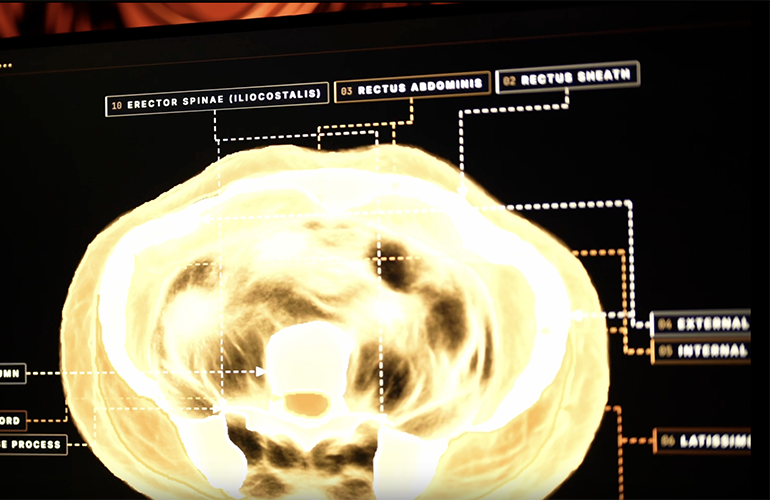
A blog post from the AI image company announced the launch of a whole-body ultrasound scanner users would step into through a pool of water.
“We’re building a bold new kind of machine to reimagine the foundations of healthcare and our relationships to our bodies,” the company noted. The “Ultrasonic CT” will be featured in the company’s “Midjourney Spa,” which is planned for a San Francisco launch at the end of 2027. The technical foundation is a licensing deal. Midjourney signed a co-development and licensing agreement with the handheld ultrasound device company Butterfly Network in November 2025, taking an exclusive license, within a specified field of use, to Butterfly’s ultrasound-on-chip technology. According to Butterfly’s SEC filings, Midjourney pays a $15 million one-time fee and a $10 million annual license fee, billed quarterly over a five-year term, with additional milestone payments, revenue-sharing on Midjourney hardware that uses Butterfly chips, and separate payments for chip purchases. Butterfly itself announced a genAI software launch earlier this year.
A representative patent from Butterfly’s portfolio, US 10,525,506 B2, describes the underlying approach: ultrasonic transducers built directly onto a CMOS chip using standard semiconductor foundry processes, with each cell able to both transmit and receive. The filing stresses low-cost, high-yield manufacturing, the premise Midjourney’s mass-deployment numbers depend on.
The company’s stated ambition is a fleet of more than 50,000 scanners and a billion scans a month by 2031. Notably, none of the licensed technology is generative AI, the field that made Midjourney’s name. Another Butterfly patent, US 2020/0214682, applies machine learning to estimate an ultrasound probe’s position and guide a novice operator in real time, but that is discriminative AI trained to read a scene, not the image-generating kind. The novelty of an image-synthesis company moving into medicine rests on hardware and software with no connection to image synthesis.
Midjourney, the company best known for turning text prompts into images, describes an experience far removed from a conventional radiology department. Users of the Ultrasonic CT would step onto a platform that descends through a ring of submerged transducers. The company says the result is MRI-grade imaging of the entire body in about 60 seconds. The label is a category error. A CT scan is X-ray computed tomography, and the Ultrasonic CT uses no X-rays; it is ultrasound. “MRI-grade” stacks on a second mismatch, since MRI images with magnetic fields rather than sound. Both phrases read as marketing coinage rather than descriptions of the underlying physics.
From a regulatory standpoint, Midjourney is initially holding back from disease diagnosis, saying it will launch by offering only “body composition maps.” It will submit test results to the FDA over time for what it calls increased capabilities. Body-composition data carrying no diagnostic claim can plausibly fall under the FDA’s general-wellness policy, the same regulatory lane whole-body MRI services like Prenuvo and Ezra occupy. 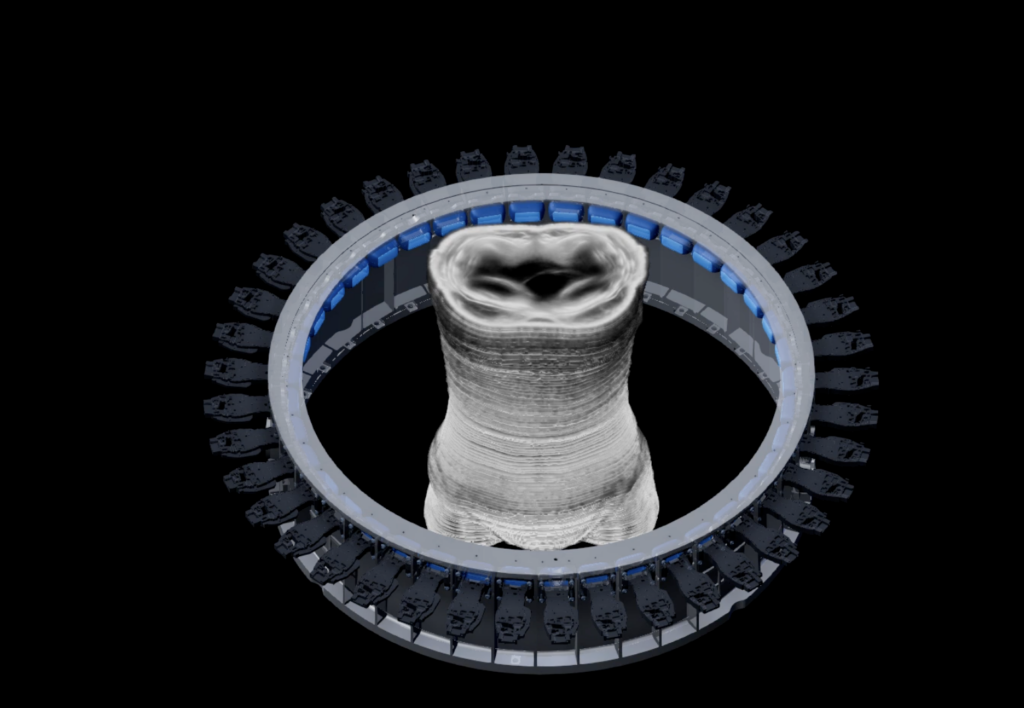
Butterfly, for its part, cast the deal as a proof point for its licensing arm. CEO Joseph DeVivo called the system “the next generation of AI on device.” He cited about half a million sensors scanning at once and more than two petaflops of processing, and said it was designed for weekly use as a running record of a person’s health. DeVivo framed it within Butterfly’s argument that U.S. healthcare is built around treating illness rather than preventing it.