Research & Development World

  • R&D World Home
  • Topics
    • Aerospace
    • Automotive
    • Biotech
    • Careers
    • Chemistry
    • Environment
    • Energy
    • Life Science
    • Material Science
    • R&D Management
    • Physics
  • Technology
    • 3D Printing
    • A.I./Robotics
    • Software
    • Battery Technology
    • Controlled Environments
      • Cleanrooms
      • Graphene
      • Lasers
      • Regulations/Standards
      • Sensors
    • Imaging
    • Nanotechnology
    • Scientific Computing
      • Big Data
      • HPC/Supercomputing
      • Informatics
      • Security
    • Semiconductors
  • R&D Market Pulse
  • R&D 100
    • 2026 R&D 100 Award Winners
    • 2026 Professional Award Winners
    • 2026 Special Recognition Winners
    • R&D 100 Awards Event
    • R&D 100 Submissions
    • Winner Archive
  • Resources
    • Research Reports
    • Digital Issues
    • Educational Assets
    • Subscribe
    • Video
    • Webinars
    • PharmSci360
    • Content submission guidelines for R&D World
  • Global Funding Forecast
  • Top Labs
  • Advertise
  • SUBSCRIBE

Miniscule, Light-Powered Wires Manipulate Brain’s Electrical Signals

By Louise Lerner, University of Chicago | February 20, 2018

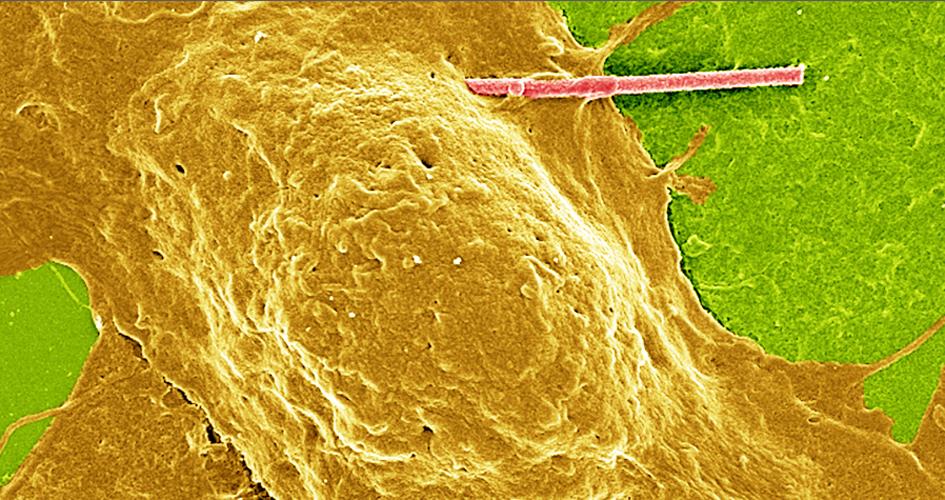
The rod at top right is positioned to modify electrical signaling between the neurons. The entire image is smaller than the diameter of a single human hair. Image: Courtesy of Parameswaran, et al.

The human brain largely remains a black box: How the network of fast-moving electrical signals turns into thought, movement and disease remains poorly understood. But it is electrical, so it can be hacked — the question is finding a precise, easy way to manipulate electrical signaling between neurons.

A new University of Chicago study shows how tiny, light-powered wires could be fashioned out of silicon to provide these electrical signals. Published Feb. 19 in Nature Nanotechnology, the study offers a new avenue to shed light on — and perhaps someday treat — brain disorders.

Ten years ago, the science world was alive with speculation about a recently discovered technique called optogenetics, which would manipulate neural activity with light. The problem is that it has to be done with genetics: inserting a gene into a target cell that would make it respond to light. Other ways of modulating neurons have since been suggested, but a perfect alternative remains elusive.

A team led by Asst. Prof. Bozhi Tian built minuscule wires previously designed for solar cells. These nanowires are so small that hundreds of them could sit side by side on the edge of a sheet of paper — putting them on the same scale as the parts of cells they’re trying to communicate with.

These nanowires combine two types of silicon to create a small electrical current when struck by light. Gold, diffused by a special process onto the surface of the wire, acts as a catalyst to promote electrochemical reactions.

“When the wire is in place and illuminated, the voltage difference between the inside and outside of the cell is slightly reduced. This lowers the barrier for the neuron to fire an electrical signal to its neighboring cells,” Tian says.

The team tested the approach with rat neurons grown in a lab, and saw they could indeed trigger neurons to fire these electrical signals.

“The nice thing about it is that both gold and silicon are biologically compatible materials,” says graduate student Ramya Parameswaran, the first author on the study. “Also, after they’re injected into the body, structures of this size would degrade naturally within a couple of months.”

“It’s a fundamental but very promising approach,” Tian says. They plan next to test the system in animals, which could both help researchers further understand how these electrical signals work in the brain as well as suggest ways to address problems like Parkinson’s disease or psychiatric disorders.

The other co-authors were Francisco Bezanilla, the Lillian Eichelberger Cannon Professor of Biochemistry and Molecular Biology; Erin Adams, the Joseph Regenstein Professor of Biochemistry and Molecular Biology; graduate students John Zimmerman (now at Harvard), Kelliann Koehler, Yuanwen Jiang and Andrew Phillips; postdoctoral researchers Jaeseok Yi and João Carvalho-de-Souza; and undergraduate student Michael Burke.

Source: University of Chicago
Related Articles Read More >

How Lantern Med Digital is helping build the digital layer of Costa Rica’s medtech boom
Norstella launches Atlas, a biopharma agentic platform that can ‘train you’
How a Duke-led HPC method brought cell-scale cancer simulation to a single cloud node 
As AI floods drug discovery with designs, Twist uses DNA chips to tackle the wet-lab bottleneck
rd newsletter
EXPAND YOUR KNOWLEDGE AND STAY CONNECTED
Get the latest info on technologies, trends, and strategies in Research & Development.

R&D World Digital Issues

Fall 2025 issue

Browse the most current issue of R&D World and back issues in an easy to use high quality format. Clip, share and download with the leading R&D magazine today.

R&D 100 Awards
Research & Development World
  • Subscribe to R&D World Magazine
  • Sign up for R&D World’s newsletter
  • Contact Us
  • About Us
  • Drug Discovery & Development
  • Pharmaceutical Processing
  • Global Funding Forecast

Copyright © 2026 Arrowfly LLC. All Rights Reserved. The material on this site may not be reproduced, distributed, transmitted, cached or otherwise used, except with the prior written permission of Arrowfly
Privacy Policy | Advertising | About Us

Search R&D World

  • R&D World Home
  • Topics
    • Aerospace
    • Automotive
    • Biotech
    • Careers
    • Chemistry
    • Environment
    • Energy
    • Life Science
    • Material Science
    • R&D Management
    • Physics
  • Technology
    • 3D Printing
    • A.I./Robotics
    • Software
    • Battery Technology
    • Controlled Environments
      • Cleanrooms
      • Graphene
      • Lasers
      • Regulations/Standards
      • Sensors
    • Imaging
    • Nanotechnology
    • Scientific Computing
      • Big Data
      • HPC/Supercomputing
      • Informatics
      • Security
    • Semiconductors
  • R&D Market Pulse
  • R&D 100
    • 2026 R&D 100 Award Winners
    • 2026 Professional Award Winners
    • 2026 Special Recognition Winners
    • R&D 100 Awards Event
    • R&D 100 Submissions
    • Winner Archive
  • Resources
    • Research Reports
    • Digital Issues
    • Educational Assets
    • Subscribe
    • Video
    • Webinars
    • PharmSci360
    • Content submission guidelines for R&D World
  • Global Funding Forecast
  • Top Labs
  • Advertise
  • SUBSCRIBE