Research & Development World

  • R&D World Home
  • Topics
    • Aerospace
    • Automotive
    • Biotech
    • Careers
    • Chemistry
    • Environment
    • Energy
    • Life Science
    • Material Science
    • R&D Management
    • Physics
  • Technology
    • 3D Printing
    • A.I./Robotics
    • Software
    • Battery Technology
    • Controlled Environments
      • Cleanrooms
      • Graphene
      • Lasers
      • Regulations/Standards
      • Sensors
    • Imaging
    • Nanotechnology
    • Scientific Computing
      • Big Data
      • HPC/Supercomputing
      • Informatics
      • Security
    • Semiconductors
  • R&D Market Pulse
  • R&D 100
    • 2025 R&D 100 Award Winners
    • 2025 Professional Award Winners
    • 2025 Special Recognition Winners
    • R&D 100 Awards Event
    • R&D 100 Submissions
    • Winner Archive
  • Resources
    • Research Reports
    • Digital Issues
    • Educational Assets
    • Subscribe
    • Video
    • Webinars
    • Content submission guidelines for R&D World
  • Global Funding Forecast
  • Top Labs
  • Advertise
  • SUBSCRIBE

Morphing Twisted Nanoscale Objects to Tailor Applications in Future Technologies

By University of Bath | May 3, 2018

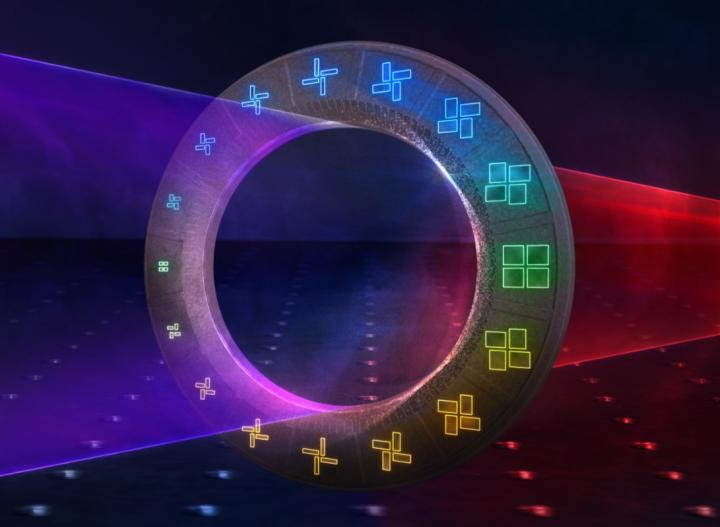
An impression of a chiral molecule moving through various configurations as it transitions from one handedness to another. Credit: Ventsislav Valev and Joel Collins

For the first time scientists have created a way to model the interaction between light and twisted molecules, as these molecules transition from left- to right-handed versions, or vice versa. The transitional forms offer a deeper insight into material symmetries and their unexpected behaviour could lead to improved design of telecoms components.

Many molecules, including important pharmaceuticals and valuable chemicals, exist in two “chiral” forms – they have the same chemical structure arranged in mirror images, termed left-handed and right-handed forms. This can alter their properties and is therefore important to fully understand how the compound interacts with other molecules, or light.

Typically, it has only been possible to study either the left- or right-handed chiral form but nothing in between, however ideally scientists would like to gradually morph a shape from one handedness to the other and observe how the effects of this change translate into physical properties.

Now a research team from the Department of Physics at the University of Bath, working with colleagues at University College London, Belgium and China, has created a way to do exactly that.

Their unique method involves manufacturing metallic nano-scale “artificial molecules” representative of 35 intermediate stages along the way of a geometric transformation, from one handedness to the other. At this nano-scale, the shape of the artificial molecule affects its optical properties, so by using twisted laser light the team studied the properties of the various stages, as the artificial molecules morphed from left to right handedness.

PhD student Joel Collins said: “We were able to follow the properties of a chiral artificial molecule, as it was morphed from left- to right-handed form, through two different routes. No-one has done this before. Surprisingly, we found that each route leads to a different behavior.

“We measured the difference in absorption of left and right circularly polarized light, known as circular-dichroism (CD). Along one route, the artificial molecules behaves as might be expected, with progressively decreasing CD, and eventually a reversal of the CD, for the mirrored structure. However, along the second route, the CD reversed several times, even before the structure changed handedness.”

The research is published in the journal Advanced Optical Materials.

Dr Ventsislav Valev who led the research said: “This is actually a very elegant idea but it has only become a possibility thanks to the recent advances in nanofabrication.

“In chemistry, you can’t tune the twist of a chiral molecule, so every scientist who studies such molecules needs to tune the wavelength of light. We have demonstrated a new, complementary physical effect, where we fix the wavelength and tune the twist of the chiral artificial molecule. In many cases, our approach is more practical; for instance, when we’re designing telecoms components, where the optical wavelength is pre-determined.”
Related Articles Read More >

Researchers developed quantum nanosensors that can measure the temperature of a single cell
Overcoming the 100-nanometer barrier: New microbottle resonators scale up optical trapping
R&D 100 winner LLNL achieves 1,000x speed boost in 3D nanofabrication
CEA-Leti achieves 400°C CMOS fabrication milestone for 3D chip stacking
rd newsletter
EXPAND YOUR KNOWLEDGE AND STAY CONNECTED
Get the latest info on technologies, trends, and strategies in Research & Development.

R&D World Digital Issues

Fall 2025 issue

Browse the most current issue of R&D World and back issues in an easy to use high quality format. Clip, share and download with the leading R&D magazine today.

R&D 100 Awards
Research & Development World
  • Subscribe to R&D World Magazine
  • Sign up for R&D World’s newsletter
  • Contact Us
  • About Us
  • Drug Discovery & Development
  • Pharmaceutical Processing
  • Global Funding Forecast

Copyright © 2026 WTWH Media LLC. All Rights Reserved. The material on this site may not be reproduced, distributed, transmitted, cached or otherwise used, except with the prior written permission of WTWH Media
Privacy Policy | Advertising | About Us

Search R&D World

  • R&D World Home
  • Topics
    • Aerospace
    • Automotive
    • Biotech
    • Careers
    • Chemistry
    • Environment
    • Energy
    • Life Science
    • Material Science
    • R&D Management
    • Physics
  • Technology
    • 3D Printing
    • A.I./Robotics
    • Software
    • Battery Technology
    • Controlled Environments
      • Cleanrooms
      • Graphene
      • Lasers
      • Regulations/Standards
      • Sensors
    • Imaging
    • Nanotechnology
    • Scientific Computing
      • Big Data
      • HPC/Supercomputing
      • Informatics
      • Security
    • Semiconductors
  • R&D Market Pulse
  • R&D 100
    • 2025 R&D 100 Award Winners
    • 2025 Professional Award Winners
    • 2025 Special Recognition Winners
    • R&D 100 Awards Event
    • R&D 100 Submissions
    • Winner Archive
  • Resources
    • Research Reports
    • Digital Issues
    • Educational Assets
    • Subscribe
    • Video
    • Webinars
    • Content submission guidelines for R&D World
  • Global Funding Forecast
  • Top Labs
  • Advertise
  • SUBSCRIBE